Loading...
Done
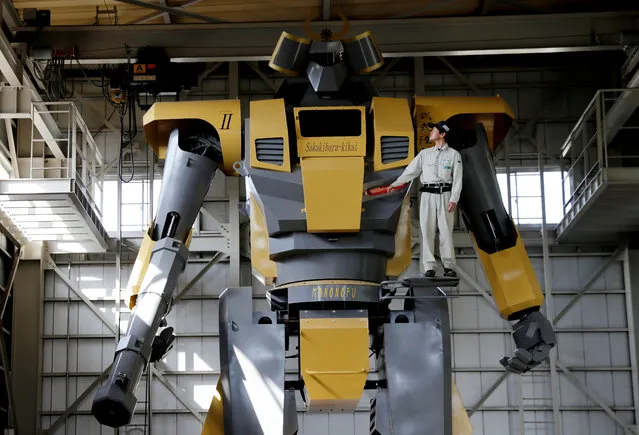
Sakakibara Kikai's engineer Go Sakakibara poses with the bipedal robot Mononofu during its demonstration at its factory in Shinto Village, Gunma Prefecture, Japan on April 12, 2018. Developed at Sakakibara Kikai, a maker of farming machinery, LW-Mononofu is a 28-feet tall, two-legged robot weighing in at more than 7 tonnes. It contains a cockpit with monitors and levers for the pilot to control the robot's arms and legs. (Photo by Kim Kyung-Hoon/Reuters)

Sakakibara Kikai's engineer Go Sakakibara poses with the bipedal robot Mononofu during its demonstration at its factory in Shinto Village, Gunma Prefecture, Japan on April 12, 2018. Developed at Sakakibara Kikai, a maker of farming machinery, LW-Mononofu is a 28-feet tall, two-legged robot weighing in at more than 7 tonnes. It contains a cockpit with monitors and levers for the pilot to control the robot's arms and legs. (Photo by Kim Kyung-Hoon/Reuters)
Details
17 Apr 2018 00:01:00
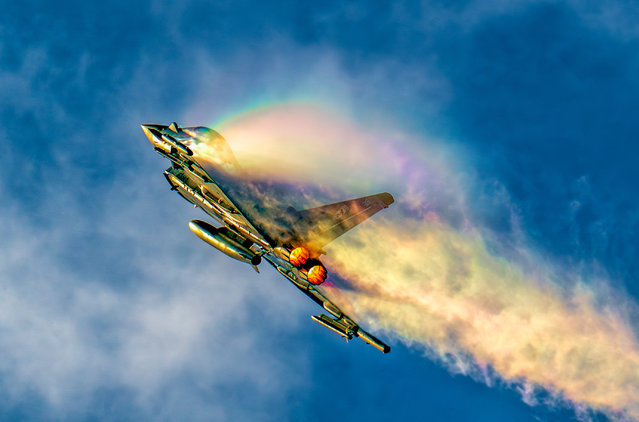
The picture dated February 24, 2025 shows Squadron Leader Nathan Sawyer, the RAF Typhoon display pilot for the 2025 season, practising over RAF Coningsby in Lincolnshire ahead of this year's airshows. Wisps of rainbow vapour were seen coming out of the tail as he put the plane through its paces at 1500ft. (Photo by Claire Hartley/Bav Media)

The picture dated February 24, 2025 shows Squadron Leader Nathan Sawyer, the RAF Typhoon display pilot for the 2025 season, practising over RAF Coningsby in Lincolnshire ahead of this year's airshows. Wisps of rainbow vapour were seen coming out of the tail as he put the plane through its paces at 1500ft. (Photo by Claire Hartley/Bav Media)
Details
20 May 2025 02:34:00
A paddler races in a giant pumpkin during the annual regatta on Lake Pisiquid in Windsor, Nova Scotia, Sunday, October 11, 2015. (Photo by Andrew Vaughan/The Canadian Press via AP Photo)

A paddler races in a giant pumpkin during the annual regatta on Lake Pisiquid in Windsor, Nova Scotia, Sunday, October 11, 2015. Participants hollow out the massive gourds and pilot them across the 500 meter course. (Photo by Andrew Vaughan/The Canadian Press via AP Photo)
Details
14 Oct 2015 08:07:00
Journalists watch the take off of a German Eurofighter jet at the airbase in Noervenich, Germany, Thursday, August 20, 2020. (Photo by Martin Meissner/AP Photo)

Journalists watch the take off of a German Eurofighter jet at the airbase in Noervenich, Germany, Thursday, August 20, 2020. Pilots from Israel and Germany will fly together the next two weeks during the first joint military Air Force exercises between the two nations in Germany. (Photo by Martin Meissner/AP Photo)
Details
22 Aug 2020 00:07:00
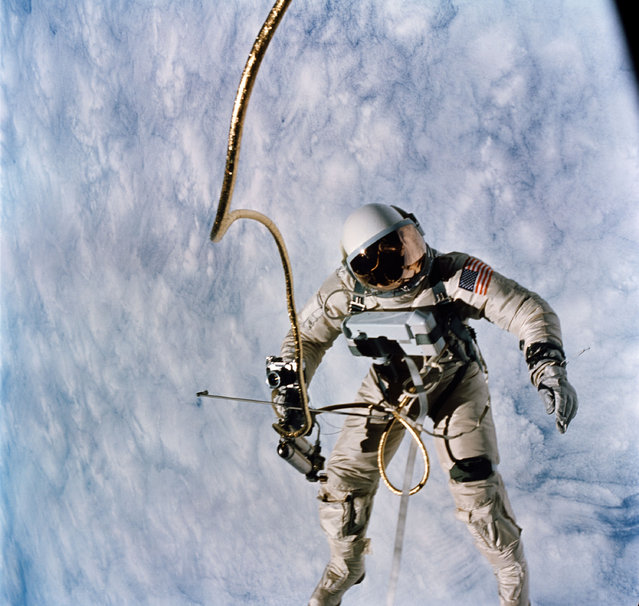
Astronaut Edward H. White II, pilot for the Gemini-Titan 4 (GT-4) spaceflight, floats in the zero-gravity of space during the third revolution of the GT-4 spacecraft on June 3, 1965. White wears a specially designed spacesuit. His face is shaded by a gold-plated visor to protect him from unfiltered rays of the sun. (Photo by NASA)

Astronaut Edward H. White II, pilot for the Gemini-Titan 4 (GT-4) spaceflight, floats in the zero-gravity of space during the third revolution of the GT-4 spacecraft on June 3, 1965. White wears a specially designed spacesuit. His face is shaded by a gold-plated visor to protect him from unfiltered rays of the sun. In his right hand he carries a Hand-Held Self-Maneuvering Unit (HHSMU) that gives him control over his movements in space. White also wears an emergency oxygen chest pack; and he carries a camera mounted on the HHSMU for taking pictures of the sky, Earth and the GT-4 spacecraft. He is secured to the spacecraft by a 25-feet umbilical line and a 23-feet tether line. Both lines are wrapped together in gold tape to form one cord. Astronaut James A. McDivitt, command pilot, remained inside the spacecraft during the extravehicular activity (EVA). Astronaut White died in the Apollo/Saturn 204 fire at Cape Kennedy on January 27, 1967. (Photo by NASA)

Details
22 Jul 2014 12:05:00
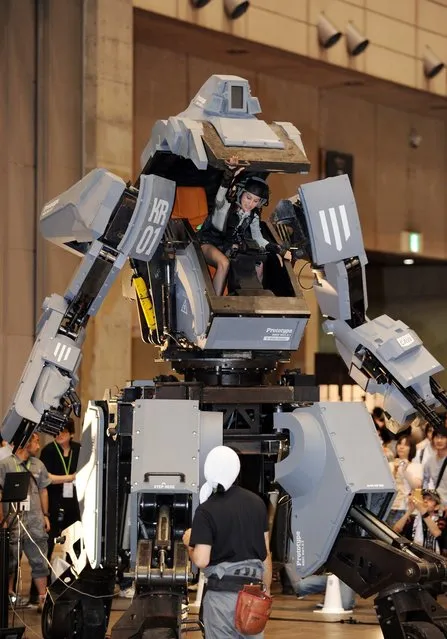
Female “pilot” Anna (C) climbs out the cockpit of Japanese electronics company Suidobashi Heavy Industry's newly unveiled robot “Kuratas” at the Wonder Festival in Chiba, suburban Tokyo on July 29, 2012. The Kuratas robot, which will go on sale with a price tag of one million USD, measures four meters in height, weighs four tons and has four wheeled legs that can either be controlled remotely through the 3G network or by a human seated within the cockpit.

Female pilot Anna climbs out the cockpit of Japanese electronics company Suidobashi Heavy Industry's newly unveiled robot “Kuratas” at the Wonder Festival in Chiba, suburban Tokyo on July 29, 2012. The “Kuratas” robot, which will go on sale with a price tag of one million USD, measures four meters in height, weighs four tons and has four wheeled legs that can either be controlled remotely through the 3G network or by a human seated within the cockpit. (Photo by Yoshikazu Tsuno/AFP Photo)
Details
30 Jul 2012 09:26:00
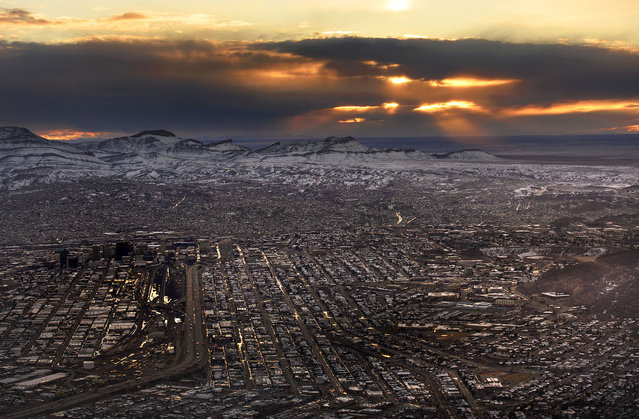
It’s the United States of Air-merica! Pilot Jassen Todorov from San Francisco spent three weeks flying across eight states in a 1976 Piper Warrior plane to capture the this shots – from deep craters in Arizona’s red desert and the swamps and wetlands in Florida and Louisiana, that look like they could be on alien planets, to freeways and stretches of suburban Texas. Here: El Paso, Texas at sunset. (Photo by Jassen Todorov/Caters News)

It’s the United States of Air-merica! Pilot Jassen Todorov from San Francisco spent three weeks flying across eight states in a 1976 Piper Warrior plane to capture the this shots – from deep craters in Arizona’s red desert and the swamps and wetlands in Florida and Louisiana, that look like they could be on alien planets, to freeways and stretches of suburban Texas. Here: El Paso, Texas at sunset. (Photo by Jassen Todorov/Caters News)
Details
22 Jan 2016 10:53:00
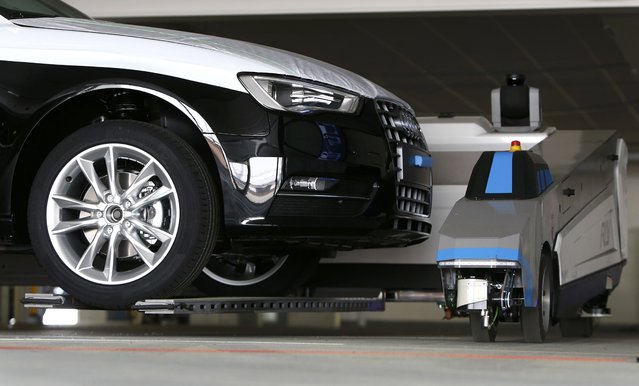
Automated guided vehicle robot “Ray” lifts up an Audi car during a pilot project at the parking area of the Audi plant in Ingolstadt, Germany, May 13, 2015. (Photo by Michaela Rehle/Reuters)

Automated guided vehicle robot “Ray” lifts up an Audi car during a pilot project at the parking area of the Audi plant in Ingolstadt, Germany, May 13, 2015. The robot has been designed to help make work more efficient and more comfortable for employees, some whom walk up to eight kilometres a day, while coordinating the finished cars for the subsequent train transportation. “Robot Ray” technology, currently being used at Dusseldorf International Airport in Germany, claims to be able to park 60 per cent more vehicles in one area compared with a human driver. (Photo by Michaela Rehle/Reuters)
Details
14 May 2015 12:04:00