Loading...
Done


“A monowheel is a one-wheeled single-track vehicle similar to a unicycle. However, instead of sitting above the wheel, the rider sits either within it or next to it. The wheel is a ring, usually driven by smaller wheels pressing against its inner rim. Most are single-passenger vehicles, though multi-passenger models have been built.

Pedal-powered monowheels were built in the late 19th century; most built in the 20th century have been motorized. Some modern builders refer to these vehicles as monocycles, though that term is also sometimes used to describe motorized unicycles. Today, monowheels are generally built and used for fun and entertainment purposes, though from the 1860s through to the 1930s, they were proposed for use as serious transportation”. – Wikipedia

Photo: Cycle inventor Kerry McLean poses for the photographer 2000 in Walled Lake, Michigan. The “Monocycle” is equipped with a 40-horsepower engine, 4ft tire and is expected to reach speeds upwards of 100 mph. (Photo by Bill Pugliano/Liaison)
Details
02 Jul 2011 12:24:00
Miss Exotic World Pageant

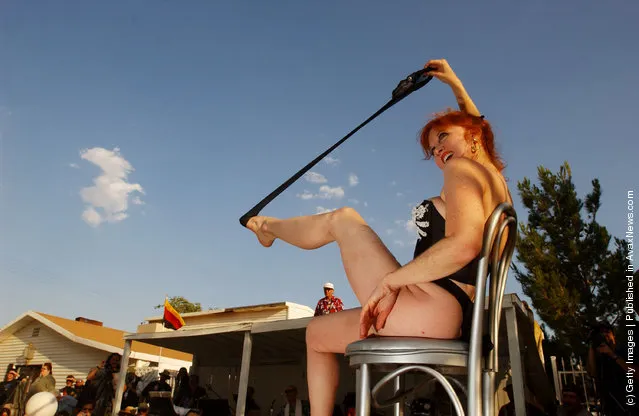
“The Miss Exotic World Pageant (officially, the Miss Exotic World Pageant and Striptease Reunion) is an annual neo-burlesque pageant and convention, and is the annual showcase event (and fundraiser for) the Burlesque Hall of Fame (formerly the Exotic World burlesque museum). The pageant, sometimes referred to as the “Miss America of Burlesque”, attracts former burlesque queens from past decades, as well as current participants of the neo-burlesque scene. The pageant consists of burlesque performances spanning a weekend, culminating with the competition to crown a single performer as Miss Exotic World. Because of the significance of the Exotic World Burlesque Museum to the burlesque community, winning the pageant is considered a top honor for a burlesque performer”. – Wikipedia

Here: Stephanie Blake removes a stocking at the Miss Exotic World Pageant at the Exotic World Burlesque Museum on June 7, 2003 in Helendale outside of Barstow, California. (Photo by David McNew/Getty Images)
Details
01 Aug 2011 12:07:00
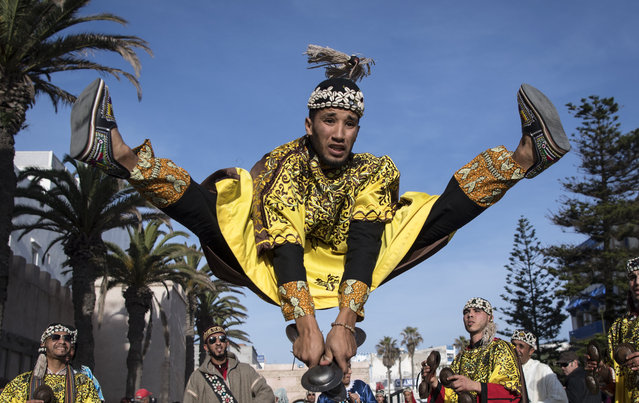
A Gnawa traditional group performs in the city of Essaouira on December 14, 2019, to celebrate the decision of adding the Gnawa culture to UNESCO's list of Intangible Cultural Heritage of Humanity. Gnawa culture, a centuries-old Moroccan practice rooted in music, African rituals and Sufi traditions, was added to UNESCO's list of Intangible Cultural Heritage of Humanity earlier in the week. Gnawa refers to a “set of musical productions, fraternal practices and therapeutic rituals where the secular mixes with the sacred”, according to the nomination submitted by Morocco. Often dressed in colourful outfits, Gnawa musicians play the guenbri, a type of lute with three strings, accompanied by steel castanets called krakebs. (Photo by Fadel Senna/AFP Photo)

A Gnawa traditional group performs in the city of Essaouira on December 14, 2019, to celebrate the decision of adding the Gnawa culture to UNESCO's list of Intangible Cultural Heritage of Humanity. Gnawa culture, a centuries-old Moroccan practice rooted in music, African rituals and Sufi traditions, was added to UNESCO's list of Intangible Cultural Heritage of Humanity earlier in the week. Gnawa refers to a “set of musical productions, fraternal practices and therapeutic rituals where the secular mixes with the sacred”, according to the nomination submitted by Morocco. Often dressed in colourful outfits, Gnawa musicians play the guenbri, a type of lute with three strings, accompanied by steel castanets called krakebs. (Photo by Fadel Senna/AFP Photo)
Details
18 Dec 2019 00:05:00
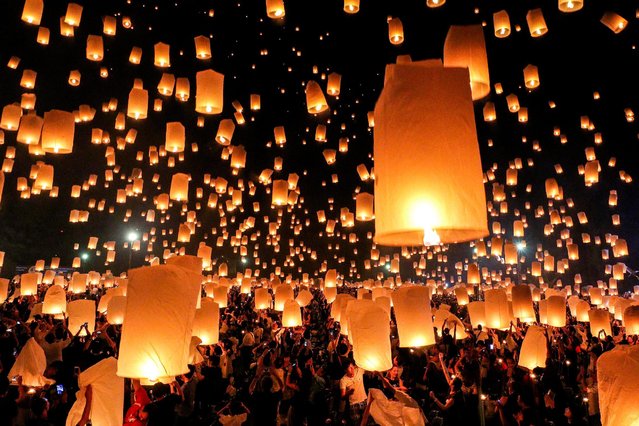
People release floating lanterns during the festival of Yee Peng in the northern capital of Chiang Mai, Thailand November 14, 2016. Yi Peng refers to the full moon day in the second month according to the Lanna lunar calendar (the twelfth month according to the Thai lunar calendar). Swarms of Lanna-style sky lanterns are launched into the air where they resemble large shoals of giant fluorescent jellyfish gracefully floating through the sky. The festival is meant as a time for tham bun, to make merit. Khom loi are made from a thin fabric, such as rice paper, stretched over a bamboo or wire frame, to which a candle or fuel cell is attached. When the fuel cell is lit, the resulting hot air is trapped inside the lantern and creates enough lift for the khom loi to float up into the sky. (Photo by Athit Perawongmetha/Reuters)

People release floating lanterns during the festival of Yee Peng in the northern capital of Chiang Mai, Thailand November 14, 2016. Yi Peng refers to the full moon day in the second month according to the Lanna lunar calendar (the twelfth month according to the Thai lunar calendar). Swarms of Lanna-style sky lanterns are launched into the air where they resemble large shoals of giant fluorescent jellyfish gracefully floating through the sky. The festival is meant as a time for tham bun, to make merit. Khom loi are made from a thin fabric, such as rice paper, stretched over a bamboo or wire frame, to which a candle or fuel cell is attached. When the fuel cell is lit, the resulting hot air is trapped inside the lantern and creates enough lift for the khom loi to float up into the sky. (Photo by Athit Perawongmetha/Reuters)
Details
15 Nov 2016 11:54:00
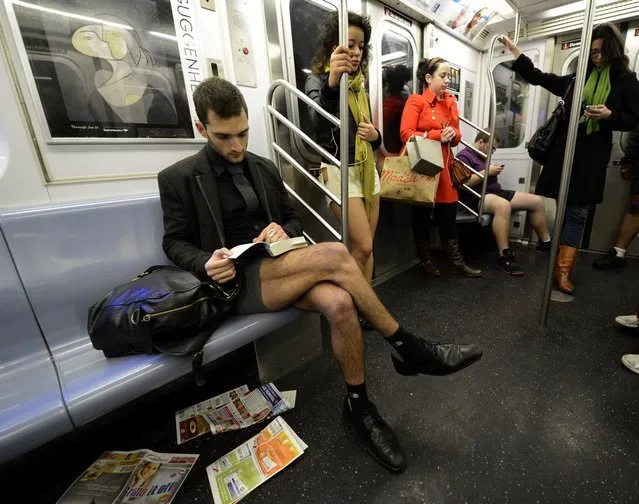
Some riders in the New York City subway in the underwear as the take part in the 2013 No Pants Subway Ride January 13, 2013. Started by Improv Everywhere, the goal is for riders to get on the subway train dressed in normal winter clothes (without pants) and keep a straight face.  AFP PHOTO / TIMOTHY A. CLARY        (Photo credit should read TIMOTHY A. CLARY/AFP/Getty Images)

Pantless people stand on a subway platform on January 13, 2013 in New York City. Thousands of people participated in the 12th annual No Pants Subway Ride, organized by New York City prank collective Improv Everywhere. During the afternoon winter event, participants boarded separate subway stops and removed their pants, pretending that they did not know each other. The event, refered to as a “celebration of silliness” is designed to make fellow subway riders laugh and smile. (Photo by Timothy A. Clary/AFP Photo)
Details
14 Jan 2013 11:03:00
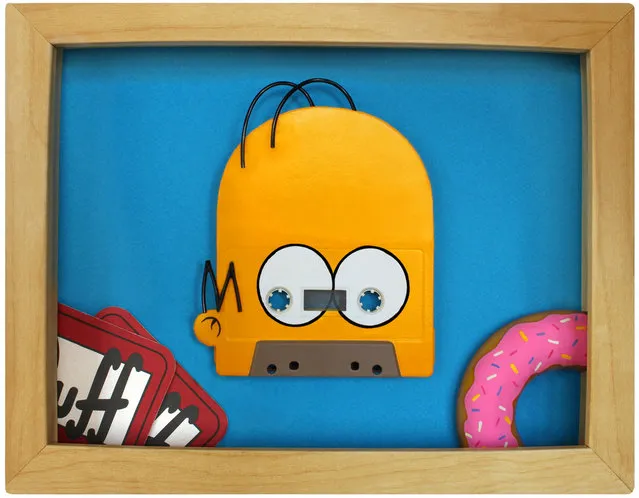
Cassette Tape Art By Benoit Jammes

So I'm a 33 year old graphic designer, and I live in Paris, France
This work on cassette tapes is entirely handmade, with a bit of work but so nostalgia... It so happened that I found a bunch of old cassettes at home; seeing them brought me back, in thought, to an earlier time, the 80s, and to me as a kid. In any case, I could not play them any more so resurrecting them sounded like a good idea...it was sound, it became visual! And I am pretty sure they are more happy now than in a shoebox :-)
I think people from my generation relate to this work because many enjoy the funny side of it, the references. They are happy to see that these old cassette tapes managed to start a new life!

Signed and numbered prints are available for sale.

Benoit Jammes

Details
11 Apr 2013 11:06:00


“The leopard seal (Hydrurga leptonyx), also referred to as the sea leopard, is the second largest species of seal in the Antarctic (after the southern elephant seal). It is most common in the southern hemisphere along the coast of Antarctica and on most sub-Antarctic islands, but can also be found on the coasts of southern Australia, Tasmania, South Africa, New Zealand, Lord Howe Island, Tierra del Fuego, the Cook Islands, and the Atlantic coast of South America. It can live twenty-six years, possibly more. Orcas and large sharks are the only natural predators of leopard seals”. – Wikipedia

Photo by: Gilad Rom; Source: Flickr
Details
13 Nov 2011 11:24:00


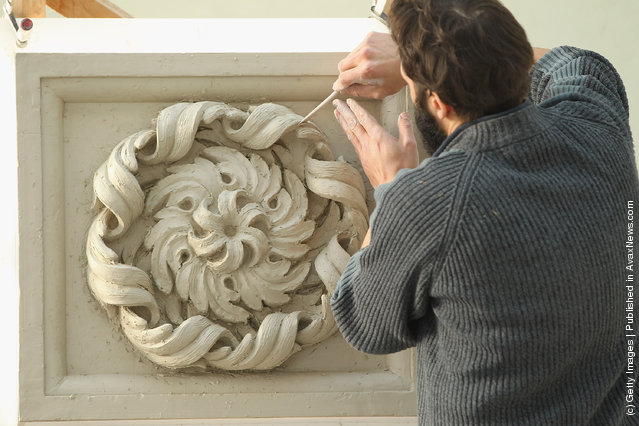
BERLIN, GERMANY - NOVEMBER 11: Sculptor Oleg Bessonov creates a rosette from clay at the Schlossbauhuette studio where a team of sculptors is creating decorative elements for the facade of the Berliner Schloss city palace on November 11, 2011 in Berlin, Germany. The Berliner Schloss was the residence of the Prussian Kaiser and was among the major architectural landmarks of Berlin until it was heavily damaged by Allied bombing in 1945. The communist authorities of East Berlin demolished the building in the 1950s, and today's Berlin government is pursuing an ambitious project to rebuild the palace according to a design by Italian architect Franco Stella, which will recreate the facade of the building but with a modern interior at a cost of approximately EUR 590 million. The Humboldt Forum, the foundation leading the project, has given the Schlossbauhuette sculptors the formidable task of recreating the hundreds of architectural elements that decorated the facade, and though some original pieces were saved, more often the sculptors have only old black and white photos as reference. (Photo by Sean Gallup/Getty Images)
Details
21 Nov 2011 11:22:00