Loading...
Done
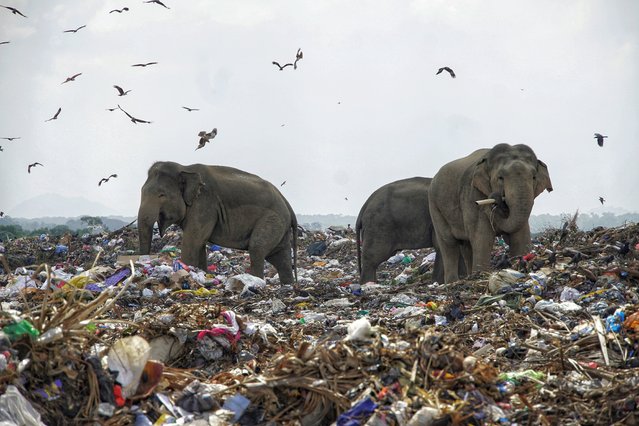
Elephants forage for food at a rubbish dump encroaching on their jungle habitat in Oluvil, Sri Lanka in September 2020. Examination of dead elephants has revealed undigested polythene and other plastic waste. (Photo by Tharmaplan Tilaxan/Cover Images)

Elephants forage for food at a rubbish dump encroaching on their jungle habitat in Oluvil, Sri Lanka in September 2020. Examination of dead elephants has revealed undigested polythene and other plastic waste. (Photo by Tharmaplan Tilaxan/Cover Images)
Details
11 Nov 2020 00:05:00
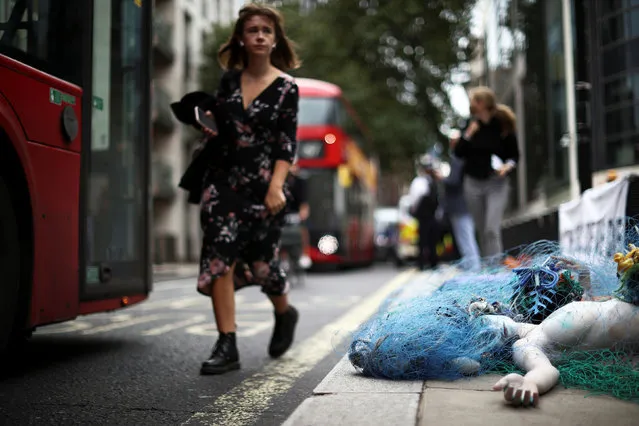
A person walks by an Ocean Rebellion activist taking part in a demonstration outside Department for Environment, Food and Rural Affairs (DEFRA) in London, Britain on September 15, 2021. (Photo by Hannah McKay/Reuters)

A person walks by an Ocean Rebellion activist taking part in a demonstration outside Department for Environment, Food and Rural Affairs (DEFRA) in London, Britain on September 15, 2021. (Photo by Hannah McKay/Reuters)
Details
21 Nov 2021 04:01:00
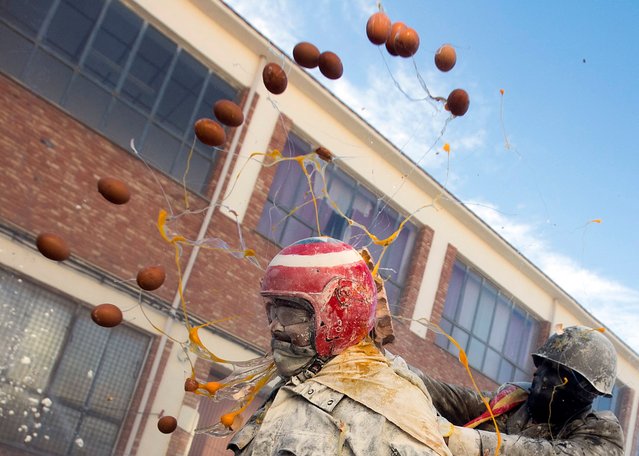
Revellers dressed in mock military garb take part in “Els Enfarinats” food-battle in the southeastern Spanish town of Ibi on December 28, 2022. (Photo by Jaime Reina/AFP Photo)

Revellers dressed in mock military garb take part in “Els Enfarinats” food-battle in the southeastern Spanish town of Ibi on December 28, 2022. (Photo by Jaime Reina/AFP Photo)
Details
30 Dec 2022 06:08:00
Hunger Pains Food Fashion

The color, texture and shape of food has inspired a collection of artists and fashion designers to create clothing inspired by culinary creations. Hunger Pains Food Fashion is a project photographed by Ted Sabarese and created by a team of 15 designers led by Ami Goodheart. Two Project Runway alums, Daniel Feld and Wesley Nault, wove the artichoke dress shown above. The model stood for six hours while the duo crafted the dress leaf by leaf before the first photograph was taken.
Details
27 May 2012 13:53:00


“The Ainu (アイヌ?), also called Aynu, Aino (アイノ), and in historical texts Ezo (蝦夷), are indigenous people or groups in Japan and Russia. Historically they spoke the Ainu language and related varieties and lived in Hokkaidō, the Kuril Islands, and much of Sakhalin. Most of those who identify themselves as Ainu still live in this same region, though the exact number of living Ainu is unknown. This is due to ethnic issues in Japan resulting in those with Ainu backgrounds hiding their identities and confusion over mixed heritages. In Japan, because of intermarriage over many years with Japanese, the concept of a 'pure Ainu' ethnic group is no longer feasible. Official estimates of the population are of around 25,000, while the unofficial number is upwards of 200,000 people”. – Wkipedia

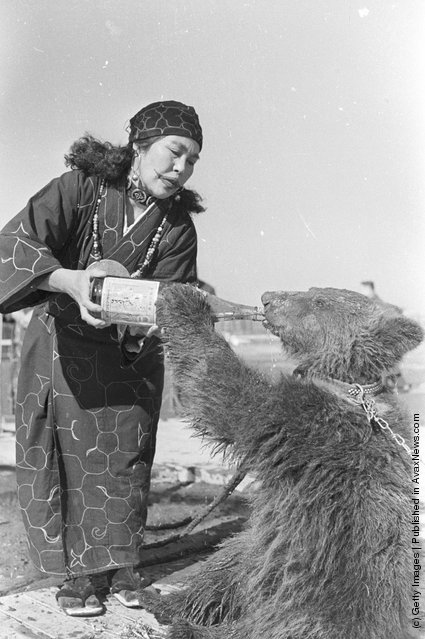
Photo: A captive bear drinking from a large bottle held by an Ainu tribeswoman. (Photo by Evans/Three Lions/Getty Images). Circa 1955

Details
24 Mar 2011 14:01:00
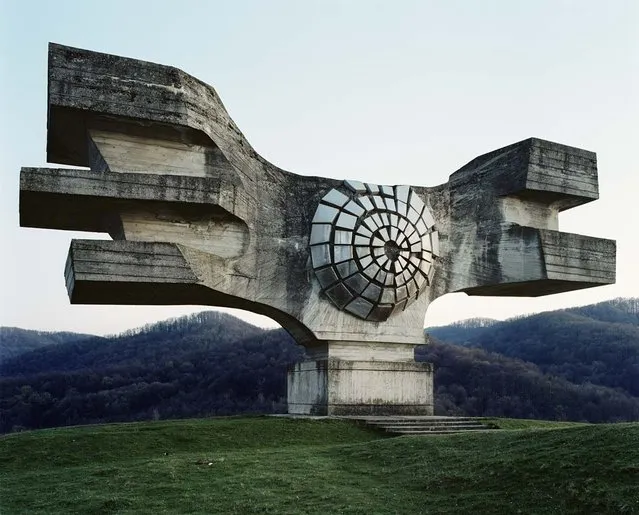
The monument of Ilirska Bistrica was designed by Janez Lenassi and built in 1965. It is dedicated to Slovenian soldiers that fell in World War II. (Photo by Jan Kempenaers)

The brutalist war memorials found throughout the former Yugoslavia were weird enough when they were built in the 1960s and 70s. Today, separated by the end of an architectural movement and the disintegration of the country, they seem almost alien. Belgian photographer Jan Kempenaers treats them purely as artistic objects in his book, “Spomenik”, named for the Serb-Croat word for monument. Known for photographing geographical oddities, Kempenaers was captivated by the spomenik after seeing them in an art encyclopedia. After hearing that many had been destroyed or abandoned, he set out to record what was left. (Photo by Jan Kempenaers)
Details
18 Aug 2014 09:07:00
A brown bear waits for food at the zoo in Madrid, Spain on July 30, 2016. (Photo by Jorge Sanz/Pacific Press/SIPA Press/Rex Features/Shutterstock)

A brown bear waits for food at the zoo in Madrid, Spain on July 30, 2016. (Photo by Jorge Sanz/Pacific Press/SIPA Press/Rex Features/Shutterstock)
Details
31 Jul 2016 10:57:00
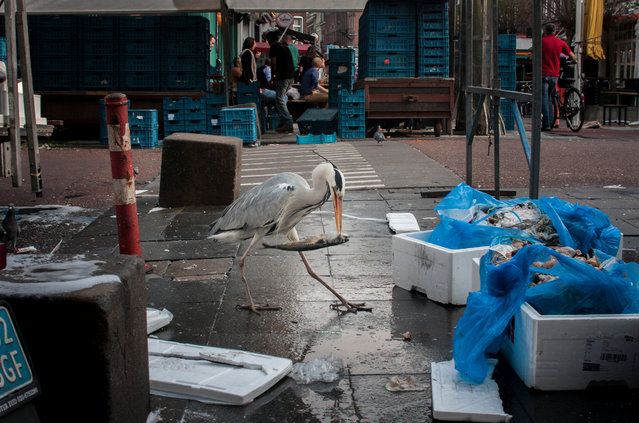
Hundreds of herons come to the city during winter to find food and shelter. (Photo by by Julie Hrudova/The Guardian)

Over the years a large population of grey herons have made an unlikely home in urban Amsterdam. Julie Hrudova documents how the birds integrate into city life. Here: Hundreds of herons come to the city during winter to find food and shelter. (Photo by by Julie Hrudova/The Guardian)
Details
07 Jun 2017 07:19:00