Loading...
Done
Palestinian barber Ramadan Odwan styles and straightens the hair of a customer with fire at his salon in Rafah, in the southern Gaza Strip February 2, 2017. In Ramadan Odwan's barbershop in Gaza, hair isn't just blow-dried, it's blowtorch-dried. “People have gone crazy about it, many people are curious to go through the experience and they are not afraid”, he told Reuters. “People here love adventures”. Odwan, 37, is not the first stylist in the world to use flame to straighten hair, but his craft is unique in the Gaza Strip. In his salon in the southern Gaza town of Rafah, Odwan applied what he described as a protective liquid coating to a customer's hair – he declined to disclose its contents – before aiming for the head and pressing the button on a small blowtorch. “I control how long I apply fire, I keep it on and off for 10 seconds or 15 seconds. It is completely safe and I have not encountered any accident since I started it two months ago”, Odwan added. Odwan charges 20 shekels ($5.20) for a haircut and fire-straightening. A barber for the past 18 years, he said part of the reason he uses the technique is to show that Palestinian barbers are as “professional as those out there around the world”. (Photo by Ibraheem Abu Mustafa/Reuters)

Palestinian barber Ramadan Odwan styles and straightens the hair of a customer with fire at his salon in Rafah, in the southern Gaza Strip February 2, 2017. In Ramadan Odwan's barbershop in Gaza, hair isn't just blow-dried, it's blowtorch-dried. “People have gone crazy about it, many people are curious to go through the experience and they are not afraid”, he told Reuters. “People here love adventures”. (Photo by Ibraheem Abu Mustafa/Reuters)
Details
11 Feb 2017 00:05:00
Image from Camille Seamans new book, “Melting Away”. (Photo by Camille Seaman/Barcroft Media)

Documenting the effects of climate change first hand over the past eight years, Camille Seaman fears we may be on the road to the last iceberg. Photographing the enormous frozen floats at both poles for the past eight years, the Californian adventurer has seen the receding ice shelves and experienced the changing warmer weather. Feeling that her intimate and emotional work documents a snapshot of history, Camille presents her series “The Last Iceberg” as a study of what she sees as the personality of each huge iceberg. Drawing parallels with the famous novel, “The Last of the Mohicans”, Camille, 42, wonders whether these unique, almost alien natural features will become a thing of the past or part of nature's renewal process. (Photo by Camille Seaman/Barcroft Media)
Details
02 Dec 2014 12:10:00
In this Tuesday, September 12, 2017 photo, Amornrat Simapsaisan, a local shop manager, watches before she ate watermelon salad with bamboo worms, at Inspects in the Backyard restaurant, Bangkok, Thailand. Tucking into insects is nothing new in Thailand, where street vendors pushing carts of fried crickets and buttery silkworms have long fed locals and adventurous tourists alike. But bugs are now fine-dining at the Bangkok bistro aiming to revolutionize views of nature’s least-loved creatures and what you can do with them. She tucked in quite happily to her watermelon and cricket salad on a recent evening.  “It’s tasty. It’s munchy”, she said. (Photo by Sakchai Lalit/AP Photo)

In this Tuesday, September 12, 2017 photo, Amornrat Simapsaisan, a local shop manager, watches before she ate watermelon salad with bamboo worms, at Inspects in the Backyard restaurant, Bangkok, Thailand. Tucking into insects is nothing new in Thailand, where street vendors pushing carts of fried crickets and buttery silkworms have long fed locals and adventurous tourists alike. But bugs are now fine-dining at the Bangkok bistro aiming to revolutionize views of nature’s least-loved creatures and what you can do with them. She tucked in quite happily to her watermelon and cricket salad on a recent evening. “It’s tasty. It’s munchy”, she said. (Photo by Sakchai Lalit/AP Photo)
Details
04 Oct 2017 06:54:00
Somali couple Mohamed Noor (L) and Huda Omar pose for a photograph at their makeshift home during their wedding ceremony in Mogadishu's Rajo camp, Somalia August 17, 2016. Having met two years ago, the pair have just married at Rajo camp, where some 400 families live. Most, like Noor's parents, came here in the early 1990s to flee famine. They stayed on as years of conflict ravaged the Horn of Africa nation. As at any wedding, there is plenty of dancing and sweet treats for the young couple as they start married life in Noor's simple home, made of iron and plastic sheets. Noor works as a mason with his father. Others here are builders or sell sweets, nuts and stick toothbrushes to make money. Some beg around the seaside city, which like the rest of Somalia has been gripped by violence since the toppling of dictator Mohamed Siad Barre in 1991. (Photo by Feisal Omar/Reuters)

Somali couple Mohamed Noor (L) and Huda Omar pose for a photograph at their makeshift home during their wedding ceremony in Mogadishu's Rajo camp, Somalia August 17, 2016. Having met two years ago, the pair have just married at Rajo camp, where some 400 families live. Most, like Noor's parents, came here in the early 1990s to flee famine. (Photo by Feisal Omar/Reuters)
Details
14 Sep 2016 10:35:00
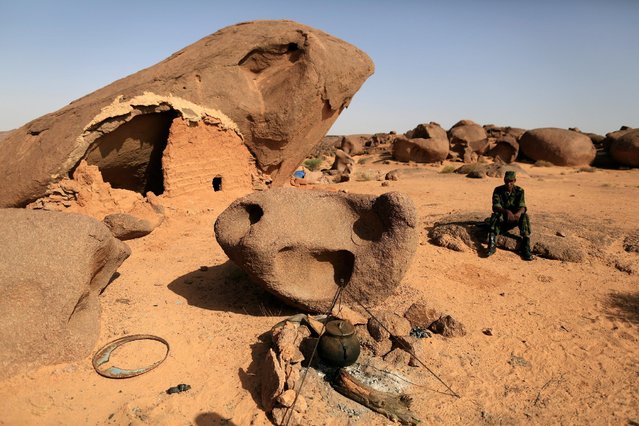
A Polisario fighter sits on a rock at a forward base on the outskirts of Tifariti, Western Sahara, September 9, 2016. At a rocky outpost in Western Sahara, a new generation of soldiers who have never known war are mobilising as tensions resurface in one of Africa's oldest disputes after a quarter century of uneasy peace. Young Sahrawi troops man new desert posts for the Polisario Front, which for more than 40 years has sought independence for the vast desert region - first in a guerrilla war against Morocco and then politically since a ceasefire deal in 1991. Now a standoff with Morocco, which controls the majority of Western Sahara, is renewing pressure for a diplomatic solution to ensure foot soldiers don't return to fighting as the last generation of commanders once did. The standoff since August has brought Moroccan and Polisario forces within 200 metres of each other in a narrow strip of land near the Mauritanian border. Rich in phosphate, Western Sahara has been contested since 1975 when Spanish colonial powers left. Morocco claimed the territory and fought the 16-year war with Polisario. (Photo by Zohra Bensemra/Reuters)

A Polisario fighter sits on a rock at a forward base on the outskirts of Tifariti, Western Sahara, September 9, 2016. At a rocky outpost in Western Sahara, a new generation of soldiers who have never known war are mobilising as tensions resurface in one of Africa's oldest disputes after a quarter century of uneasy peace. (Photo by Zohra Bensemra/Reuters)
Details
04 Nov 2016 12:09:00


“The ONE Campaign is a international, nonpartisan, non-profit organization which aims to increase government funding for and effectiveness of international aid programs. ONE was originally founded by a coalition of 11 non-profit humanitarian and advocacy organizations — including DATA, World Vision, Oxfam America, and Bread for the World — with funding from the Bill & Melinda Gates Foundation. In 2007, ONE announced that it would be merging with DATA. Currently, ONE is campaigning for resources to help developing countries adapt to climate change. During the 2008 U.S. presidential election the organization launched a campaign, called ONE Vote '08, which was co-chaired by former U.S. Senate majority leaders Tom Daschle (D-SD) and Bill Frist (R-TN). The campaign is named after the U2 song “One” which was a top ten hit single on the critically acclaimed 1991 Achtung Baby album”. – Wikipedia

Photo: Bill Gates, founder of Microsoft and now philanthropist, poses with One.org charity volunteers at Pariser Platz square during a brief stop at Brandenburg Gate on April 6, 2011 in Berlin, Germany. Gates is in Berlin to meet with German government officials, including Chancellor Angela Merkel and Development Minister Dirk Niebel, to discuss aid for developing countries and promote his One.org charity initiative, which is part of the Bill and Melinda Gates Foundation. (Photo by Sean Gallup/Getty Images)
Details
07 Apr 2011 08:31:00
Before heading up to Alaska, the ship loads up with 3 months worth of food. Even so, it's hardly necessary. The ship's cook is constantly steaming fresh crab legs and seafood caught during the day. The hard labour of fishing requires a diet heavy in fat, protein, and omega-3s. Here, a sea lion gets a bite of the grub. (Photo by Corey Arnold)

In 2002 photographer Corey Arnold left behind a poor economy in San Francisco and headed up to Alaska to try his luck at his longtime passion of fishing. Arnold, who had worked summers during college on a salmon boat in Alaska, signed onto the f/v Rollo, a crabbing boat that fishes in the dangerous Bering Sea. While working long, strenuous hours on the Rollo, Arnold often stole away with the captain’s permission to grab his camera and photograph the crew and the ship. Arnold eventually put together “Fish Work: Bering Sea”, a documentation of his seven adventurous and dicey crab seasons aboard the Rollo. (Photo by Corey Arnold)
Details
20 Aug 2014 10:05:00
Thor Heyerdahl with a model of the balsa raft Kon Tiki

“Thor Heyerdahl (October 6, 1914, Larvik, Norway – April 18, 2002, Colla Micheri, Italy) was a Norwegian ethnographer and adventurer with a background in zoology and geography. He became notable for his Kon-Tiki expedition, in which he sailed 8,000 km (4,300 miles) by raft from South America to the Tuamotu Islands. All his expeditions are shown in the Kon-Tiki Museum, Oslo”. – Wikipedia

Photo: Norwegian anthropologist Thor Heyerdahl with a model of the balsa raft “Kon-Tiki” on which he drifted 4,300 miles from Peru to the Tuamotu Islands, proving his theory that Polynesia could originally have been populated by South Americans. (Photo by Express/Express/Getty Images). 1950
Details
09 Aug 2011 11:05:00