Loading...
Done
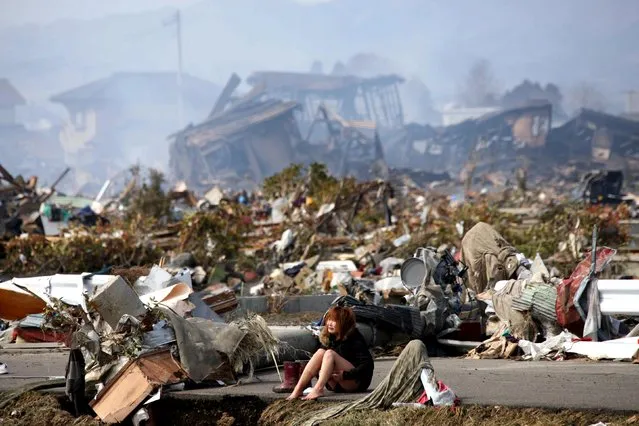
A woman cries while sitting on a road amid the destroyed city of Natori, Miyagi Prefecture in northern Japan March 13, 2011, after a massive earthquake and tsunami that are feared to have killed more than 10,000 people. (Photo by Asahi Shimbun/Reuters)

A woman cries while sitting on a road amid the destroyed city of Natori, Miyagi Prefecture in northern Japan March 13, 2011, after a massive earthquake and tsunami. Five years on from the tsunami that triggered meltdowns at Japan's Fukushima nuclear plant, the page is anything but turned. A magnitude 9 earthquake and towering tsunami on March 11, 2011 killed nearly 16,000 people along Japan's northeastern coast and left more than 2,500 missing. The 10-metre (33-foot) tsunami swept away everything in its path, including houses, ships, cars and farm buildings. (Photo by Asahi Shimbun/Reuters)
Details
09 Mar 2016 12:40:00
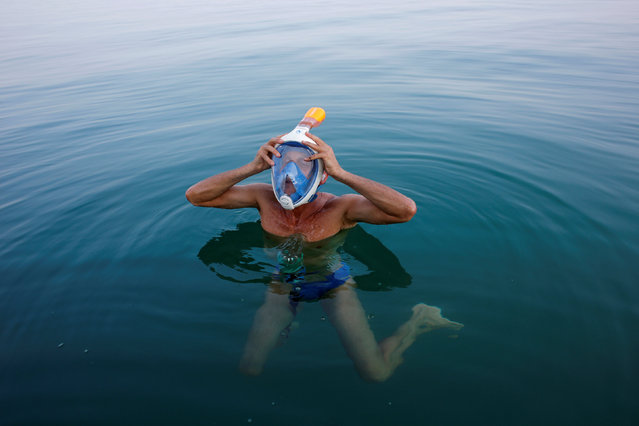
An environmental activist adjusts his mask while taking part in “The Dead Sea Swim Challenge”, swimming from the Jordanian to Israeli shore, to draw attention to the ecological threats facing the Dead Sea, in Kibbutz Ein Gedi, Israel November 15, 2016. (Photo by Nir Elias/Reuters)

An environmental activist adjusts his mask while taking part in “The Dead Sea Swim Challenge”, swimming from the Jordanian to Israeli shore, to draw attention to the ecological threats facing the Dead Sea, in Kibbutz Ein Gedi, Israel November 15, 2016. Swimmers from around the world plunged into the salty waters of the Dead Sea on Tuesday to attempt a seven-hour swim across the fabled lake in a bid to draw attention to its environmental degradation. Wearing protective masks and snorkels, 25 swimmers paddled through the muddy water to attempt the 9-mile (15-kilometer) swim from Jordan to Israel. (Photo by Nir Elias/Reuters)
Details
16 Nov 2016 10:59:00
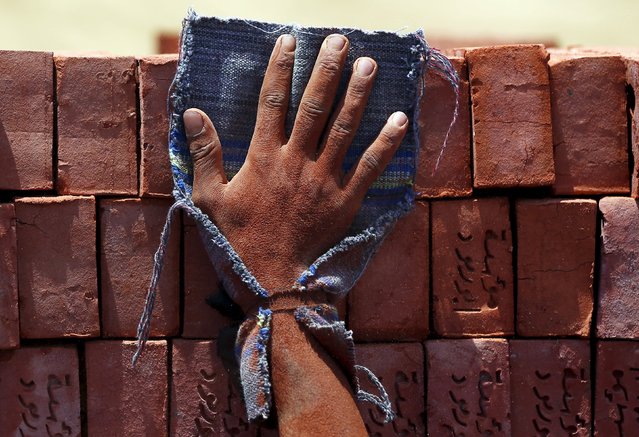
A hand of a labourer pushes bricks at a traditional brick factory in Arab Mesad district of Helwan, northeast of Cairo, May 14, 2015. (Photo by Amr Abdallah Dalsh/Reuters)

A hand of a labourer pushes bricks at a traditional brick factory in Arab Mesad district of Helwan, northeast of Cairo, May 14, 2015. About 45 labourers are employed at the brick factory and most work 10 hours a day. Adult workers earn a daily wage of 70 Egyptian pounds ($9) and child workers earn 40 Egyptian pounds ($5). The labourers, who are usually temporary or seasonally employed in Egypt's brick-making industry, experience unsafe work conditions, according to local media. (Photo by Amr Abdallah Dalsh/Reuters)
Details
19 May 2015 11:37:00
A firefighter breaks down after the World Trade Center buildings collapsed September 11, 2001

“The September 11 attacks (called September 11, September 11th or 9/11), were a series of four coordinated suicide attacks against targets in New York City and the Washington, D.C. area on September 11, 2001. On that morning, 19 terrorists from the Islamist militant group al-Qaeda hijacked four passenger jets. The hijackers intentionally crashed two planes into the Twin Towers of the World Trade Center in New York City; both towers collapsed within two hours. Hijackers crashed a third plane into the Pentagon in Arlington, Virginia. When passengers attempted to take control of the fourth plane, United Airlines Flight 93, it crashed into a field near Shanksville, Pennsylvania, preventing it from reaching its intended target in Washington, D.C. Nearly 3,000 died in the attacks”. – Wikipedia

Photo: A firefighter breaks down after the World Trade Center buildings collapsed September 11, 2001 after two hijacked airplanes slammed into the twin towers in a terrorist attack. (Photo by Mario Tama/Getty Images)
Details
10 Sep 2011 12:33:00
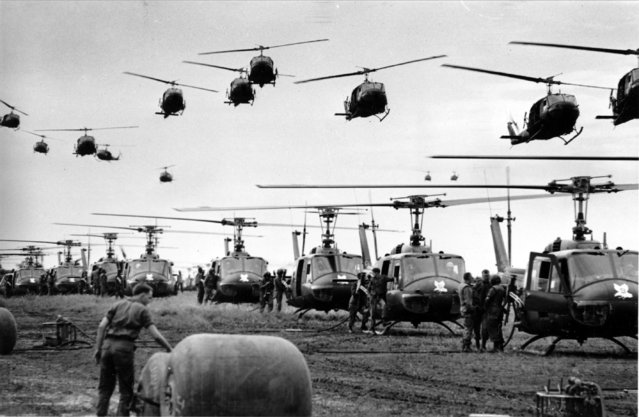
U.S. Army helicopters providing support for U.S. ground troops  fly into a staging area fifty miles northeast of Saigon, Vietnam, August 28, 1966. Helicopter fuel is stored in the large rubber tanks, foreground. (Photo by Henri Huet/AP Photo)

U.S. Army helicopters providing support for U.S. ground troops fly into a staging area fifty miles northeast of Saigon, Vietnam, August 28, 1966. Helicopter fuel is stored in the large rubber tanks, foreground. (Photo by Henri Huet/AP Photo)
Details
29 Aug 2015 11:05:00
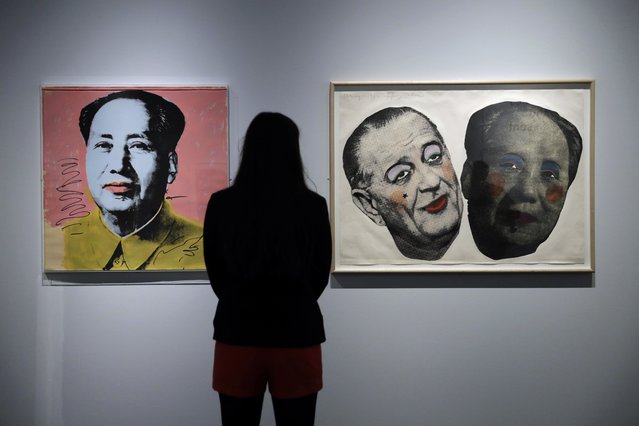
A British Museum representative poses for photographs next to Andy Warhol's “Mao”, left, and Jim Dine's “Drag: Johnson and Mao” which feature in “The American Dream: pop to the present” exhibition during a media photocall at the British Museum in London, Monday, March 6, 2017. (Photo by Matt Dunham/AP Photo)

A British Museum representative poses for photographs next to Andy Warhol's “Mao”, left, and Jim Dine's “Drag: Johnson and Mao” which feature in “The American Dream: pop to the present” exhibition during a media photocall at the British Museum in London, Monday, March 6, 2017. The exhibition, which opens to the public from March 9 and runs until June 18, charts modern and contemporary print making. (Photo by Matt Dunham/AP Photo)
Details
09 Mar 2017 00:00:00
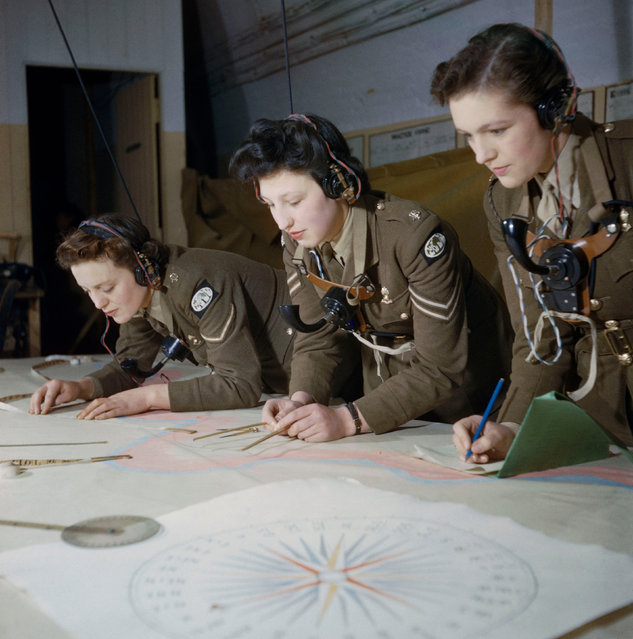
Auxiliary Territorial Service (ATS) plotters at work at Coastal Artillery Headquarters in Dover, December 1942. (Photo by Ted Dearberg/IWM/PA Wire)

Auxiliary Territorial Service (ATS) plotters at work at Coastal Artillery Headquarters in Dover, December 1942. The Auxiliary Territorial Service was the women's branch of the British Army during the Second World War. It was formed on 9 September 1938, initially as a women's voluntary service, and existed until 1 February 1949, when it was merged into the Women's Royal Army Corps. The ATS had its roots in the Women's Auxiliary Army Corps (WAAC), which was formed in 1917 as a voluntary service. During the First World War its members served in a number of jobs including clerks, cooks, telephonists and waitresses. The WAAC was disbanded after four years in 1921. (Photo by Ted Dearberg/IWM/PA Wire)
Details
13 Jul 2017 07:52:00
Kawakanih Yawalapiti, 9, Upper Xingu region of Mato Grosso, Brazil, 2018: Kawakanih lives with her tribe, the Yawalapiti, in Xingu national park, a preserve in the Amazon basin of Brazil. The Yawalapiti collect seeds to preserve species unique to their ecosystem, which lies between the rain forest and savannah. Kawakanih’s diet is simple, consisting mainly of fish, cassava, porridge, fruit and nuts. “It takes five minutes to catch dinner”, says Kawakanih. “When you’re hungry, you just go to the river with your net”. (Photo by Gregg Segal/The Guardian)

Photographer Gregg Segal travelled the world to document children and the food they eat in a week. Partly inspired by the increasing problems of childhood obesity, he tracked traditional regional diets as yet unaffected by globalisation, and ironically, found that the healthiest diets were often eaten by the least well off. (Photo by Gregg Segal/The Guardian)
Details
03 Jul 2019 00:03:00