Loading...
Done
Young Korean women wearing  hanbok (Korean traditional dress) walk inside Gyeongbok Palace on March 27, 2016 in Seoul, South Korea. There has been a trend in recent years for the young Koreans to wear the traditional Korean dress, Hanbok. Wearing the traditional dress, they will walk around downtown Seoul on weekends taking selfies, and share their memories with friends on social media, and also to promote their traditional dress to foreign visitors. (Photo by Jean Chung/Getty Images)

Young Korean women wearing hanbok (Korean traditional dress) walk inside Gyeongbok Palace on March 27, 2016 in Seoul, South Korea. There has been a trend in recent years for the young Koreans to wear the traditional Korean dress, Hanbok. Wearing the traditional dress, they will walk around downtown Seoul on weekends taking selfies, and share their memories with friends on social media, and also to promote their traditional dress to foreign visitors. (Photo by Jean Chung/Getty Images)
Details
03 Apr 2016 11:31:00
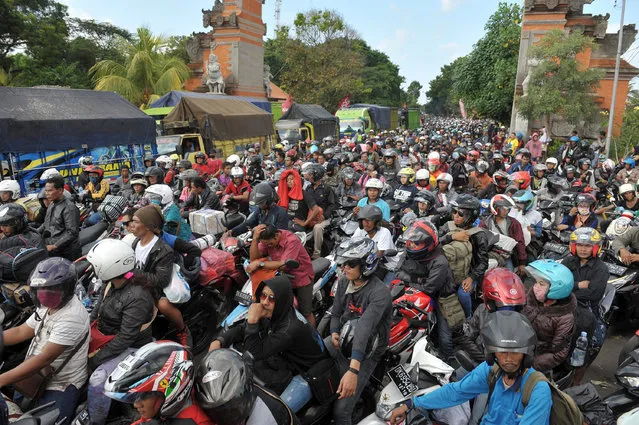
Thousands of travellers heading to their hometowns to celebrate Eid al-Fitr, the Muslim holiday to mark the end of Ramadan, wait in a traffic jam to board a ferry at the entrance to Gilimanuk port on Bali, Indonesia July 3, 2016 in this photo taken by Antara Foto. (Photo by Nyoman Budhiana/Reuters/Antara Foto)

Thousands of travellers heading to their hometowns to celebrate Eid al-Fitr, the Muslim holiday to mark the end of Ramadan, wait in a traffic jam to board a ferry at the entrance to Gilimanuk port on Bali, Indonesia July 3, 2016 in this photo taken by Antara Foto. (Photo by Nyoman Budhiana/Reuters/Antara Foto)
Details
12 Jul 2016 12:18:00
A Vietnamese bride is seen pushing the groom on a scooter during a photo shoot for their wedding in An Bang Beach outside Hoi An in Vietnam December 11, 2016. (Photo by Reuters/Stringer)

A Vietnamese bride is seen pushing the groom on a scooter during a photo shoot for their wedding in An Bang Beach outside Hoi An in Vietnam December 11, 2016. (Photo by Reuters/Stringer)
Details
12 Dec 2016 10:49:00
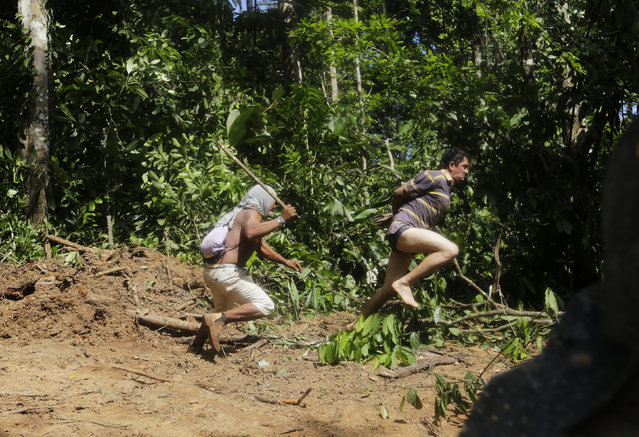
A Ka'apor Indian warrior (L) chases a logger who tried to escape after they captured him during a jungle expedition to search for and expel loggers from the Alto Turiacu Indian territory, near the Centro do Guilherme municipality in the northeast of Maranhao state in the Amazon basin, August 7, 2014. (Photo by Lunae Parracho/Reuters)

A Ka'apor Indian warrior (L) chases a logger who tried to escape after they captured him during a jungle expedition to search for and expel loggers from the Alto Turiacu Indian territory, near the Centro do Guilherme municipality in the northeast of Maranhao state in the Amazon basin, August 7, 2014. Tired of what they say is a lack of sufficient government assistance in keeping loggers off their land, the Ka'apor Indians, who along with four other tribes are the legal inhabitants and caretakers of the territory, have sent their warriors out to expel all loggers they find and set up monitoring camps in the areas that are being illegally exploited. (Photo by Lunae Parracho/Reuters)
Details
05 Sep 2014 11:41:00
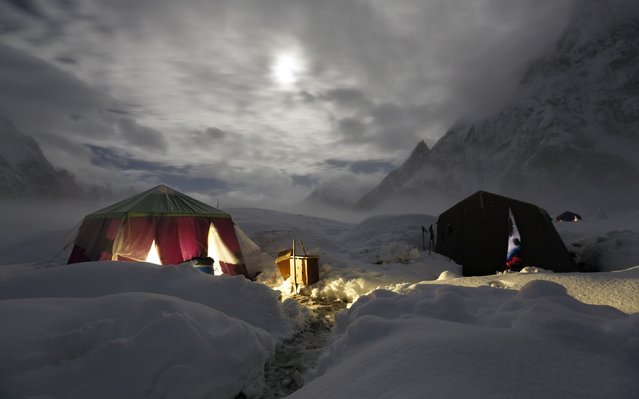
The moon illuminates the snow-covered Concordia, the confluence of the Baltoro and Godwin-Austen glaciers, near the world's second highest mountain the K2 (8,000 meters) in the Karakoram mountain range in Pakistan September 6, 2014. (Photo by Wolfgang Rattay/Reuters)

The moon illuminates the snow-covered Concordia, the confluence of the Baltoro and Godwin-Austen glaciers, near the world's second highest mountain the K2 (8,000 meters) in the Karakoram mountain range in Pakistan September 6, 2014. While other parts of Pakistan and northern India were flooded, Concordia in the Karakoram mountain range was covered with a seasonally unusual amount of snow. Geographically, Pakistan is a climbers paradise. It rivals Nepal for the number of peaks over 7,000 meters and is home to the world's second tallest mountain, K2, as well as four of the world's 14 summits higher than 8,000 meters. (Photo by Wolfgang Rattay/Reuters)
Details
24 Oct 2014 12:27:00
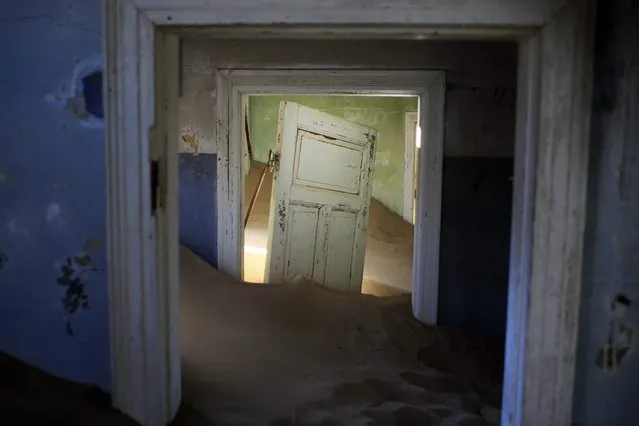
In this July 23, 2013 photo, sand fills an abandoned house in Kolmanskop, Namibia. Kolmanskop, was a diamond mining town south of Namibia, build in 1908 and deserted in 1956. SInce then, the desert slowly reclaims its territory, with sand invading the buildings where 350 German colonists and more than 800 local workers lived during its hay-days of the 1920s. (Photo by Jerome Delay/AP Photo)

In this July 23, 2013 photo, sand fills an abandoned house in Kolmanskop, Namibia. Kolmanskop, was a diamond mining town south of Namibia, build in 1908 and deserted in 1956. SInce then, the desert slowly reclaims its territory, with sand invading the buildings where 350 German colonists and more than 800 local workers lived during its hay-days of the 1920s. (Photo by Jerome Delay/AP Photo)
Details
14 Nov 2014 14:34:00
A small section of the expanding remains of the Veil Nebula, a massive star that exploded about 8,000 years ago. The entire nebula is 110 light-years across, covering six full moons on the sky as seen from Earth, and resides about 2,100 light-years away in the constellation Cygnus, the Swan. Image taken by NASA's Hubble Space Telescope. Released September 24, 2015. (Photo by Reuters/NASA/ESA/Hubble Heritage Team)

A small section of the expanding remains of the Veil Nebula, a massive star that exploded about 8,000 years ago. The entire nebula is 110 light-years across, covering six full moons on the sky as seen from Earth, and resides about 2,100 light-years away in the constellation Cygnus, the Swan. Image taken by NASA's Hubble Space Telescope. Released September 24, 2015. (Photo by Reuters/NASA/ESA/Hubble Heritage Team)
Details
10 Dec 2015 08:01:00
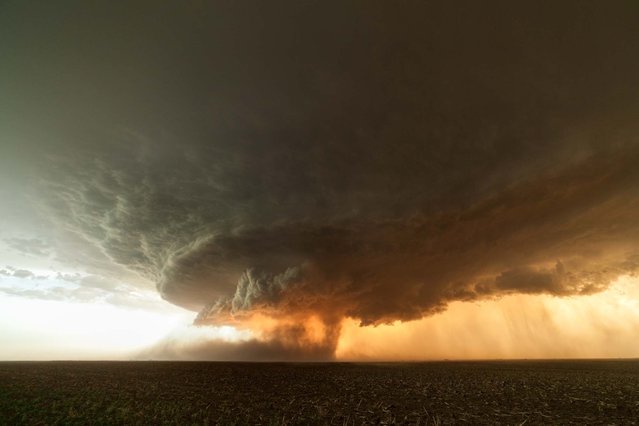
A picturesque supercell formation in the northwest of Booker, Texas from June 2013. (Photo by Mike Olbinski/Barcroft Media)

A picturesque supercell formation in the northwest of Booker, Texas from June 2013. (Photo by Mike Olbinski/Barcroft Media)
Details
24 Apr 2014 10:25:00