Loading...
Done
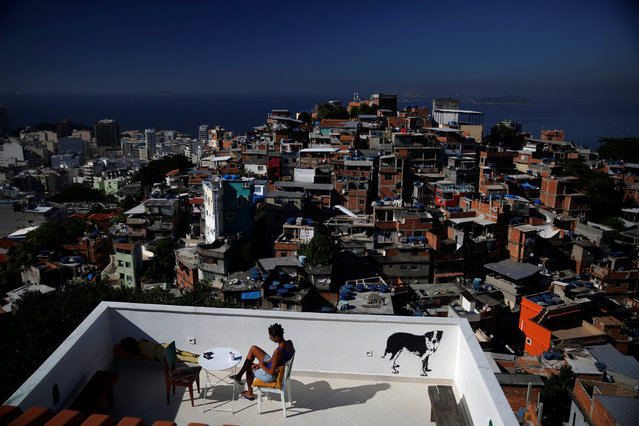
A woman sits on a terrace at Tiki hostel in Cantagalo favela, in Rio de Janeiro, Brazil, April 16, 2016. (Photo by Pilar Olivares/Reuters)

A woman sits on a terrace at Tiki hostel in Cantagalo favela, in Rio de Janeiro, Brazil, April 16, 2016. Hostels in a few of Rio's more than 1,000 slums serve not only as a cheap housing alternative for the more adventurous among the estimated 500,000 foreign tourists expected to arrive for the Olympics in August. The establishments also open up the rich culture of the city's shantytowns for travellers, giving them a glimpse into once “no-go” areas where about one-fifth of Rio's population lives. (Photo by Pilar Olivares/Reuters)
Details
04 May 2016 12:18:00
Women wearing "Shiroshozoku" or the traditional white robe pray as they bathe in ice-cold water at the Teppozu Inari shrine in Tokyo, Japan, January 10, 2016. (Photo by Yuya Shino/Reuters)

Women wearing "Shiroshozoku" or the traditional white robe pray as they bathe in ice-cold water at the Teppozu Inari shrine in Tokyo, Japan, January 10, 2016. About 100 participants took part in the Shinto ceremony to purify their souls and wish for good health in the new year. (Photo by Yuya Shino/Reuters)
Details
12 Jan 2016 08:04:00
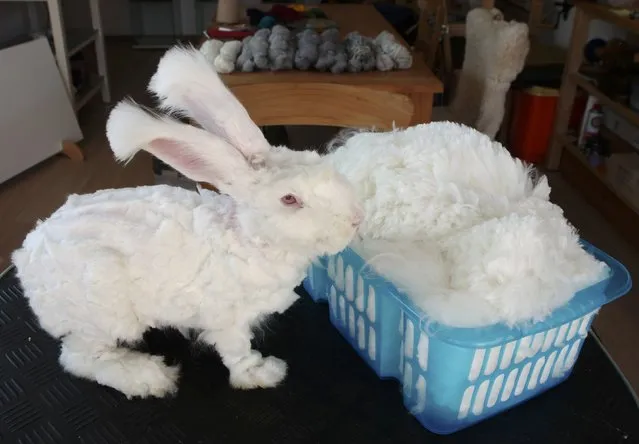
Angora rabbit Emilson sits next to its freshly shaved hair at Georgia Spausta's small farm in Herzogbirbaum, Austria March 10, 2015. (Photo by Heinz-Peter Bader/Reuters)

Angora rabbit Emilson sits next to its freshly shaved hair at Georgia Spausta's small farm in Herzogbirbaum, Austria March 10, 2015. Spausta produces hand-spun yarn from some 25 angora rabbits which is sold in small scale to enthusiasts or at local markets. The rabbits are clipped four times a year, each time giving some 300 grams of wool, about the amount needed to knit one pullover. (Photo by Heinz-Peter Bader/Reuters)
Details
26 Apr 2015 09:06:00
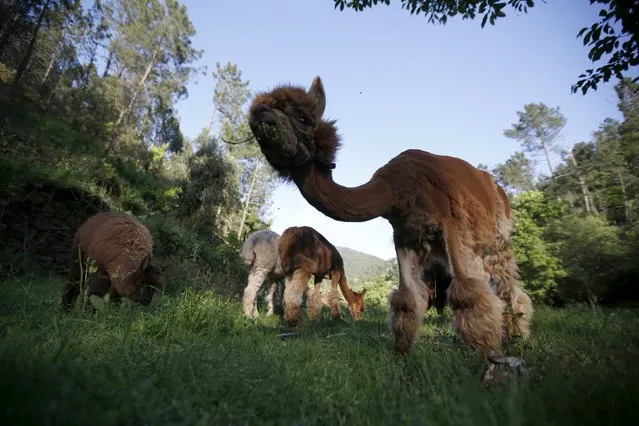
Alpacas of Lisa Vella-Gatt (not pictured) graze at her farm near Benfeita, Portugal May 11, 2015. (Photo by Rafael Marchante/Reuters)

Alpacas of Lisa Vella-Gatt (not pictured) graze at her farm near Benfeita, Portugal May 11, 2015. Lisa came to Portugal from England in 2009 to set up Monte Frio Alpacas, a project where she breeds alpacas, which produce wool. Lisa's 14 alpacas produce about 50 kilos (110 pounds) of wool annually. (Photo by Rafael Marchante/Reuters)
Details
20 May 2015 08:33:00
Youths during a party organised on a decommissioned bridge in Kiev. (Photo by Aude Osnowycz/The Guardian)

For more than three years, Ukraine has been plagued by a conflict between the eastern secessionist territories and the Kiev government. Demonstrations by pro-Russian parties that oppose the current government first began in 2014 - and now, over 10,000 people have died, many of them civilians. These images portray a generation caught between war and peace. Many of them were born into the civil conflict dominating the country and are disorientated about their place in the world. Here: Youths during a party organised on a decommissioned bridge in Kiev. (Photo by Aude Osnowycz/The Guardian)
Details
30 Jun 2018 00:01:00
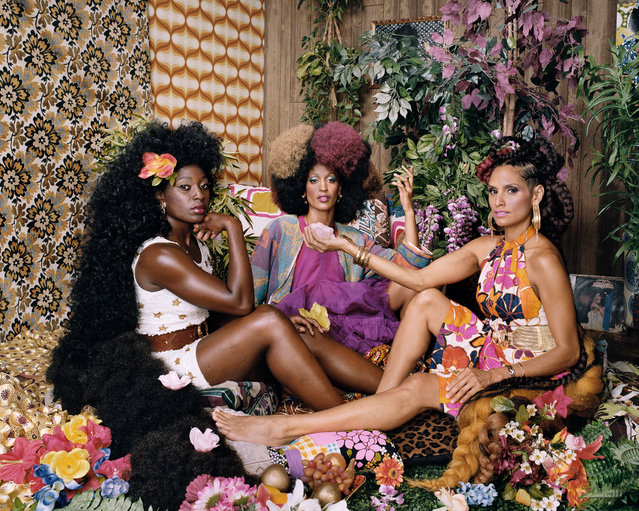
Les Trois Femmes Deux, 2018. (Photo by Mickalene Thomas/Courtesy of Yancey Richardson Gallery, New York)

Vast collection of fine art photography about to open at Pier 24 in Manhattan. One of the world's most prestigious annual photography events, The Photography Show is the longest-running and foremost exhibition dedicated to the photographic medium, offering a wide range of museum-quality work, including contemporary, modern, and 19th-century photographs as well as photo-based art, video, and new media. Here: Les Trois Femmes Deux, 2018. (Photo by Mickalene Thomas/Courtesy of Yancey Richardson Gallery, New York)
Details
04 Apr 2019 00:01:00
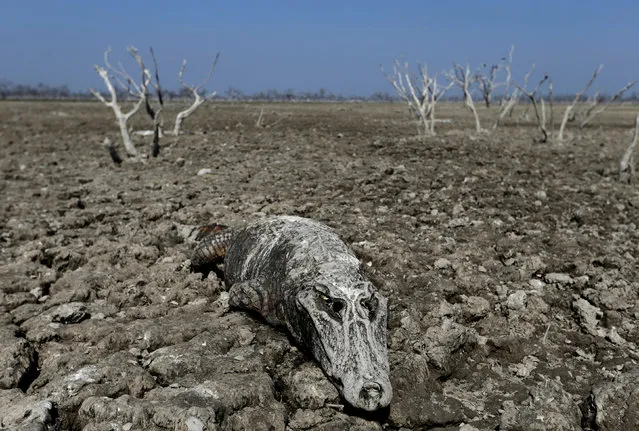
The carcass of a yacare caiman lies in the dried-up river bed of the Pilcomayo river in Boqueron, Paraguay, August 14, 2016. In Paraguay, alongside the Pilcomayo River, black vultures flew over a shrinking pond where a group of crocodilian reptiles known as yacare caimans sought refuge. Water from the river, which divides Paraguay and Argentina in the area of the Gran Chaco, was scarce. This is not an uncommon sight in the region of General Diaz, about 700 kilometres (435 miles) northwest of the country's capital Asuncion, where the Pilcomayo's waters form lakes and streams that give life to capybaras, birds and caimans. “The river's situation is critical. No water is forecast to enter the basin until December, as happens every year”, said Alcides Gonzalez, a resident of the area. (Photo by Jorge Adorno/Reuters)

The carcass of a yacare caiman lies in the dried-up river bed of the Pilcomayo river in Boqueron, Paraguay, August 14, 2016. In Paraguay, alongside the Pilcomayo River, black vultures flew over a shrinking pond where a group of crocodilian reptiles known as yacare caimans sought refuge. Water from the river, which divides Paraguay and Argentina in the area of the Gran Chaco, was scarce. This is not an uncommon sight in the region of General Diaz, about 700 kilometres (435 miles) northwest of the country's capital Asuncion, where the Pilcomayo's waters form lakes and streams that give life to capybaras, birds and caimans. (Photo by Jorge Adorno/Reuters)
Details
03 Nov 2016 12:40:00
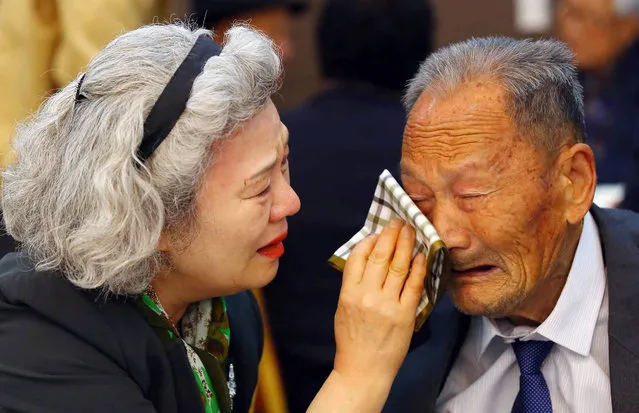
South Korean Lee Jung-sook (L), 68, wipes the tears from her North Korean father Lee Heung-jong, 88, as they bid each other a sad farewell at a resort on Mount Kumgang, North Korea, 22 October 2015. About 390 South Koreans arrived at the resort two days ago for the first face-to-face reunion of families separated by the 1950-53 Korean War in nearly 20 months. A second group of some 260 South Koreans will do the same for three days starting on 24 October. (Photo by Yonhap/EPA)

South Korean Lee Jung-sook (L), 68, wipes the tears from her North Korean father Lee Heung-jong, 88, as they bid each other a sad farewell at a resort on Mount Kumgang, North Korea, 22 October 2015. About 390 South Koreans arrived at the resort two days ago for the first face-to-face reunion of families separated by the 1950-53 Korean War in nearly 20 months. A second group of some 260 South Koreans will do the same for three days starting on 24 October. (Photo by Yonhap/EPA)
Details
24 Oct 2015 08:06:00