Loading...
Done
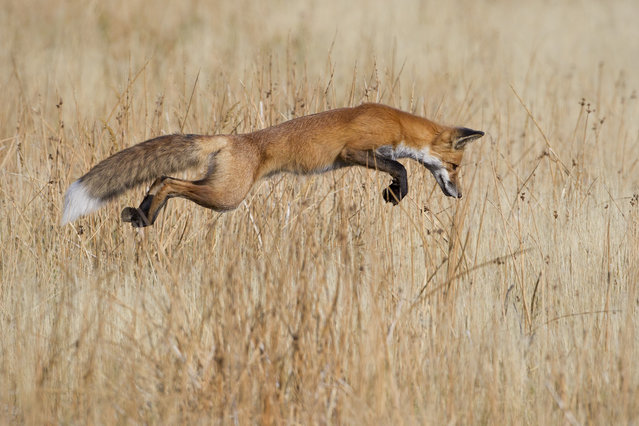
Canada: “Lucky pounce”. (Photo by Connor Stefanison/Wildlife Photographer of the Year 2013)

The winners of The London’s Natural History Museum's prestigious Wildlife Photographer of the Year for 2013 have finally been unveiled. Selected from almost 43,000 entries from 96 countries, the winners offer a glimpse of the stunning array of natural beauty on our planet. Photo: Canada: “Lucky pounce”. “Anticipating the pounce – that was the hardest part”, says Connor, who had come to Yellowstone National Park, Wyoming, USA, in search of wildlife as much as the spectacular landscape. He had found this fox, his first ever, on his last day in the park. It was so absorbed in hunting that Connor had plenty of time to get out of the car and settle behind a rock. It quartered the grassland, back and forth, and then started staring intently at a patch of ground, giving Connor just enough warning of the action to come. When it sprung up, Connor got his shot. And when it landed, the fox got his mouse. (Photo by Connor Stefanison/Wildlife Photographer of the Year 2013)
Details
17 Oct 2013 08:12:00
U.S. Air Force wounded warrior, Capt. Sarah Evans, jumps rope in a gym in San Antonio, Texas. Evans was diagnosed with cancer while deployed to Afghanistan and was medically evacuated back to the United States where her leg was amputated. (Photo by Master Sgt. Jeffrey Allen/U.S. Air Force)

U.S. Air Force wounded warrior, Capt. Sarah Evans, jumps rope in a gym in San Antonio, Texas. Evans was diagnosed with cancer while deployed to Afghanistan and was medically evacuated back to the United States where her leg was amputated. (Photo by Master Sgt. Jeffrey Allen/U.S. Air Force)
Details
26 Mar 2015 11:43:00
Visitors photograph an animatronic Tyrannosaurus Rex at the National Museum of Scotland, July 29, 2011. (Photo by David Moir/Reuters)

Visitors photograph an animatronic Tyrannosaurus Rex at the National Museum of Scotland, July 29, 2011. (Photo by David Moir/Reuters)
Details
12 Apr 2015 08:02:00
Takeoka Chisaka, Hiroshima, Japan. “One morning in August 1945, I was walking home from the night shift at a factory in Hiroshima. As I reached my door, there was a huge explosion. When I came to, my head was bleeding and I had been blasted 30m away”. (Photo and caption by Sasha Maslov)

Takeoka Chisaka, Hiroshima, Japan. “One morning in August 1945, I was walking home from the night shift at a factory in Hiroshima. As I reached my door, there was a huge explosion. When I came to, my head was bleeding and I had been blasted 30m away. The atomic bomb had detonated. When I found my mother, her eyes were badly burned. A doctor said they had to come out, but he didn’t have the proper tools so used a knife instead. It was hellish. I became a peace-worker after the war. In the 1960s, at a meeting at the UN, I met one of the people who created the atomic bomb. He apologised”. (Photo and caption by Sasha Maslov)
Details
11 May 2015 11:56:00
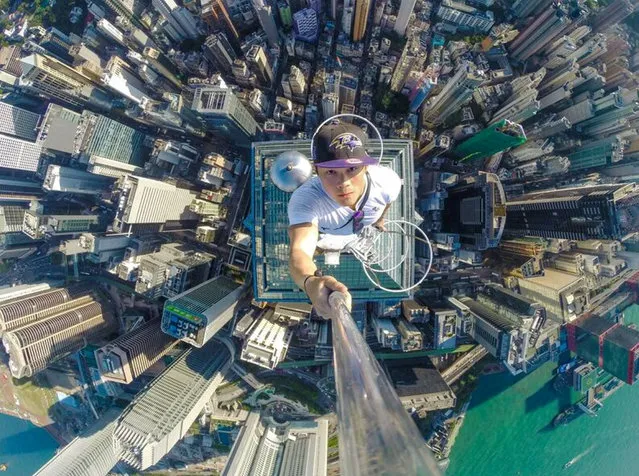
Roof-topping enthusiast Daniel Lau takes a selfie with high-rise buildings down below as he stands on the top of a skyscraper in Hong Kong, China on August 15, 2017. Welcome to “roof-topping”, where daredevils take pictures of themselves standing on the tops of tall buildings, or in some cases even dangling from them, without any safety equipment. A craze that began in Russia has now taken hold in Hong Kong, one of the world's most vertical cities, with dramatic results. “I'm an explorer”, said Daniel Lau, one of the three who climbed to the top of The Center. A student, he said roof-topping was “a getaway from my structured life”. “Before doing this, I lived like an ordinary person, having a boring life”, he said. “I wanted to do something special, something memorable. I want to let people see Hong Kong, the place they are living, from a new perspective”. Mr Lau said he had been inspired by Russian climbers and that he was unafraid of the vertiginous heights he scales. (Photo by ImagineChina/Rex Features/Shutterstock)

Roof-topping enthusiast Daniel Lau takes a selfie with high-rise buildings down below as he stands on the top of a skyscraper in Hong Kong, China on August 15, 2017. A craze that began in Russia has now taken hold in Hong Kong, one of the world's most vertical cities. Mr Lau said he had been inspired by Russian climbers and that he was unafraid of the vertiginous heights he scales. (Photo by ImagineChina/Rex Features/Shutterstock)
Details
16 Aug 2017 07:23:00
Festival goers participate in a dance class on embracing kinetic intimacy in the dance shala a the Oregon Eclipse Festival, August 20, 2017, at Big Summit Prairie ranch in Oregon' s Ochoco National Forest near the city of Mitchell ahead of the total solar eclipse on August 21, 2017. (Photo by Robyn Beck/AFP Photo)

Festival goers participate in a dance class on embracing kinetic intimacy in the dance shala a the Oregon Eclipse Festival, August 20, 2017, at Big Summit Prairie ranch in Oregon' s Ochoco National Forest near the city of Mitchell ahead of the total solar eclipse on August 21, 2017. (Photo by Robyn Beck/AFP Photo)
Details
22 Aug 2017 08:08:00
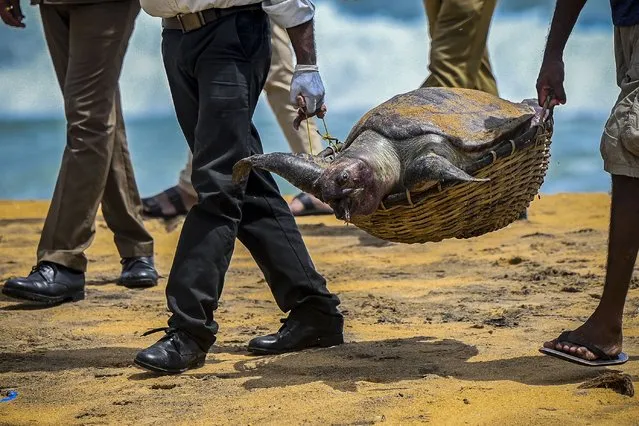
Wildlife officials carry away the carcass of a turtle that was washed ashore at the beach of Angulana, south of Sri Lanka's capital Colombo on June 24, 2021. (Photo by Ishara S. Kodikara/AFP Photo)

Wildlife officials carry away the carcass of a turtle that was washed ashore at the beach of Angulana, south of Sri Lanka's capital Colombo on June 24, 2021. (Photo by Ishara S. Kodikara/AFP Photo)
Details
27 Jun 2021 07:58:00
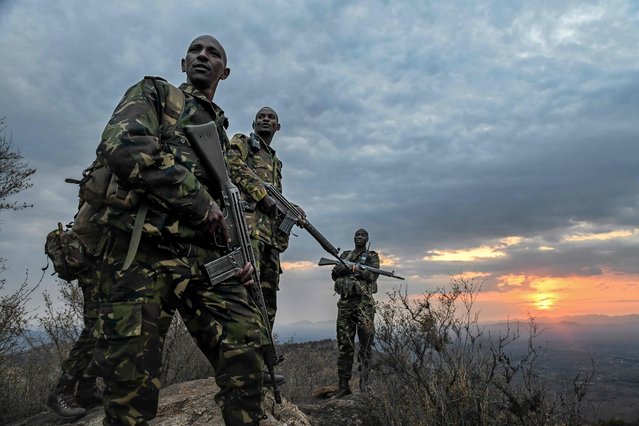
Armed officers of Lewa Wildlife Conservancy's (LWC) anti-poaching unit look out from a ridge at dawn in Meru, on July 31, 2021, as they wind up their nightly security patrol against poaching and illegal incursions into the conservancy. Despite the global condemnation of poaching and the resources that have been mobilised to safeguard endangered wildlife, well-funded and well-equipped poaching groups continue to pose a real threat to Africa’s wildlife. (Photo by Tony Karumba/AFP Photo)

Armed officers of Lewa Wildlife Conservancy's (LWC) anti-poaching unit look out from a ridge at dawn in Meru, on July 31, 2021, as they wind up their nightly security patrol against poaching and illegal incursions into the conservancy. Despite the global condemnation of poaching and the resources that have been mobilised to safeguard endangered wildlife, well-funded and well-equipped poaching groups continue to pose a real threat to Africa’s wildlife. (Photo by Tony Karumba/AFP Photo)
Details
19 Aug 2021 09:19:00