Loading...
Done
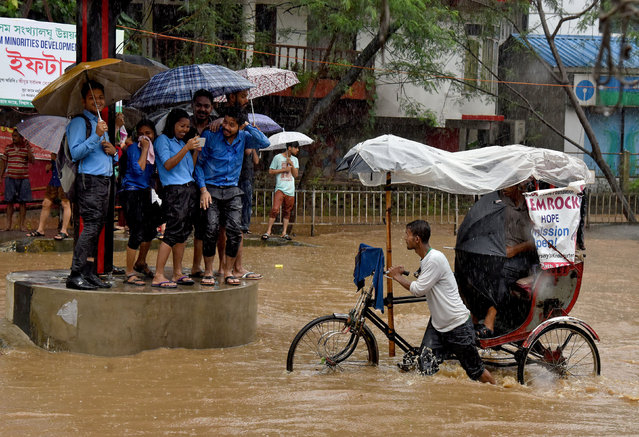
College students take shelter at a traffic point as a man paddles his rickshaw through a flooded road during heavy rain in Guwahati, India, June 13, 2017. (Photo by Anuwar Hazarika/Reuters)

College students take shelter at a traffic point as a man paddles his rickshaw through a flooded road during heavy rain in Guwahati, India, June 13, 2017. (Photo by Anuwar Hazarika/Reuters)
Details
18 Jun 2017 03:31:00
A child dressed in a Santa Claus costume reacts, on the day Palestinian Christians attend an Orthodox Christmas Mass at the Greek Orthodox Saint Porphyrius Church, amid the ongoing conflict between Israel and Hamas, in Gaza City on January 7, 2025. (Photo by Dawoud Abu Alkas/Reuters)

A child dressed in a Santa Claus costume reacts, on the day Palestinian Christians attend an Orthodox Christmas Mass at the Greek Orthodox Saint Porphyrius Church, amid the ongoing conflict between Israel and Hamas, in Gaza City on January 7, 2025. (Photo by Dawoud Abu Alkas/Reuters)
Details
31 Jan 2025 03:15:00
A woman sits as she gets a tattoo on her leg during the annual Panama City Ink Fest in Panama City August 16, 2015. (Photo by Carlos Jasso/Reuters)

A woman sits as she gets a tattoo on her leg during the annual Panama City Ink Fest in Panama City August 16, 2015. (Photo by Carlos Jasso/Reuters)
Details
18 Aug 2015 14:40:00
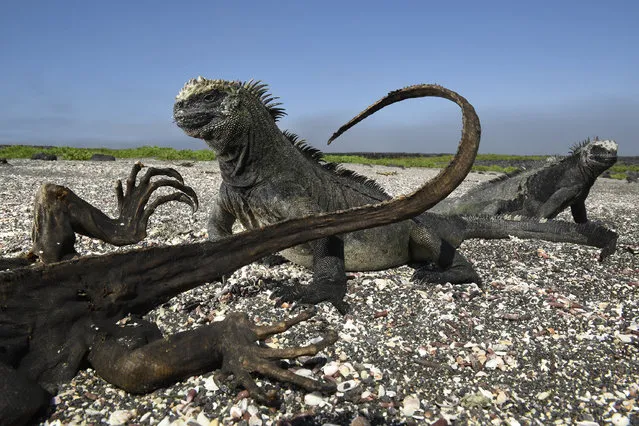
Galapagos – Rocking the Cradle: Four major ocean currents converge along the Galapagos archipelago, creating the conditions for an extraordinary diversity of animal life, April 25, 2016. The islands are home to at least 7,000 flora and fauna species, of which 97 percent of the reptiles, 80 percent of the land birds, 50 percent of the insects and 30 percent of the plants are endemic. The local ecosystem is highly sensitive to the changes in temperature, rainfall and ocean currents that characterize the climatic events known as El Niño and La Niña. These changes cause marked fluctuations in weather and food availability. Many scientists expect the frequency of El Niño and La Niña to increase as a result of climate change, making the Galapagos a possible early-warning location for its effects. (Photo by Thomas P. Peschak for National Geographic/World Press Photo)

Galapagos – Rocking the Cradle: Four major ocean currents converge along the Galapagos archipelago, creating the conditions for an extraordinary diversity of animal life, April 25, 2016. The islands are home to at least 7,000 flora and fauna species, of which 97 percent of the reptiles, 80 percent of the land birds, 50 percent of the insects and 30 percent of the plants are endemic. (Photo by Thomas P. Peschak for National Geographic/World Press Photo)
Details
16 Apr 2018 00:01:00
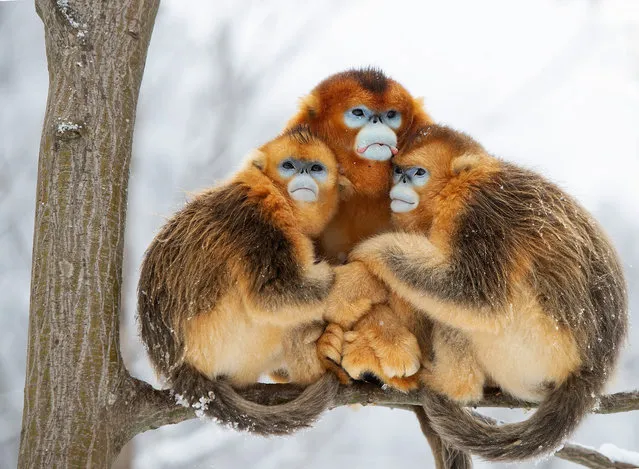
A golden huddle by Minqiang Lu, China. Two females and a male golden snub-nosed monkey huddle together to keep warm in the extreme cold. Threatened by forest loss and fragmentation, this endangered species is confined to central China. Restricted to living high up in the temperate forests, these monkeys – here in the Qinling mountains in Shaanxi province – feed mostly in the trees, on leaves, bark, buds and lichen. In heavy wind and snow, Minqiang walked up the mountain carrying his equipment. He stayed for half an hour in temperatures of –10C opposite the tree where the group was huddled before achieving this eye-level composition. (Photo by Minqiang Lu/Wildlife Photographer of the Year)

A golden huddle by Minqiang Lu, China. Two females and a male golden snub-nosed monkey huddle together to keep warm in the extreme cold. Threatened by forest loss and fragmentation, this endangered species is confined to central China. Restricted to living high up in the temperate forests, these monkeys – here in the Qinling mountains in Shaanxi province – feed mostly in the trees, on leaves, bark, buds and lichen. In heavy wind and snow, Minqiang walked up the mountain carrying his equipment. He stayed for half an hour in temperatures of –10C opposite the tree where the group was huddled before achieving this eye-level composition. (Photo by Minqiang Lu/Wildlife Photographer of the Year)
Details
12 Jan 2023 01:19:00
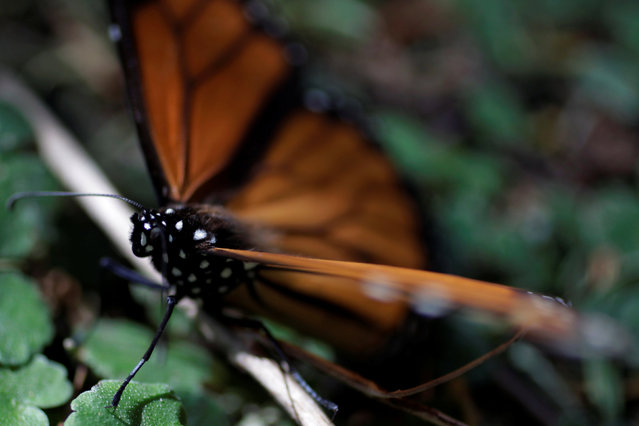
A monarch butterfly rests on the ground at the Sierra Chincua butterfly sanctuary on a mountain in Angangeo, Michoacan November 24, 2016. Angangueo is a town and municipality located in far eastern Michoacán state in central Mexico noted for its history of mining and its location in the Monarch Butterfly Biosphere Reserve. The Monarch Butterfly Biosphere Reserve is a World Heritage Site containing most of the over-wintering sites of the eastern population of the monarch butterfly. The reserve is located in the Trans-Mexican Volcanic Belt pine-oak forests ecoregion on the border of Michoacán and State of Mexico, 100 km (62 miles), northwest of Mexico City. Millions of butterflies arrive in the reserve annually. Butterflies only inhabit a fraction of the 56,000 hectares of the reserve from October–March. (Photo by Carlos Jasso/Reuters)

A monarch butterfly rests on the ground at the Sierra Chincua butterfly sanctuary on a mountain in Angangeo, Michoacan November 24, 2016. Angangueo is a town and municipality located in far eastern Michoacán state in central Mexico noted for its history of mining and its location in the Monarch Butterfly Biosphere Reserve. The Monarch Butterfly Biosphere Reserve is a World Heritage Site containing most of the over-wintering sites of the eastern population of the monarch butterfly. (Photo by Carlos Jasso/Reuters)
Details
26 Nov 2016 10:20:00
Thor Heyerdahl with a model of the balsa raft Kon Tiki

“Thor Heyerdahl (October 6, 1914, Larvik, Norway – April 18, 2002, Colla Micheri, Italy) was a Norwegian ethnographer and adventurer with a background in zoology and geography. He became notable for his Kon-Tiki expedition, in which he sailed 8,000 km (4,300 miles) by raft from South America to the Tuamotu Islands. All his expeditions are shown in the Kon-Tiki Museum, Oslo”. – Wikipedia

Photo: Norwegian anthropologist Thor Heyerdahl with a model of the balsa raft “Kon-Tiki” on which he drifted 4,300 miles from Peru to the Tuamotu Islands, proving his theory that Polynesia could originally have been populated by South Americans. (Photo by Express/Express/Getty Images). 1950
Details
09 Aug 2011 11:05:00
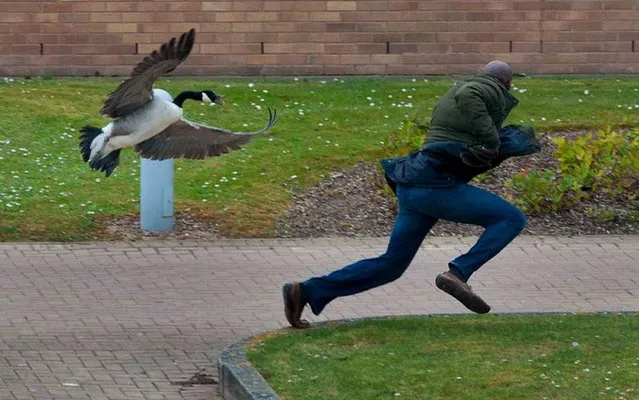
A goose has terrorized students at the University of Warwick, Coventry, UK, on May 22, 2013. The bird built its nest near a block of student apartments and attacks anyone who goes near the nest. (Photo by Caters News/The Grosby Group)

A goose has terrorized students at the University of Warwick, Coventry, UK, on May 22, 2013. The bird built its nest near a block of student apartments and attacks anyone who goes near the nest. (Photo by Caters News/The Grosby Group)
Details
26 May 2013 13:01:00