A group of Chinese hostesses walk during the opening session of the National People's Congress (NPC) at the Tiananmen square in Beijing on March 5, 2025. (Photo by WANG Zhao/AFP Photo)
Visitors pose for a picture next to a mallard duck on the cobblestones of St Peter's Square with St Peter's Basilica in the background at The Vatican, on May 5, 2025. (Photo by Alberto Pizzoli/AFP Photo)
hello! finally I got together all my energy leftovers from the day to write a journal entry... and stright to the point about commission works, yup those are still CLOSED. at this point I'm trying to take more time just to draw and paint for myself ( just like in childhood times haha ). whenever I will feel like opening more personal commission work slots I will definitely let you all know ( just in case I must warn about a little price rise, yup o; ). sooner or later I will open few slots this year!
HalfPics is a Twitter feed pointing to things cut in half like a bowl of ramen, a Mini Cooper, and toothpaste. Their tagline: “Ever wonder what stuff looks like when it’s cut in half?” Yes. We previously posted about “Cut Food,” a photo series of foods cut neatly in half by food photographer Beth Galton and food stylist Charlotte Omnès.
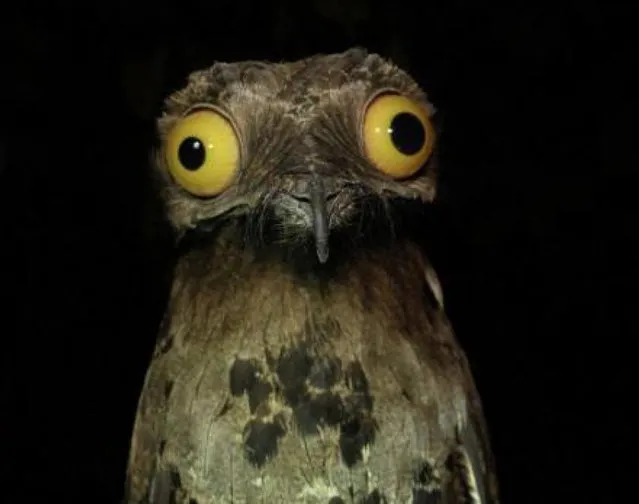
Potoos (family Nyctibiidae) are a group of near passerine birds related to the nightjars and frogmouths. They are sometimes called Poor-me-ones, after their haunting calls. There are seven species in one genus, Nyctibius, in tropical Central and South America.
These are nocturnal insectivores which lack the bristles around the mouth found in the true nightjars. They hunt from a perch like a shrike or flycatcher. During the day they perch upright on tree stumps, camouflaged to look like part of the stump. The single spotted egg is laid directly on the top of a stump.
A woman wearing a four-leaf clover-like hairpin takes a selfie nearby Nanluoguxiang street in Beijing, China, September 16, 2015. Wearing antenna styled hairpins in the shape of various flowers and plants at scenic spots has become a new trend in Beijing. (Photo by Kim Kyung-Hoon/Reuters)
Those lights are actually bioluminescent shrimp, better known as sea fireflies, or, in Japan, as “umibotaru”. Visible every year from May until the end of October, they live in the sand around very shallow sea water and are often seen floating between the extremes of high and low tides. Here: Bioluminescent sea fireflies glittering like diamonds on the rocks and sand. Okayama, Japan. July 2016. (Photo by Trevor Williams/Jonathan Galione/Getty Images)
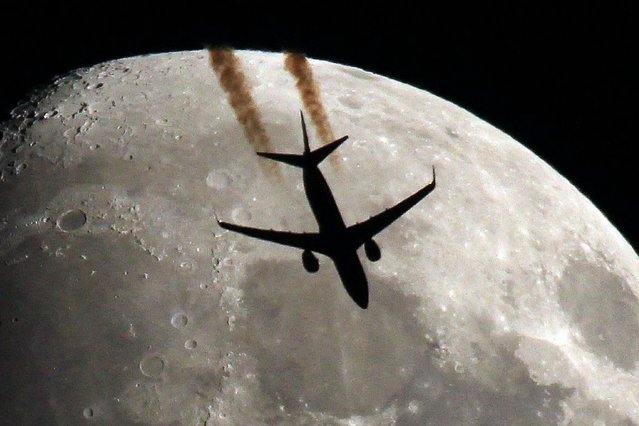
This plane looks like it's bound for the moon as it shoots across the sky. Photographer Sebastien Lebrigand was impressed he could even see the lights on the jet's wings in this stunning silhouette. (Photo by Sebastien Lebrigand/Solent News)