Loading...
Done
A man sets himself on fire during protest rallies in front of the presidential office in Kiev, Ukraine on February 26, 2020. The man, who called himself Oleksandr Burlakov, said subsequently that his motive was to draw the attention of the authorities to his plight, related to the ownership of the land parcel. (Photo by Ihor Behus/Reuters)

A man sets himself on fire during protest rallies in front of the presidential office in Kiev, Ukraine on February 26, 2020. The man, who called himself Oleksandr Burlakov, said subsequently that his motive was to draw the attention of the authorities to his plight, related to the ownership of the land parcel. (Photo by Ihor Behus/Reuters)
Details
04 Jan 2021 00:01:00
A boy fires blanks from a Kalashnikov rifle, during Maslenitsa celebrations, or Shrovetide, to say farewell to winter in Minsk, Belarus, Sunday, March 1, 2020. Maslenitsa is a traditional Russian and Belarusian holiday marking the end of winter that dates back to pagan times. (Photo by Sergei Grits/AP Photo)

A boy fires blanks from a Kalashnikov rifle, during Maslenitsa celebrations, or Shrovetide, to say farewell to winter in Minsk, Belarus, Sunday, March 1, 2020. Maslenitsa is a traditional Russian and Belarusian holiday marking the end of winter that dates back to pagan times. (Photo by Sergei Grits/AP Photo)
Details
13 May 2020 00:01:00
Kevin and Merith Starren have their picture taken by Merith's brother Mark Ernst (R) and nephew Logan Ernst (L) in front of a 50-foot snowman named “Granddaddy” in Gilman, Minnesota, March 6, 2014. (Photo by Eric Miller/Reuters)

Kevin and Merith Starren have their picture taken by Merith's brother Mark Ernst (R) and nephew Logan Ernst (L) in front of a 50-foot snowman named “Granddaddy” in Gilman, Minnesota, March 6, 2014. (Photo by Eric Miller/Reuters)
Details
08 Mar 2014 10:57:00
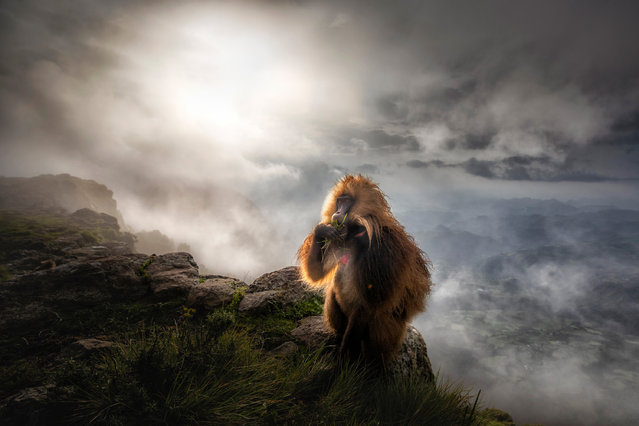
Highly commended, mammals: Gelada after the storm – Marco Gaiotti (Italy). “Gelada baboons are the only monkey species in the world that feed on grasses. They are native to the tableland of Ethiopia. Every morning large family groups wander from their sleeping places in the steep rock face, up to 1,000 metres high, to the feeding grounds at the tablelands. This image clearly depicts their feeding strategy: they pull out bunches of grass, sort the stalks and then lift them to their mouth. This shot was taken towards the end of the rainy season after a heavy storm”. (Photo by Marco Gaiotti/2019 GDT European Wildlife Photographer of the Year)

Highly commended, mammals: Gelada after the storm – Marco Gaiotti (Italy). “Gelada baboons are the only monkey species in the world that feed on grasses. They are native to the tableland of Ethiopia. Every morning large family groups wander from their sleeping places in the steep rock face, up to 1,000 metres high, to the feeding grounds at the tablelands. This image clearly depicts their feeding strategy: they pull out bunches of grass, sort the stalks and then lift them to their mouth. This shot was taken towards the end of the rainy season after a heavy storm”. (Photo by Marco Gaiotti/2019 GDT European Wildlife Photographer of the Year)
Details
31 Oct 2019 00:03:00
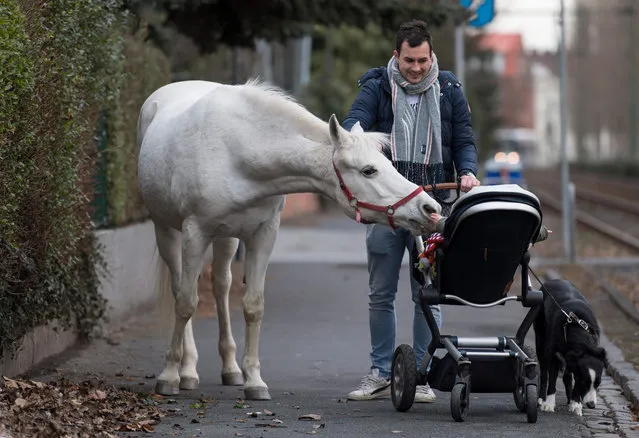
The Arabian mare “Jenny” curiously sniffs at the child of Raphael Wöllstein, who is on his way to the train, on her daily walk through the Fechenheim district of Frankfurt, Germany on March 8, 2019. Her owner opens the stable door for the 22-year-old horse every morning. Then the animal can decide for itself where it wants to spend the day. So that nobody thinks she's escaped, a sign with the inscription “My name is Jenny, didn't run away, just go for a walk” is on the halter. (Photo by Boris Roessler/dpa)

The Arabian mare “Jenny” curiously sniffs at the child of Raphael Wöllstein, who is on his way to the train, on her daily walk through the Fechenheim district of Frankfurt, Germany on March 8, 2019. Her owner opens the stable door for the 22-year-old horse every morning. Then the animal can decide for itself where it wants to spend the day. So that nobody thinks she's escaped, a sign with the inscription “My name is Jenny, didn't run away, just go for a walk” is on the halter. (Photo by Boris Roessler/dpa)
Details
10 Mar 2019 00:07:00
The Berenson robot strolls among visitors during the exhibition “Persona : Oddly Human” at the Quai Branly museum in Paris, France, February 23, 2016. The Berenson robot, developed in France in 2011, is the brainchild of anthropologist Denis Vidal and robotics engineer Philippe Gaussier. Its programming allows it to record reactions of museum visitors to certain pieces of art and then use the data to develop its own unique taste, which allows “Berenson” to judge whether or not it likes a certain work of art within an exhibition. (Photo by Philippe Wojazer/Reuters)

The Berenson robot strolls among visitors during the exhibition “Persona : Oddly Human” at the Quai Branly museum in Paris, France, February 23, 2016. The Berenson robot, developed in France in 2011, is the brainchild of anthropologist Denis Vidal and robotics engineer Philippe Gaussier. Its programming allows it to record reactions of museum visitors to certain pieces of art and then use the data to develop its own unique taste, which allows “Berenson” to judge whether or not it likes a certain work of art within an exhibition. (Photo by Philippe Wojazer/Reuters)
Details
25 Feb 2016 12:26:00
Pregnant revelers dance during a street pre-carnival party by the “Cordao do Boitata” Block, in Rio de Janeiro, Brazil, Sunday, February 12, 2023. Revelers are taking to the streets for the open-air block parties, leading up to Carnival's official Feb. 17th opening. (Photo by Bruna Prado/AP Photo)

Pregnant revelers dance during a street pre-carnival party by the “Cordao do Boitata” Block, in Rio de Janeiro, Brazil, Sunday, February 12, 2023. Revelers are taking to the streets for the open-air block parties, leading up to Carnival's official Feb. 17th opening. (Photo by Bruna Prado/AP Photo)
Details
27 Feb 2023 05:20:00
A vendor (C) cuts slaughtered dogs for sale at his roadside stall in Duong Noi village, outside Hanoi December 16, 2011. While animal rights activists have condemned eating dog meat as cruel treatment of the animals, it is still an accepted popular delicacy for some Vietnamese, as well in some other Asian countries. (Photo by Reuters/Kham)

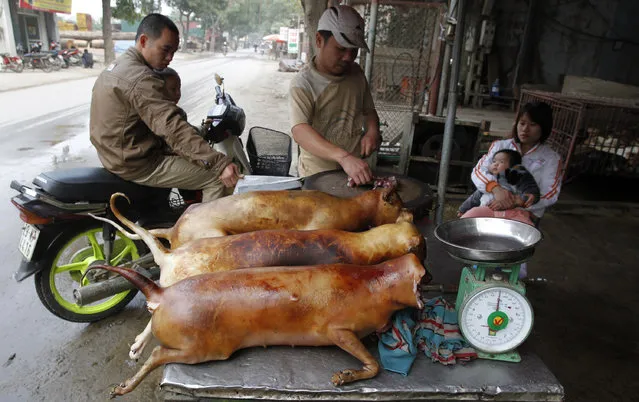
A vendor (C) cuts slaughtered dogs for sale at his roadside stall in Duong Noi village, outside Hanoi December 16, 2011. While animal rights activists have condemned eating dog meat as cruel treatment of the animals, it is still an accepted popular delicacy for some Vietnamese, as well in some other Asian countries. Duong Noi is well-known as a dog-meat village, where hundreds of dogs are killed each day for sale as popular traditional food. Dog-eating as a custom is rooted in Vietnam and was developed as a result of poverty. One kilogram of dog meat costs about 130,000 dongs ($6.2). (Photo by Reuters/Kham)
Details
16 Jul 2013 11:40:00