Loading...
Done
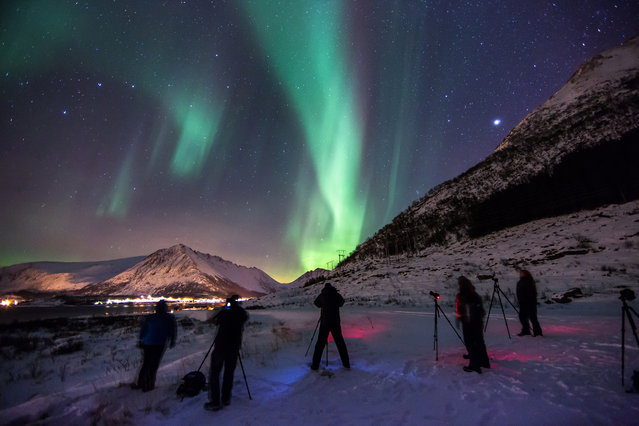
“Aurora Hunters”. Photographers taking part in a photography tour on the Lofoten Islands in Norway, pull over on the side of the road to take a photo of their first ever Aurora Borealis after spotting it from their tour bus. Photo location: Rystad, Lofoten Islands, Norway. (Photo and caption by Mark Gee/National Geographic Photo Contest)

“Aurora Hunters”. Photographers taking part in a photography tour on the Lofoten Islands in Norway, pull over on the side of the road to take a photo of their first ever Aurora Borealis after spotting it from their tour bus. Photo location: Rystad, Lofoten Islands, Norway. (Photo and caption by Mark Gee/National Geographic Photo Contest)
Details
17 Jun 2014 10:08:00
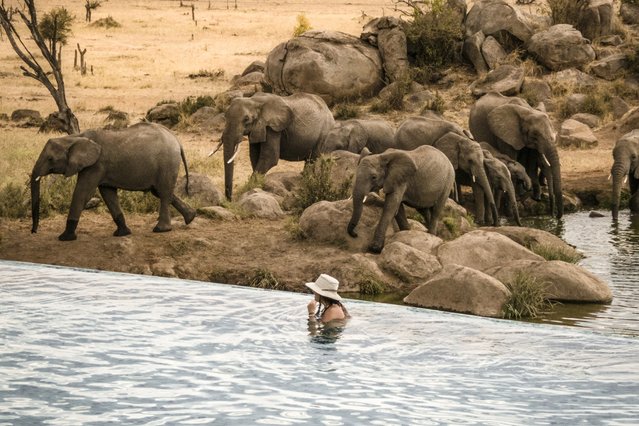
World's Greatest Swimming Pools: Four Seasons, Serengeti Pool, Tanzania. A show of elephants, buffalo and baboons awaits thanks to an active watering hole below the free-form infinity pool at this plush hideaway inside Serengeti National Park. Bonus: Because of infrared technology at the hole, guests can be notified on their bedroom TV when animals are approaching. When you've got word of wildlife on the horizon, catch them from your private terrace – or head back to the pool. (From $1,650). (Photo by Four Seasons)

World's Greatest Swimming Pools: Four Seasons, Serengeti Pool, Tanzania. A show of elephants, buffalo and baboons awaits thanks to an active watering hole below the free-form infinity pool at this plush hideaway inside Serengeti National Park. Bonus: Because of infrared technology at the hole, guests can be notified on their bedroom TV when animals are approaching. When you've got word of wildlife on the horizon, catch them from your private terrace – or head back to the pool. (From $1,650). (Photo by Four Seasons)
Details
06 Aug 2018 00:03:00
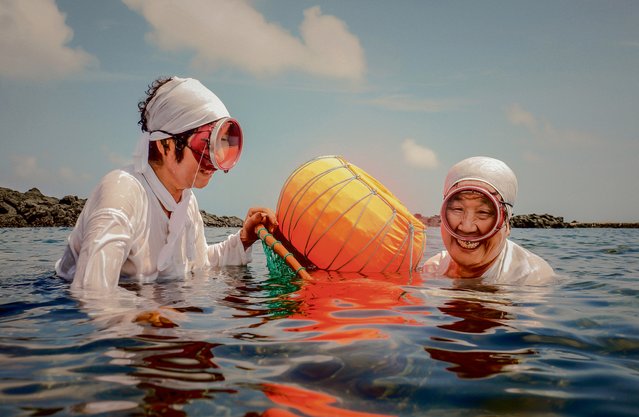
Ja Kang Song, 71, and Ja Hyun Su, 72, dive for shellfish and are the main breadwinners for their families. In South Korea, 45% of the diving women of Jeju are over the age of 70. Routinely diving to depths of 20m and staying under for an average of two to three minutes, the pressure on the body takes its toll and, like many others, burst eardrums have left Ja Hyun Su deaf. Each season, between seven and 10 women die diving the waters around Jeju Island. (Photo by Andy W. Langton/Age International)

Ja Kang Song, 71, and Ja Hyun Su, 72, dive for shellfish and are the main breadwinners for their families. In South Korea, 45% of the diving women of Jeju are over the age of 70. Routinely diving to depths of 20m and staying under for an average of two to three minutes, the pressure on the body takes its toll and, like many others, burst eardrums have left Ja Hyun Su deaf. Each season, between seven and 10 women die diving the waters around Jeju Island. (Photo by Andy W. Langton/Age International)
Details
12 Sep 2016 10:35:00
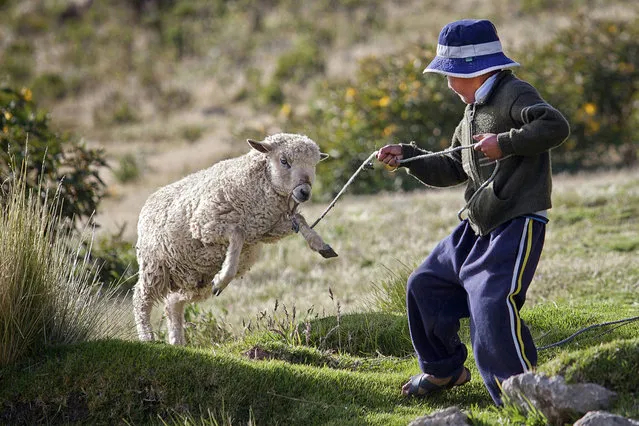
“The Challenge!” Young boy relishes in a game of tug of war before school. Photo location:  Lake Titicaca, Peru. (Photo and caption by Paul Heyman/National Geographic Photo Contest)

“The Challenge!” Young boy relishes in a game of tug of war before school. Photo location: Lake Titicaca, Peru. (Photo and caption by Paul Heyman/National Geographic Photo Contest)
Details
18 Jun 2014 12:40:00
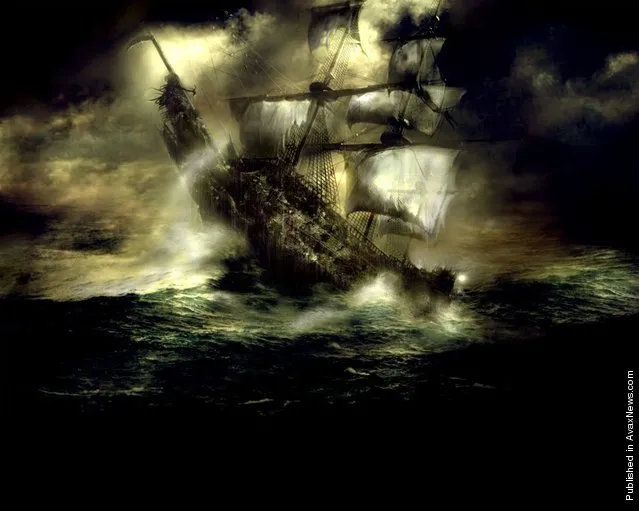
Ocean voyage

Do you think that history is a science? Well, not exactly. First, and foremost, history is the state's “legend of wars”, it’s official regalia. Of course, public historians are not interested in scientific truth – quite the opposite. In this respect, any attempt to present a state’s history as altruistic and benevolent as possible is welcomed and encouraged – as opposed to any revisionism attempts that may be more accurate. In this matter, Chinese have surpassed us all – they revised in highly creative manner (but rather shamelessly) the technology already invented by Europeans, a process that resulted in oldest state on the planet. Here is an interesting paradox: ask any sinologist about the Middle Kingdom during second century B.C., and he will describe it to you in such a vivid manner as if he has been living there all his life – but as soon as you will ask him to describe Chinese history in the 19-20th centuries… let's say, his eagerness will be greatly diminished. However, we will discuss China in a different article, and in the meantime we will try to understand how exactly historic “legend of wars” is formed and functions – based on a specific and well-known example. A great example is Ferdinand Magellan's first voyage around the world.

Details
14 Nov 2011 09:11:00
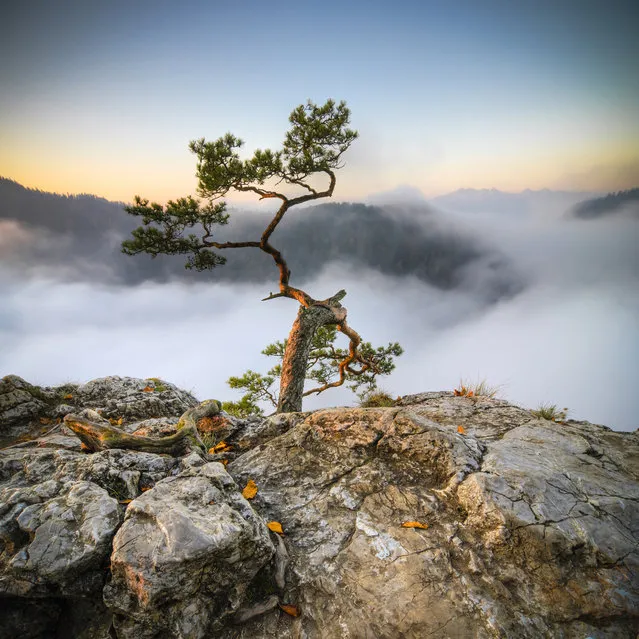
“Sokolica”. Sokolica, Poland. (Photo and caption by Marcin Kęsek/National Geographic Traveler Photo Contest)

“Sokolica”. Sokolica, Poland. (Photo and caption by Marcin Kęsek/National Geographic Traveler Photo Contest)

ATTENTION! All pictures are presented in high resolution. To see Hi-Res images – just TWICE click on any picture. In other words, click small picture – opens the BIG picture. Click BIG picture – opens VERY BIG picture.
Details
25 Jun 2013 09:13:00
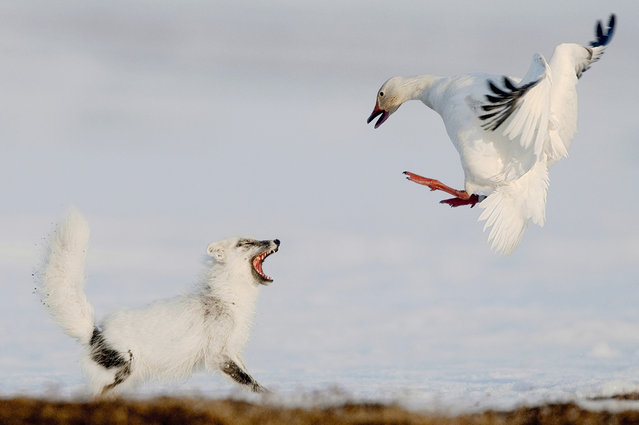
Commended. In late May, about a quarter of a million snow geese arrive from North America to nest on Wrangel Island, in northeastern Russia. They form the world's largest breeding colony of snow geese. Photographer Sergey Gorshkov spent two months on the remote island photographing the unfolding dramas. (Photo by Sergey Gorshkov/Veolia Environnement Wildlife Photographer)

Commended. In late May, about a quarter of a million snow geese arrive from North America to nest on Wrangel Island, in northeastern Russia. They form the world's largest breeding colony of snow geese. Photographer Sergey Gorshkov spent two months on the remote island photographing the unfolding dramas. Arctic foxes take advantage of the abundance of eggs, caching surplus eggs for leaner times. But a goose (here the gander) is easily a match for a fox, which must rely on speed and guile to steal eggs. “The battles were fairly equal”, notes Sergey, “and I only saw a fox succeed in grabbing an egg on a couple of occasions, despite many attempts”. Surprisingly, “the geese lacked any sense of community spirit”, he adds, “and never reacted when a fox harassed a neighboring pair nesting close by”. (Photo by Sergey Gorshkov/Veolia Environnement Wildlife Photographer)
Details
16 Jun 2015 12:30:00
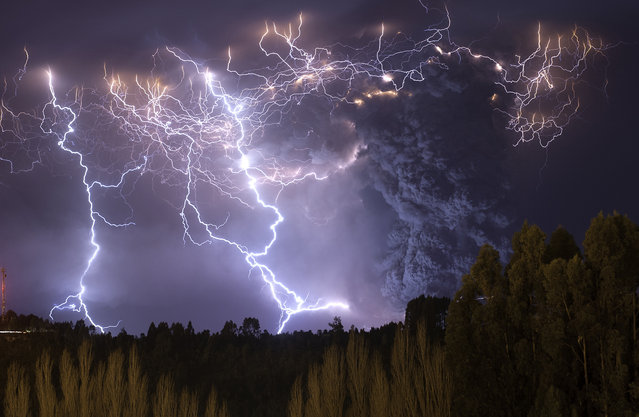
The eruption of Cordon Caulle began on June 4, 2011, located in the Region of Los Rios in Chile. For about 12 months, people and animals became accustomed to living with the daily fall of ash, which also caused problems in the air traffic in South America. The explosions and lightning during first days of the eruption could be seen from hundreds of miles around. This photograph was taken on the second night of eruption from the town of Lago Ranco. (Photo and caption by Francisco Negroni/National Geographic Traveler Photo Contest)

The eruption of Cordon Caulle began on June 4, 2011, located in the Region of Los Rios in Chile. For about 12 months, people and animals became accustomed to living with the daily fall of ash, which also caused problems in the air traffic in South America. The explosions and lightning during first days of the eruption could be seen from hundreds of miles around. This photograph was taken on the second night of eruption from the town of Lago Ranco. (Photo and caption by Francisco Negroni/National Geographic Traveler Photo Contest)

ATTENTION! All pictures are presented in high resolution. To see Hi-Res images – just TWICE click on any picture. In other words, click small picture – opens the BIG picture. Click BIG picture – opens VERY BIG picture.
Details
23 Jun 2013 11:24:00