Loading...
Done
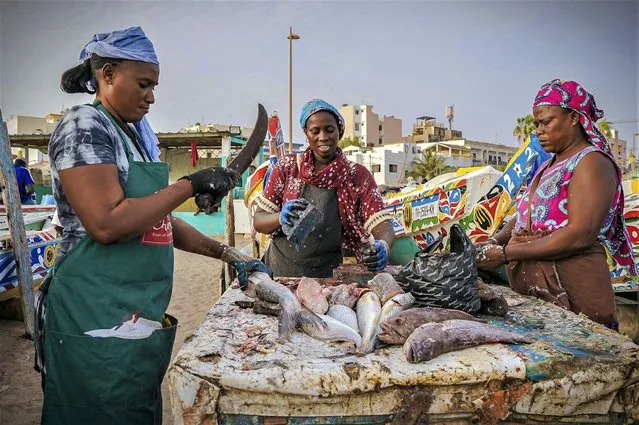
Fishmongers cut and clean fish at the Soumbedioune fish market in Dakar, Senegal, May 31, 2022. In Senegal, fish and seafood represent more than 40% of the animal protein intake in the diet. According to a U.S. report, one in six people work in the fisheries sector. (Photo by Grace Ekpu/AP Photo)

Fishmongers cut and clean fish at the Soumbedioune fish market in Dakar, Senegal, May 31, 2022. In Senegal, fish and seafood represent more than 40% of the animal protein intake in the diet. According to a U.S. report, one in six people work in the fisheries sector. (Photo by Grace Ekpu/AP Photo)

Details
04 Jul 2023 02:04:00
A Palestinian fisherman cleans up his fishing net after the Israeli decision to close Gaza's fishing zone, on the beach in Gaza City, Tuesday, August 18, 2020. (Photo by Khalil Hamra/AP Photo)

A Palestinian fisherman cleans up his fishing net after the Israeli decision to close Gaza's fishing zone, on the beach in Gaza City, Tuesday, August 18, 2020. (Photo by Khalil Hamra/AP Photo)
Details
30 Sep 2020 00:05:00
Kawakanih Yawalapiti, 9, Upper Xingu region of Mato Grosso, Brazil, 2018: Kawakanih lives with her tribe, the Yawalapiti, in Xingu national park, a preserve in the Amazon basin of Brazil. The Yawalapiti collect seeds to preserve species unique to their ecosystem, which lies between the rain forest and savannah. Kawakanih’s diet is simple, consisting mainly of fish, cassava, porridge, fruit and nuts. “It takes five minutes to catch dinner”, says Kawakanih. “When you’re hungry, you just go to the river with your net”. (Photo by Gregg Segal/The Guardian)

Photographer Gregg Segal travelled the world to document children and the food they eat in a week. Partly inspired by the increasing problems of childhood obesity, he tracked traditional regional diets as yet unaffected by globalisation, and ironically, found that the healthiest diets were often eaten by the least well off. (Photo by Gregg Segal/The Guardian)
Details
03 Jul 2019 00:03:00
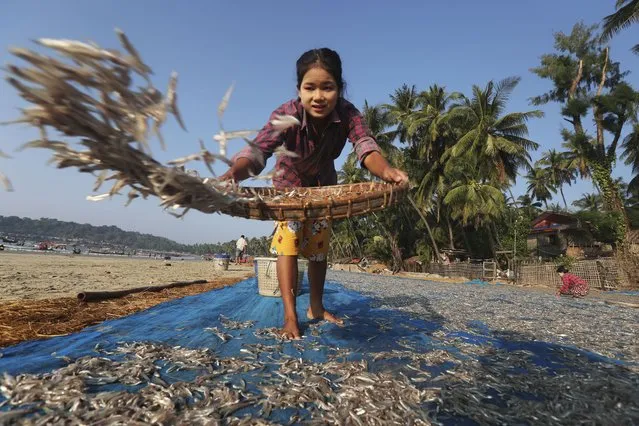
A woman spreads out fish to dry at Ngapali Beach near a fishing village in Myanmar's western Rakhine State, Saturday, December 31, 2022. (Photo by Aung Shine Oo/AP Photo)

A woman spreads out fish to dry at Ngapali Beach near a fishing village in Myanmar's western Rakhine State, Saturday, December 31, 2022. (Photo by Aung Shine Oo/AP Photo)
Details
06 Jan 2023 05:12:00
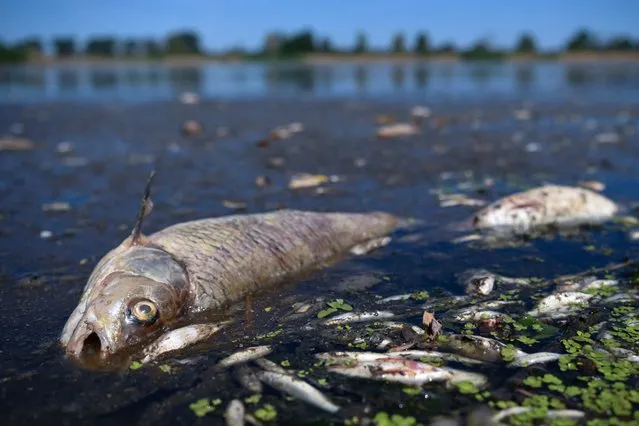
A dead fish lies on the bank of Oder River on the German-Polish border, in Brieskow-Finkenheerd, Frankfurt (Oder), Germany, August 11, 2022. Authorities are looking into the cause of the mysterious fish deaths. (Photo by Annegret Hilse/Reuters)

A dead fish lies on the bank of Oder River on the German-Polish border, in Brieskow-Finkenheerd, Frankfurt (Oder), Germany, August 11, 2022. Authorities are looking into the cause of the mysterious fish deaths. (Photo by Annegret Hilse/Reuters)
Details
07 Oct 2022 04:22:00
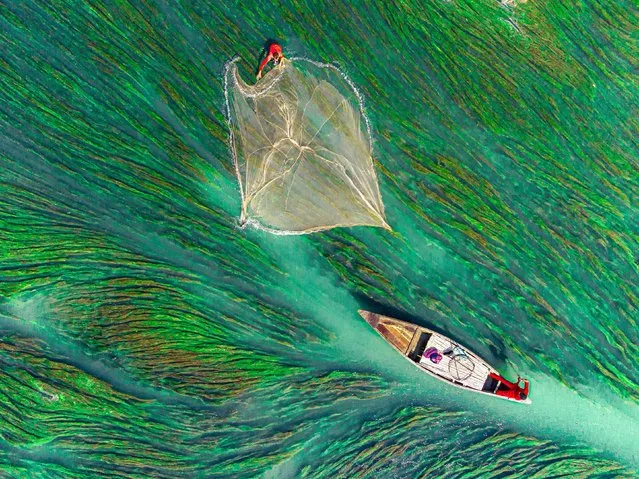
Fishermen are surrounded by green water as they use large nets to catch fish. The workers were pictured trying to find fish below the algae in Rajshahi, Bangladesh in the last decade of February 2024. (Photo by Bipul Ahmed/Solent News & Photo Agency)

Fishermen are surrounded by green water as they use large nets to catch fish. The workers were pictured trying to find fish below the algae in Rajshahi, Bangladesh in the last decade of February 2024. (Photo by Bipul Ahmed/Solent News & Photo Agency)
Details
27 Mar 2024 07:50:00
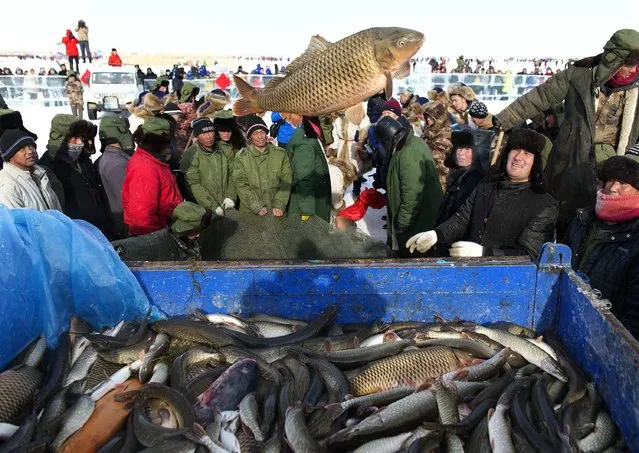
Fish are thrown onto a truck during a winter fishing festival held on the frozen Wulungu Lake in Fuhai county, Xinjiang Uighur Autonomous Region, January 18, 2015. (Photo by Reuters/China Daily)

Fish are thrown onto a truck during a winter fishing festival held on the frozen Wulungu Lake in Fuhai county, Xinjiang Uighur Autonomous Region, January 18, 2015. (Photo by Reuters/China Daily)
Details
22 Jan 2015 13:56:00
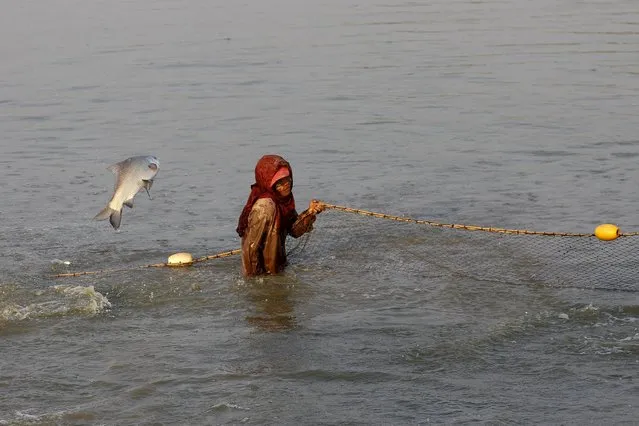
A fish jumps over a net as a boy works in a fish farm at Htantapin township, outside Yangon, Myanmar February 18, 2016. (Photo by Soe Zeya Tun/Reuters)

A fish jumps over a net as a boy works in a fish farm at Htantapin township, outside Yangon, Myanmar February 18, 2016. One in five children in Myanmar aged 10-17 go to work instead of school, according to figures from a census report on employment published last month, and the opening up of the economy since 2011 has triggered a spike in demand for labour. Many children work in fish farming and processing. At Yangon's San Pya fish market, the country's largest, girls and boys as young as nine clean and process fish and unload boats and trucks during 12-hour overnight shifts. (Photo by Soe Zeya Tun/Reuters)
Details
20 Apr 2016 12:18:00