Loading...
Done
Thomas Thwaites of the United Kingdom accepts the 2016 Ig Nobel Prize in Biology for “creating prosthetic extensions of his limbs that allowed him to move in the manner of, and spend time roaming the hills in the company of, goats” during the 26th First Annual Ig Nobel Prize ceremony at Harvard University in Cambridge, Massachusetts, U.S. September 22, 2016. (Photo by Brian Snyder/Reuters)

Thomas Thwaites of the United Kingdom accepts the 2016 Ig Nobel Prize in Biology for “creating prosthetic extensions of his limbs that allowed him to move in the manner of, and spend time roaming the hills in the company of, goats” during the 26th First Annual Ig Nobel Prize ceremony at Harvard University in Cambridge, Massachusetts, U.S. September 22, 2016. (Photo by Brian Snyder/Reuters)
Details
24 Sep 2016 10:46:00
Evie and Conor Enright, from Portmarnock pictured on a walk in Howth, Co. Dublin on December 30, 2022. (Photo by Damien Eagers for The Irish Times)

Evie and Conor Enright, from Portmarnock pictured on a walk in Howth, Co. Dublin on December 30, 2022. (Photo by Damien Eagers for The Irish Times)
Details
04 Jan 2023 07:24:00
People observe a protest against a new citizenship law from a bus, in New Delhi, India, January 3, 2020. (Photo by Anushree Fadnavis/Reuters)

People observe a protest against a new citizenship law from a bus, in New Delhi, India, January 3, 2020. (Photo by Anushree Fadnavis/Reuters)
Details
07 Jan 2020 00:03:00
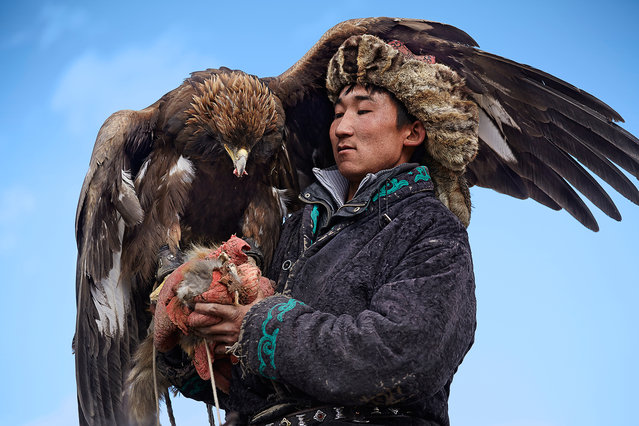
In one of the planet’s most desolate and harsh terrains, the Altai Mountains which run from Siberia in Russia down to Mongolia’s Gobi Desert, hunting with eagles is currently only practiced by a handful of Kyrgyz and Kazakhs. This form of falconry, the practice of hunting with the aid of birds of prey, can be traced back as far as 4,000 years in Central Asia. (Photo by Tariq Zaidi/The Washington Post)

In one of the planet’s most desolate and harsh terrains, the Altai Mountains which run from Siberia in Russia down to Mongolia’s Gobi Desert, hunting with eagles is currently only practiced by a handful of Kyrgyz and Kazakhs. This form of falconry, the practice of hunting with the aid of birds of prey, can be traced back as far as 4,000 years in Central Asia. Here: after a successful hunt, a proud hunter rewards his eagle by feeding it the lungs of the prey, which is considered the most highly prized part of the animal. (Photo by Tariq Zaidi/The Washington Post)
Details
22 Aug 2015 12:46:00
A Philippine boy collects used plastic bottles to be sold at a junk shop at Divisoria market in Manila on November 29, 2017. (Photo by Noel Celis/AFP Photo)

A Philippine boy collects used plastic bottles to be sold at a junk shop at Divisoria market in Manila on November 29, 2017. (Photo by Noel Celis/AFP Photo)
Details
30 Nov 2017 08:22:00
Flamingoes in Laguna Colorada, Altiplano, Bolivia, South America in 2018. (Photo by Oksana Belikova/Rex Features/Shutterstock)

Flamingoes in Laguna Colorada, Altiplano, Bolivia, South America in 2018. (Photo by Oksana Belikova/Rex Features/Shutterstock)
Details
06 Aug 2023 04:24:00
Members of Japan's idol group “Virtual Currency Girls” wearing cryptocurrency-themed masks perform in their debut stage in Tokyo, Japan, January 12, 2018. Japan and South Korea are home to some of the bigger digital exchanges, with investors piling in as growth in bitcoin and other cryptocurrencies soared last year, provoking regulators' concerns. (Photo by Kim Kyung-Hoon/Reuters)

Members of Japan's idol group “Virtual Currency Girls” wearing cryptocurrency-themed masks perform in their debut stage in Tokyo, Japan, January 12, 2018. Japanese female idols have teamed up to form the ‘Virtual Currency Girls’ group to promote the knowledge of cryptocurrencies through entertainment. Each of its 8 members represents a cryptocurrency: bitcoin cash, bitcoin, ether, neo, nem, ripple, mona, and cardano. (Photo by Kim Kyung-Hoon/Reuters)
Details
15 Jan 2018 03:15:00
At the Krasnopresnenskaya station, the benches come from the Cathedral of Christ-Sauveur, which was built from 1839 to 1883 in memory of the victory of Russia against the army of Napoleon I. The cathedral was destroyed under Stalin in 1931, but the benches remained intact. Metro architects decided to install them in some stations. (Photo by Didier Bizet/The Washington Post)

At the Krasnopresnenskaya station, the benches come from the Cathedral of Christ-Sauveur, which was built from 1839 to 1883 in memory of the victory of Russia against the army of Napoleon I. The cathedral was destroyed under Stalin in 1931, but the benches remained intact. Metro architects decided to install them in some stations. (Photo by Didier Bizet/The Washington Post)
Details
24 Jan 2018 06:23:00