Loading...
Done
Revellers take a break during the Carnival 2016 parade in Port-au-Prince, Haiti, February 8, 2016. (Photo by Andres Martinez Casares/Reuters)

Revellers take a break during the Carnival 2016 parade in Port-au-Prince, Haiti, February 8, 2016. (Photo by Andres Martinez Casares/Reuters)
Details
10 Feb 2016 11:41:00
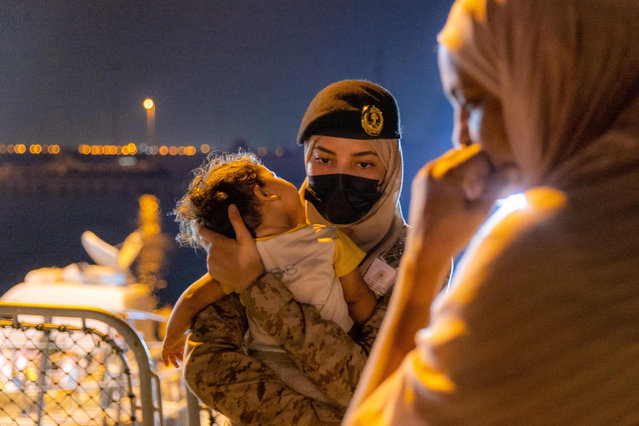
This handout picture provided by the Saudi Media Ministry on April 24, 2023 shows a member of the Saudi Navy Forces carrying an evacuee baby upon arrival at King Faisal navy base in Jeddah, following a rescue operation from Sudan. Elderly women in wheelchairs and babies asleep in their parents' arms were among nearly 200 people from 14 countries who disembarked from a naval frigate in the coastal city of Jeddah on Monday night after daring – and draining – journeys to safety. (Photo by SPA/AFP Photo)

This handout picture provided by the Saudi Media Ministry on April 24, 2023 shows a member of the Saudi Navy Forces carrying an evacuee baby upon arrival at King Faisal navy base in Jeddah, following a rescue operation from Sudan. Elderly women in wheelchairs and babies asleep in their parents' arms were among nearly 200 people from 14 countries who disembarked from a naval frigate in the coastal city of Jeddah on Monday night after daring – and draining – journeys to safety. (Photo by SPA/AFP Photo)
Details
02 Aug 2024 04:15:00
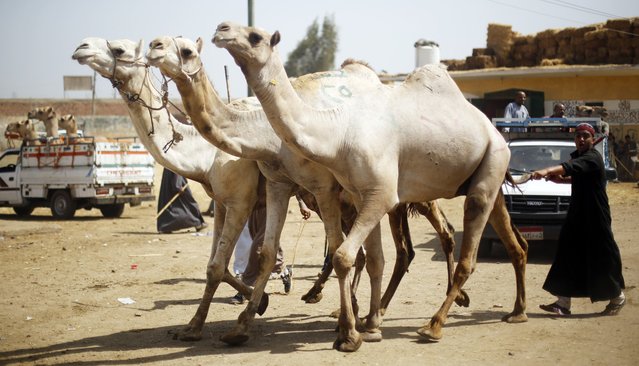
A man walks behind camels at the Birqash Camel Market, ahead of Eid al-Adha or Festival of Sacrifice, on the outskirts of Cairo September 29, 2014. (Photo by Amr Abdallah Dalsh/Reuters)

A man walks behind camels at the Birqash Camel Market, ahead of Eid al-Adha or Festival of Sacrifice, on the outskirts of Cairo September 29, 2014. Birqash Camel Market, one of the biggest markets for camel meat in Africa, draws sellers from Libya, Sudan, Somalia and other regions in Egypt. The camels sold at the market are also used in tourism. Traders say that the selling rate for a camel in 2014 is anywhere between 5,000 and 20,000 Egyptian pounds (700 – 2800 USD). (Photo by Amr Abdallah Dalsh/Reuters)
Details
02 Oct 2014 10:20:00
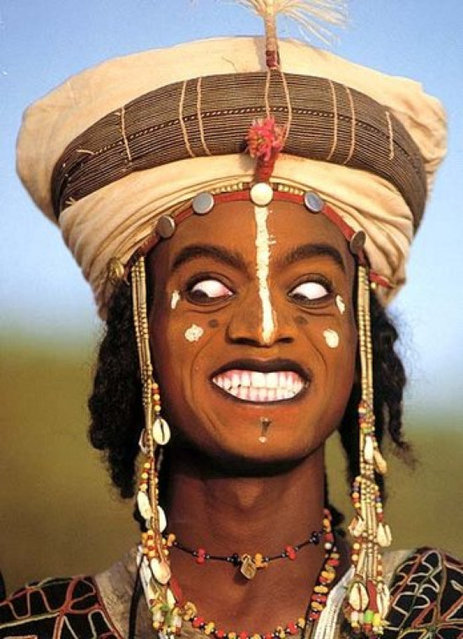
Beauty_By_Fulani

Fula people or Fulani or Fulbe are an ethnic group spread over many countries, predominantly in West Africa, but found also in Central Africa and Sudanese North Africa. African countries where they are present include Mauritania, Ghana, Senegal, Guinea, The Gambia, Mali, Nigeria, Sierra Leone, Benin, Burkina Faso, Guinea Bissau, Cameroon, Côte d'Ivoire, Niger, Chad, Togo, the Central African Republic, Liberia, and as far as Sudan and Egypt in the East. Fula people form a minority in every country they inhabit, but in Guinea they represent a plurality of the population (40%).
Details
25 Sep 2012 10:17:00
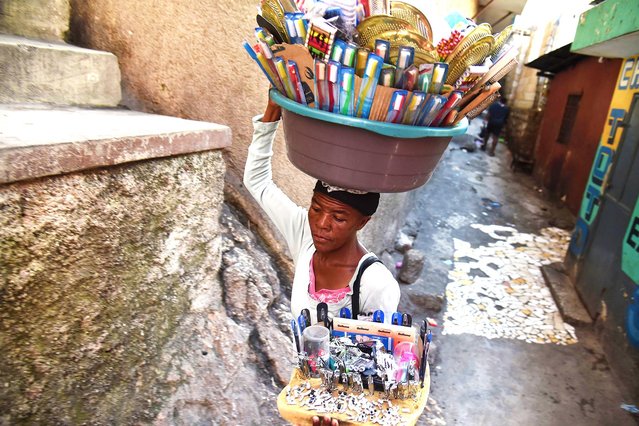
A vendor carries her products in a bucket on her head as she walks through the neighborhood of Jalousie, in the commune of Petion Ville, Port-au-Prince, on December 17, 2018. On the hills of Port-au-Prince, a chaotic jumble of structures stretches ever farther into the distance: Haiti's capital is suffering under the weight of high inflation, endemic corruption and a perilous drop in the value of its currency. Jalousie is a poor neighborhood of the capital which lacks sanitation and potable water. (Photo by Hector Retamal/AFP Photo)

A vendor carries her products in a bucket on her head as she walks through the neighborhood of Jalousie, in the commune of Petion Ville, Port-au-Prince, on December 17, 2018. On the hills of Port-au-Prince, a chaotic jumble of structures stretches ever farther into the distance: Haiti's capital is suffering under the weight of high inflation, endemic corruption and a perilous drop in the value of its currency. Jalousie is a poor neighborhood of the capital which lacks sanitation and potable water. (Photo by Hector Retamal/AFP Photo)
Details
30 Jan 2019 00:01:00
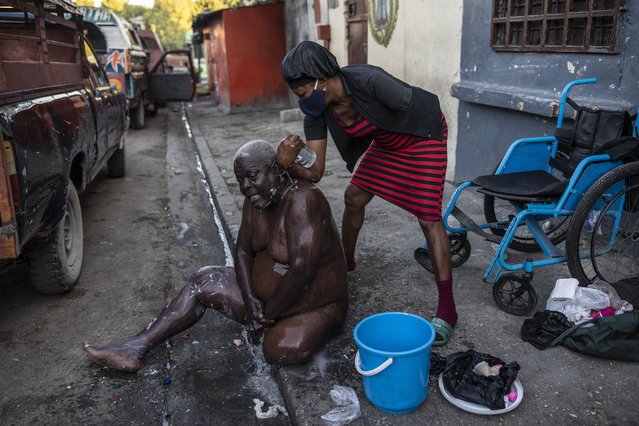
Marie Joseph bathes her friend Jean Robert outside a shelter for the internally displaced where they live due to police violence in Port-au-Prince, Haiti, Thursday, September 16, 2021. Most of the population of Port-au-Prince has no access to basic public services, no drinking water, electricity or garbage collection. (Photo by Rodrigo Abd/AP Photo)

Marie Joseph bathes her friend Jean Robert outside a shelter for the internally displaced where they live due to police violence in Port-au-Prince, Haiti, Thursday, September 16, 2021. Most of the population of Port-au-Prince has no access to basic public services, no drinking water, electricity or garbage collection. (Photo by Rodrigo Abd/AP Photo)
Details
26 Oct 2021 08:34:00
A reveller parades on stage at the annual Trinidad and Tobago Red Cross Society's Children's Carnival Competition at the Queen's Park Savannah in Port-Of-Spain February 7, 2015. (Photo by Andrea De Silva/Reuters)

A reveller parades on stage at the annual Trinidad and Tobago Red Cross Society's Children's Carnival Competition at the Queen's Park Savannah in Port-Of-Spain February 7, 2015. (Photo by Andrea De Silva/Reuters)
Details
09 Feb 2015 12:13:00
A Libyan fireman stands in front of smoke and flames rising from an oil storage tank at an oil facility in northern Libya's Ras Lanouf region on January 23, 2016, after it was set ablaze earlier in the week following attacks launched by Islamic State (IS) group jihadists to seize key port terminals. (Photo by AFP Photo/Stringer)

A Libyan fireman stands in front of smoke and flames rising from an oil storage tank at an oil facility in northern Libya's Ras Lanouf region on January 23, 2016, after it was set ablaze earlier in the week following attacks launched by Islamic State (IS) group jihadists to seize key port terminals. (Photo by AFP Photo/Stringer)
Details
25 Jan 2016 12:19:00