Loading...
Done
Racegoers react as they leave after the second day of the Grand National meeting at Aintree, northern England April 5, 2013. (Photo by Nigel Roddis/Reuters)

Racegoers react as they leave after the second day of the Grand National meeting at Aintree, northern England April 5, 2013. (Photo by Nigel Roddis/Reuters)

ATTENTION: VISUAL COVERAGE OF SCENES OF INJURY AND DEATH

P.S. All pictures are presented in high resolution. To see Hi-Res images – just TWICE click on any picture. In other words, click small picture – opens the BIG picture. Click BIG picture – opens VERY BIG picture (if available; this principle works anywhere on the site AvaxNews)
Details
06 Apr 2013 11:31:00
Tsuchiura National Fireworks Competition, Tsuchiura City, Ibaraki Prefecture. (Photo by Makoto Igari/Caters News Agency)

These kaleidoscopic images showcase the sheer beauty of the mammoth firework displays held across Japan every summer. The Japanese word for fireworks, hanabi, means fire flower, and each year, local governments in Japan throw around 7,000 festivals, or hanabi taikai. Here: Tsuchiura National Fireworks Competition, Tsuchiura City, Ibaraki Prefecture. (Photo by Makoto Igari/Caters News Agency)
Details
25 Sep 2018 00:01:00
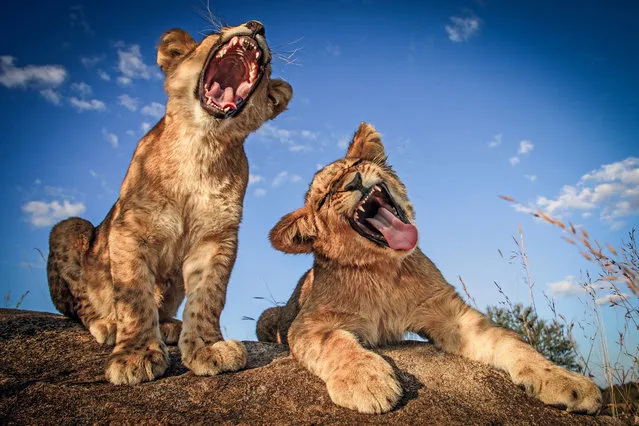
The two lion cubs singing their hearts out  at Antelope park in Zimbabwe. (Photo by David Jenkins/Caters News Agency)

They say a picture is worth a thousand words, and these striking images of 2017 are no exception. The photo highlights include incredible snapshots of the natural world as well as some awesome animal and human encounters. The vibrant gallery also shows thrill-seekers pushing themselves to the limit with breathtaking stunts captured in perfect clarity. The pictures have been taken by a host of photographers from around the world. Here: The two lion cubs singing their hearts out at Antelope park in Zimbabwe. (Photo by David Jenkins/Caters News Agency)
Details
03 Jan 2018 07:27:00
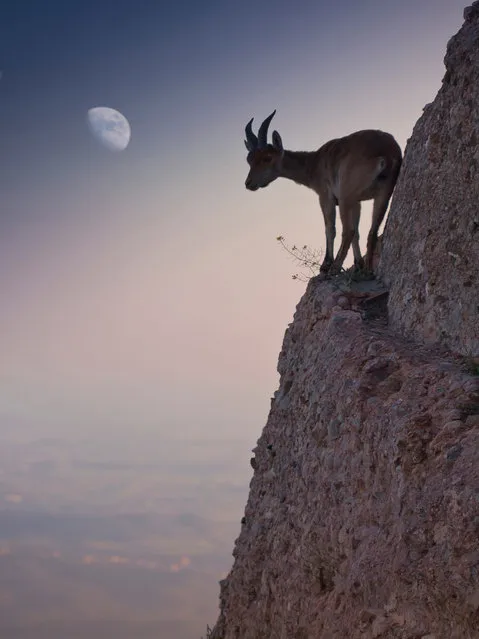
“For a bouquet of flowers”. Photographs made ​​in the last hours of the day. A goat is directed by a dangerous way to eat a small bouquet of flowers. Location: España, Barcelona, Montserrat. (Photo and caption by Renato Lopez Baldo/National Geographic Traveler Photo Contest)

“For a bouquet of flowers”. Photographs made ​​in the last hours of the day. A goat is directed by a dangerous way to eat a small bouquet of flowers. Location: España, Barcelona, Montserrat. (Photo and caption by Renato Lopez Baldo/National Geographic Traveler Photo Contest)

ATTENTION! All pictures are presented in high resolution. To see Hi-Res images – just TWICE click on any picture. In other words, click small picture – opens the BIG picture. Click BIG picture – opens VERY BIG picture.
Details
25 Jun 2013 12:51:00
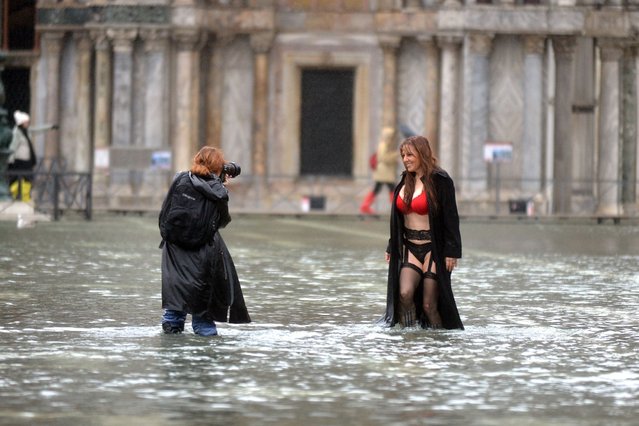
A woman poses on the flooded St. Mark's square during an acqua-alta (high-water) alert in Venice, on November 19, 2013. (Photo by Andrea Pattaro/AFP Photo)

A woman poses on the flooded St. Mark's square during an acqua-alta (high-water) alert in Venice, on November 19, 2013. (Photo by Andrea Pattaro/AFP Photo)

P.S. All pictures, as usual, are presented in high resolution. To see Hi-Res images – just TWICE click on any picture. In other words, click small picture – opens the BIG picture. Click BIG picture – opens VERY BIG picture (if available; this principle works anywhere on the site AvaxNews).
Details
23 Nov 2013 11:21:00
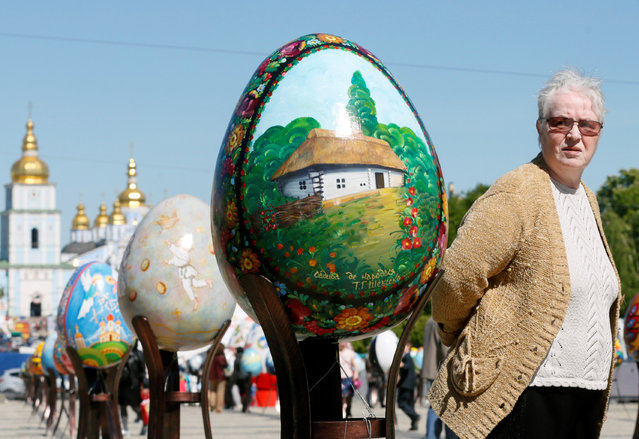
A woman looks at traditional Ukrainian Easter eggs “Pysanka”, installed as part of the upcoming celebrations of Easter, in central Kiev, Ukraine, April 29, 2016. A pysanka is a Ukrainian Easter egg, decorated with traditional Ukrainian folk designs using a wax-resist (batik) method. The word pysanka comes from the verb pysaty, “to write”, as the designs are not painted on, but written with beeswax. Many other eastern European ethnic groups decorate eggs using wax resist for Easter. These include the Belarusians, Bulgarians, Croats, Czechs, Hungarians, Lithuanians, Poles, Romanians, Serbs, Slovaks, Slovenes and Sorbs. (Photo by Valentyn Ogirenko/Reuters)

A woman looks at traditional Ukrainian Easter eggs “Pysanka”, installed as part of the upcoming celebrations of Easter, in central Kiev, Ukraine, April 29, 2016. A pysanka is a Ukrainian Easter egg, decorated with traditional Ukrainian folk designs using a wax-resist (batik) method. The word pysanka comes from the verb pysaty, “to write”, as the designs are not painted on, but written with beeswax. Many other eastern European ethnic groups decorate eggs using wax resist for Easter. These include the Belarusians, Bulgarians, Croats, Czechs, Hungarians, Lithuanians, Poles, Romanians, Serbs, Slovaks, Slovenes and Sorbs. (Photo by Valentyn Ogirenko/Reuters)
Details
30 Apr 2016 09:00:00


“Itasha (痛車), literally “painmobile”, is a Japanese term for an otaku fad of individuals decorating the bodies of their cars with fictional characters of anime, manga, or video games (especially bishōjo game or eroge). These characters are predominately “cute” female. The decorations usually involve paint schemes and stickers. Automobiles are called Itasha, while similar motorcycles and bicycles are called itansha (痛単車) and itachari (痛チャリ), respectively”. – Wikipedia


Photo: A visitor takes pictures of an anime-decorated «Itasha» car displayed during the “Moe Fes in Washimiya” at Washimiya Town Hall on July 18, 2009 in Washimiya, Saitama, Japan. Itasha, a word derived from “itai” (painful) and “sha” (car), are vehicles decorated with mostly female characters from Japanese manga, anime and video games. (Photo by Kiyoshi Ota/Getty Images)
Details
02 May 2011 08:38:00
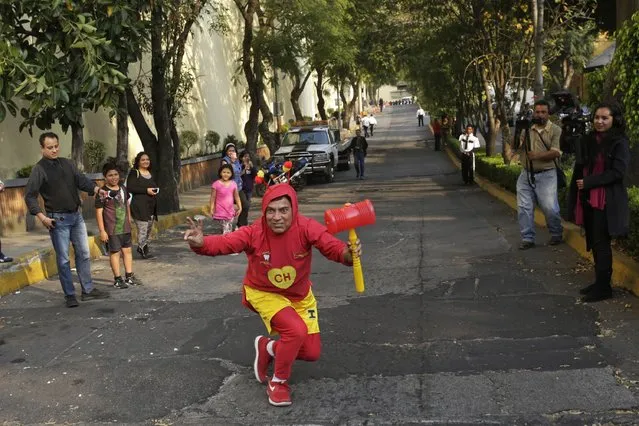
A man dressed as “El Chapulin Colorado”, a character by screenwriter Roberto Gomez Bolanos, performs for fans and media as they wait for the arrival of the funeral van carrying the body of Bolanos, at Mexican media company Televisa in Mexico City November 29, 2014. (Photo by Carlos Jasso/Reuters)

A man dressed as “El Chapulin Colorado”, a character by screenwriter Roberto Gomez Bolanos, performs for fans and media as they wait for the arrival of the funeral van carrying the body of Bolanos, at Mexican media company Televisa in Mexico City November 29, 2014. Mexican actor and screenwriter Roberto Gomez Bolanos, one of Latin America's most beloved comedians, whose slapstick acts charmed fans from Spain to Argentina for over four decades, died on Friday at the age 85. Known as “Chespirito”, a word play on “Little Shakespeare” for his diminutive stature and his prolific scripts, Gomez Bolanos created some of the region's most enduring comic characters. (Photo by Carlos Jasso/Reuters)
Details
01 Dec 2014 13:50:00