Loading...
Done
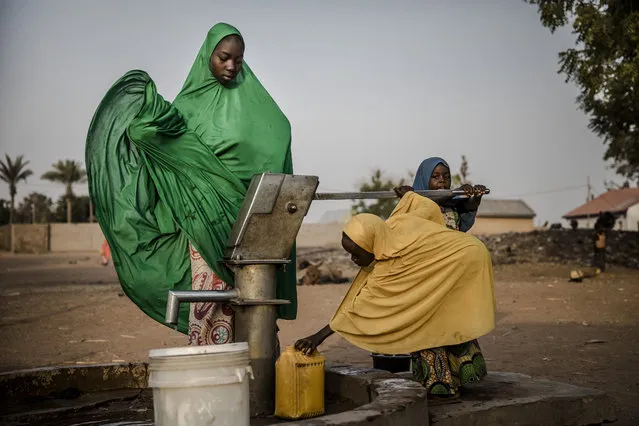
Camp dwellers pump water from a well at Malkohi refugee camp in Jimeta, Adamawa State, Nigeria on February 19, 2019, four days ahead of the country's General elections set for February 23 after a last-minute rescheduling. Malkohi is a camp for internal displaced who fled their homes as Boko Haram insurgents advanced across north-eastern Nigeria. From their homes on the outskirts of Yola, capital of presidential candidate Atiku Abubakar's home state Adamawa, Malkohi residents say they feel forgotten. (Photo by Luis Tato/AFP Photo)

Camp dwellers pump water from a well at Malkohi refugee camp in Jimeta, Adamawa State, Nigeria on February 19, 2019, four days ahead of the country's General elections set for February 23 after a last-minute rescheduling. Malkohi is a camp for internal displaced who fled their homes as Boko Haram insurgents advanced across north-eastern Nigeria. From their homes on the outskirts of Yola, capital of presidential candidate Atiku Abubakar's home state Adamawa, Malkohi residents say they feel forgotten. (Photo by Luis Tato/AFP Photo)
Details
02 Mar 2019 00:05:00
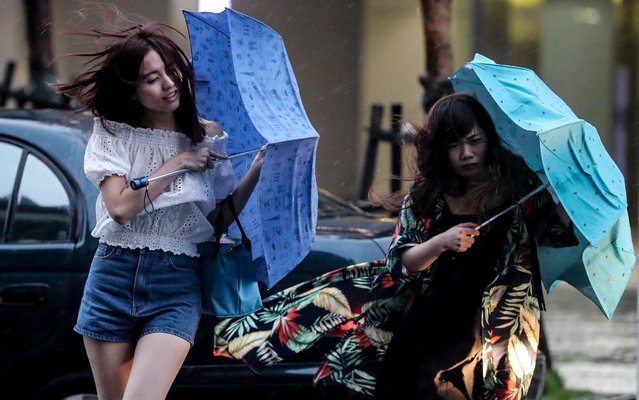
People struggle with the wind as they cross the street under the rain as typhoon Mitag is expected to hit northern Taiwan, in Keelung, Taiwan, 30 September 2019. According to report, Typhoon Mitag will disrupt air, land and water traffic. Mitag is located at sea about 290 kilometers off the south-southeast of Yilan County, moving at 27 kilometers per hour at a northwesterly direction, with maximum sustained winds of 126 kilometers per hour, with gusts of up to 162 kilometers per hour, and with a radius of 180 kilometers, according to Taiwan Central Weather Bureau. (Photo by Ritchie B. Tongo/EPA/EFE/Rex Features/Shutterstock)

People struggle with the wind as they cross the street under the rain as typhoon Mitag is expected to hit northern Taiwan, in Keelung, Taiwan, 30 September 2019. According to report, Typhoon Mitag will disrupt air, land and water traffic. Mitag is located at sea about 290 kilometers off the south-southeast of Yilan County, moving at 27 kilometers per hour at a northwesterly direction, with maximum sustained winds of 126 kilometers per hour, with gusts of up to 162 kilometers per hour, and with a radius of 180 kilometers, according to Taiwan Central Weather Bureau. (Photo by Ritchie B. Tongo/EPA/EFE/Rex Features/Shutterstock)
Details
02 Oct 2019 00:05:00
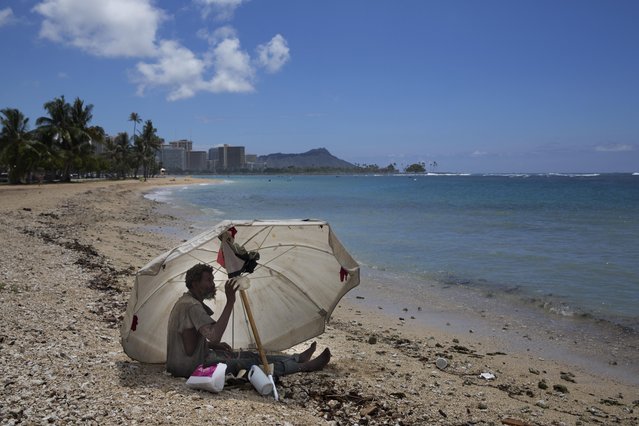
In this Thursday, August 27, 2015 photo, a homeless man drinks water while sitting on the beach at Ala Moana Beach Park located near Waikiki in Honolulu. Homelessness in Hawaii has grown steadily in recent years, leaving the state with the nation's highest rate of homeless people per capita. (Photo by Jae C. Hong/AP Photo)

Hawaii has long been known as a tropical paradise, but in recent years another image has intruded into the state's carefully crafted one of idyllic beaches and relaxing resorts: homelessness. The number of homeless people has grown in recent years, leaving the state with 487 homeless per 100,000 people, the nation's highest rate per capita, above New York and Nevada, according to federal statistics. Many of the homeless, however, defy the stereotype of the mentally ill or drug addicted. They are families, with men and women who work full-time jobs. They are struggling to get a foothold in a place with a high cost of living and low wages. Here: in this Thursday, August 27, 2015 photo, a homeless man drinks water while sitting on the beach at Ala Moana Beach Park located near Waikiki in Honolulu. (Photo by Jae C. Hong/AP Photo)
Details
11 Nov 2015 08:03:00
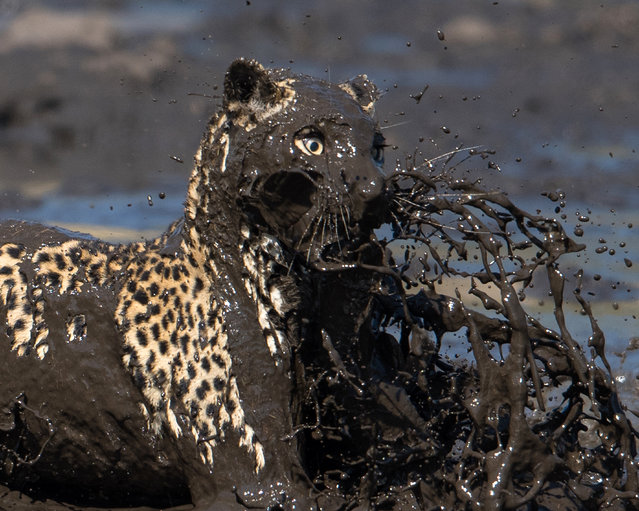
A leopard leaps into a muddy waterhole to catch a fish on August 13, 2015, in the Savuti Channel in Botswana. A leopard leaps into a muddy waterhole to catch a fish in the Savuti Channel in Botswana. The spotted predator stood poised waiting for a fish to appear – before leaping in ferociously with lightening reflexes. (Photo by Greatstock/Barcroft Media)

A leopard leaps into a muddy waterhole to catch a fish on August 13, 2015, in the Savuti Channel in Botswana. A leopard leaps into a muddy waterhole to catch a fish in the Savuti Channel in Botswana. The spotted predator stood poised waiting for a fish to appear – before leaping in ferociously with lightening reflexes. Coated in a layer of thick dark mud the big cat emerged from the water clutching the fish in its jaws. The fishing leopards of Savuti are known for their unique skills in catching fish – but have rarely been photographed. (Photo by Greatstock/Barcroft Media)
Details
06 Sep 2015 13:00:00
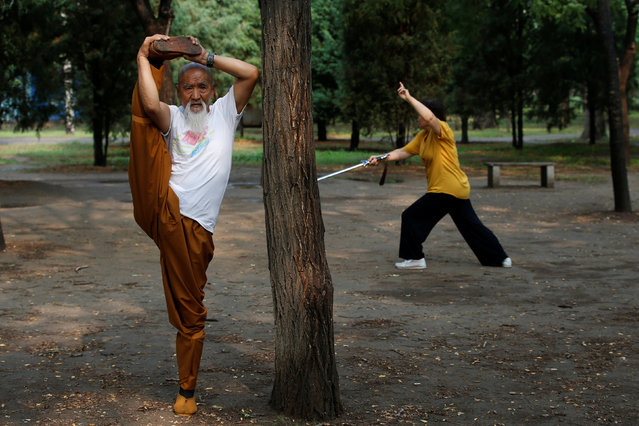
Kung Fu master Li Liangui practices 'Suogugong' Kung Fu and his wife Liang Xiaoyan (R) practices Qigong at a park in Beijing, China, June 30, 2016. (Photo by Kim Kyung-Hoon/Reuters)

Kung Fu master Li Liangui practices “Suogugong” Kung Fu and his wife Liang Xiaoyan (R) practices Qigong at a park in Beijing, China, June 30, 2016. For 50 years, kung fu master Li Liangui has been contorting his body into eye-watering positions while practising one of the more unusual and less popular Chinese martial art forms. The 70-year-old is an expert in suogugong, or body shrinking kung fu, where practitioners dislocate their bones to help them achieve unlikely positions and feats. (Photo by Kim Kyung-Hoon/Reuters)
Details
17 Sep 2016 10:27:00
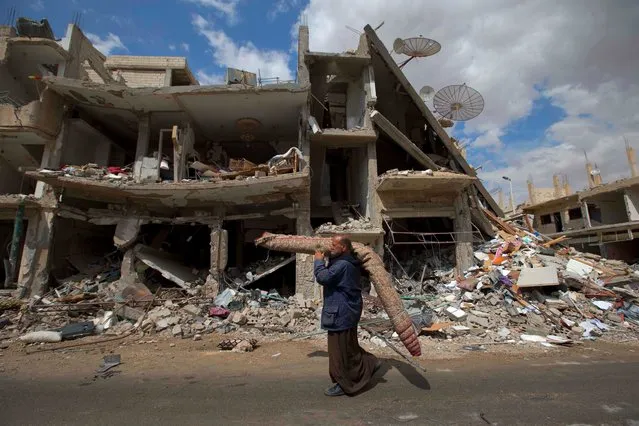
In this picture taken Thursday, April 14, 2016, a Syrian man carries a carpet as walk through a devastated part of the town of Palmyra as families load their belongings onto a bus in the central Homs province, Syria. (Photo by Hassan Ammar/AP Photo)

In this picture taken Thursday, April 14, 2016, a Syrian man carries a carpet as walk through a devastated part of the town of Palmyra as families load their belongings onto a bus in the central Homs province, Syria. Thousands of residents of this ancient town who fled Islamic State rule are returning briefly to check on their homes and salvage what they can – some carpets, blankets, a fridge or a few family mementos. There is no water or electricity in the town, and it will be at least few months before anyone can return to stay. (Photo by Hassan Ammar/AP Photo)
Details
16 Apr 2016 12:27:00
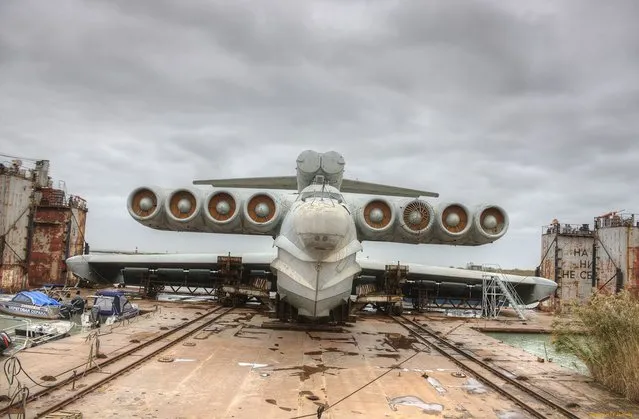
The Lun-class Ekranoplane was used by the Soviet Navy starting in 1987, and wasn't retired until the late 1990s, after the Soviet Union's fall. (Igor113)

“The Lun-class ekranoplan (NATO reporting name Duck) was a ground effect vehicle (GEV) designed by Rostislav Evgenievich Alexeev and used by the Soviet and Russian navies from 1987 until sometime in the late 1990s. It “flew” using the lift generated by the ground effect of its large wings when close to the surface of the water – about four metres or less. Although they might look similar and/or have related technical characteristics, ekranoplans like the Lun are not aircraft, seaplanes, hovercraft, or hydrofoils – ground effect is a separate technology altogether. The International Maritime Organization classifies these vehicles as maritime ships. The name Lun comes from the Russian for harrier”. – Wikipedia (Photo by Igor113)
Details
08 Aug 2014 10:51:00
Longsheng Rice Terraces

The Longsheng Rice Terraces are located in Longsheng County, about 100 km (2 hours drive) from Guilin, Guangxi, China. The most popular are Ping An Rice Terrace and Jinkeng Rice Terrace. The terraced fields are built along the slope winding from the riverside up to the mountain top, the highest part being 880 m in elevation while the lowest part is 380 m[citation needed]. The coiling line that starts from the mountain foot up to the mountain top divides the mountain into layers of water glittering in the sun in spring, layers of green rice shoots in summer, layers of golden rice in fall, and layers of silvery frost in winter. The terraced fields were mostly built during the Ming Dynasty, about 500 years ago.
Details
18 Oct 2013 12:45:00