Loading...
Done
Its main predators are the birds of prey and the leopard. The Giant Squirrel is mostly active in the early hours of the morning and in the evening, resting in the midday. They are typically solitary animals that only come together for breeding. (Photo by Kaushik Vijayan/South West News Service)

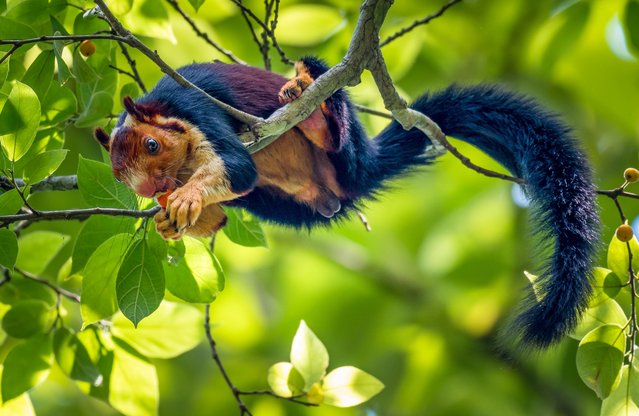
The Malabar Giant squirrel – double the size of their grey relatives and measuring up to 36 inches (91.5 cm) from head to tail – lives deep in the forests of India. The athletic animals can leap an incredible 20 feet (6 m) between trees. Photographer Kaushik Vijayan, 39, snapped the animals in their native habit to produce these stunning images. Kaushik, from Kerala State, India, said: “Up until that point I had never heard about a squirrel like that or seen one. The sight was an absolute feast for my eyes. The squirrels fascinated me and I got excited to capture this beauty on my camera”. (Photo by Kaushik Vijayan/South West News Service)
Details
04 Apr 2019 00:03:00
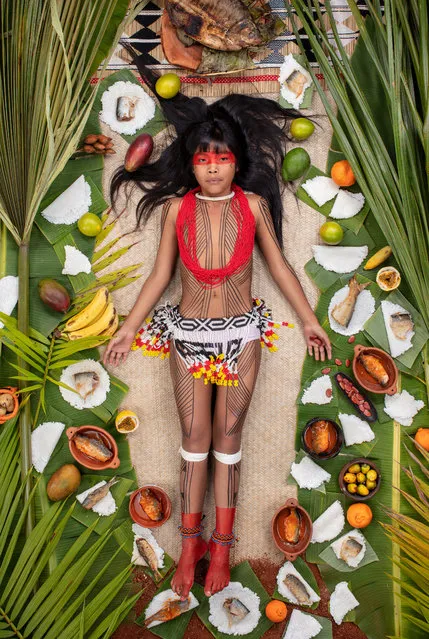
Kawakanih Yawalapiti, 9, Upper Xingu region of Mato Grosso, Brazil, 2018: Kawakanih lives with her tribe, the Yawalapiti, in Xingu national park, a preserve in the Amazon basin of Brazil. The Yawalapiti collect seeds to preserve species unique to their ecosystem, which lies between the rain forest and savannah. Kawakanih’s diet is simple, consisting mainly of fish, cassava, porridge, fruit and nuts. “It takes five minutes to catch dinner”, says Kawakanih. “When you’re hungry, you just go to the river with your net”. (Photo by Gregg Segal/The Guardian)

Photographer Gregg Segal travelled the world to document children and the food they eat in a week. Partly inspired by the increasing problems of childhood obesity, he tracked traditional regional diets as yet unaffected by globalisation, and ironically, found that the healthiest diets were often eaten by the least well off. (Photo by Gregg Segal/The Guardian)
Details
03 Jul 2019 00:03:00
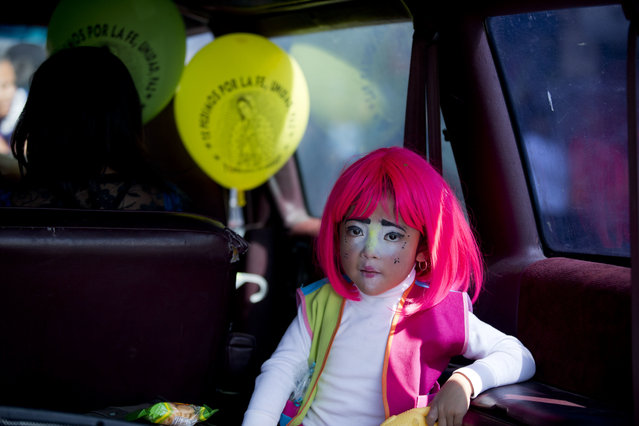
In this December 14, 2015, file photo, a young clown rides in the back of a car following a procession to the Basilica of Our Lady of Guadalupe in Mexico City. Hundreds belonging to various clown associations made their annual pilgrimage to the Basilica to pay their respects to the Virgin of Guadalupe, Mexico's patron saint. (Photo by Rebecca Blackwell/AP Photo)

As the world marks the International Day of the Girl Child, women's rights activists point to progress on a wide array of issues but say more needs to be done to protect girls from child marriage, sexual assault and other forms of exploitation. Here is a selection of pictures showing the daily lives of girls across the globe, all taken by female Associated Press photojournalists. Here: In this December 14, 2015, file photo, a young clown rides in the back of a car following a procession to the Basilica of Our Lady of Guadalupe in Mexico City. Hundreds belonging to various clown associations made their annual pilgrimage to the Basilica to pay their respects to the Virgin of Guadalupe, Mexico's patron saint. (Photo by Rebecca Blackwell/AP Photo)
Details
19 Oct 2018 00:03:00
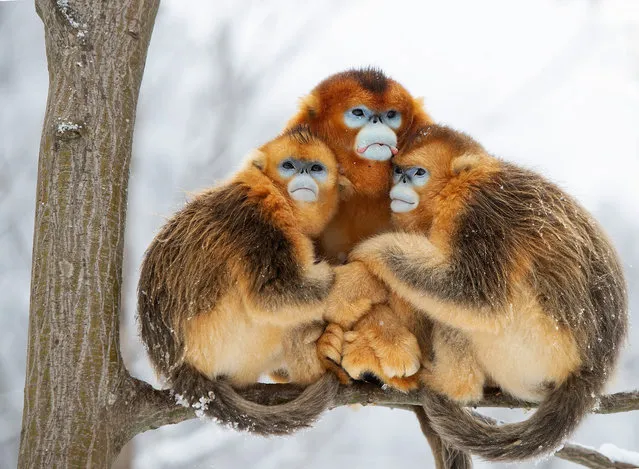
A golden huddle by Minqiang Lu, China. Two females and a male golden snub-nosed monkey huddle together to keep warm in the extreme cold. Threatened by forest loss and fragmentation, this endangered species is confined to central China. Restricted to living high up in the temperate forests, these monkeys – here in the Qinling mountains in Shaanxi province – feed mostly in the trees, on leaves, bark, buds and lichen. In heavy wind and snow, Minqiang walked up the mountain carrying his equipment. He stayed for half an hour in temperatures of –10C opposite the tree where the group was huddled before achieving this eye-level composition. (Photo by Minqiang Lu/Wildlife Photographer of the Year)

A golden huddle by Minqiang Lu, China. Two females and a male golden snub-nosed monkey huddle together to keep warm in the extreme cold. Threatened by forest loss and fragmentation, this endangered species is confined to central China. Restricted to living high up in the temperate forests, these monkeys – here in the Qinling mountains in Shaanxi province – feed mostly in the trees, on leaves, bark, buds and lichen. In heavy wind and snow, Minqiang walked up the mountain carrying his equipment. He stayed for half an hour in temperatures of –10C opposite the tree where the group was huddled before achieving this eye-level composition. (Photo by Minqiang Lu/Wildlife Photographer of the Year)
Details
12 Jan 2023 01:19:00
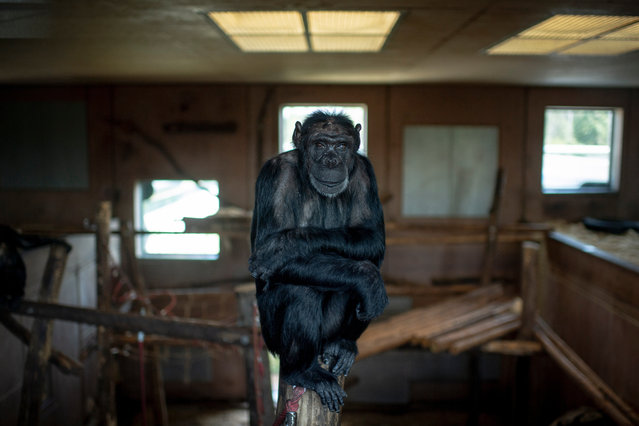
A chimpanzee looks in the direction of a camera at the Gut Aiderbichl Sanctuary for Traumatized Chimpanzees and other Primates in Gaenserndorf, near Vienna, 17 September 2018. 34 former laboratory chimpanzees of former Austrian pharmaceutical company Immuno AG spend their lives at the Gut Aiderbichl Sanctuary for Traumatized Chimpanzees and other Primates since 2009. U.S.-based Baxter International Inc. took over the Immuno AG in 1996, banned experiments with primates and rebuilt a former safari park for the Gut Aiderbichl Sanctuary for Traumatized Chimpanzees and other Primates. After three decades in captivity in too small cages, the chimpanzees, most of them came from Sierra Leone as cubs, have species-appropriate indoor and outdoor enclosures. The financial support by Baxter International Inc. and Austrian officials will end by 2019. (Photo by Christian Bruna/EPA/EFE)

A chimpanzee looks in the direction of a camera at the Gut Aiderbichl Sanctuary for Traumatized Chimpanzees and other Primates in Gaenserndorf, near Vienna, 17 September 2018. 34 former laboratory chimpanzees of former Austrian pharmaceutical company Immuno AG spend their lives at the Gut Aiderbichl Sanctuary for Traumatized Chimpanzees and other Primates since 2009. (Photo by Christian Bruna/EPA/EFE)
Details
23 Sep 2018 00:03:00
Iranian athlete Maryam Toosi practises on the rooftop of her apartment building following  the closure of sports facilities as part of measures aimed at containing the COVID-19 coronavirus, in Iran's capital Tehran on May 19, 2020. The coronavirus pandemic has forced the world's athletes to keep fit in confinement. The novel coronavirus has claimed the lives of nearly 7,200 people in Iran, making it the deadliest outbreak in the Middle East. The government ordered the closure of sports facilities in mid-March as part of measures aimed at containing the virus. (Photo by Atta Kenare/AFP Photo)

Iranian athlete Maryam Toosi practises on the rooftop of her apartment building following the closure of sports facilities as part of measures aimed at containing the COVID-19 coronavirus, in Iran's capital Tehran on May 19, 2020. The coronavirus pandemic has forced the world's athletes to keep fit in confinement. The novel coronavirus has claimed the lives of nearly 7,200 people in Iran, making it the deadliest outbreak in the Middle East. The government ordered the closure of sports facilities in mid-March as part of measures aimed at containing the virus. (Photo by Atta Kenare/AFP Photo)
Details
29 Jul 2020 00:01:00
Environmental activist Rob Greenfield walks around Beverly Hills, California on May 16, 2022 wearing a suit filled with every piece of trash he has generated living and consuming like a typical American for one month to raise awareness about how much garbage just one person generates. Greenfield is currently on day 27 of the 30-day project and is wearing 63 lbs (28,5kg) of trash. We all know someone with a rubbish fashion sense, but Rob Greenfield is proud to be wearing garbage – it's all part of a plan to show just how much trash we unthinkingly throw away every month. The campaigner is wandering the streets of Los Angeles and surrounding cities in a specially designed suit that holds all of the junk he has produced over the last few weeks. (Photo by Robyn Beck/AFP Photo)

Environmental activist Rob Greenfield walks around Beverly Hills, California on May 16, 2022 wearing a suit filled with every piece of trash he has generated living and consuming like a typical American for one month to raise awareness about how much garbage just one person generates. (Photo by Robyn Beck/AFP Photo)
Details
25 May 2022 05:06:00
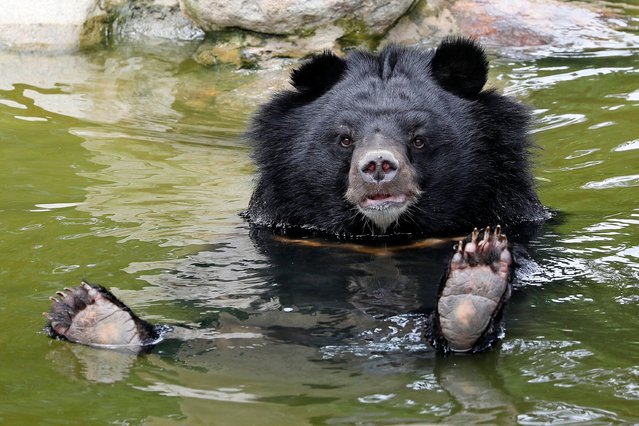
A moon bear rests in a pool inside an enclosure at the Vietnam bear rescue centre, in Tam Dao national park, Vinh Phuc, Vietnam, 09 July 2019. The center is operated by international organization Animals Asia. There are currently 184 bears living at the the Vietnam Bear Rescue Centre. It is estimated that there are less than a few hundred bears left in the wild in Vietnam. According to the latest data from the Ministry of Agriculture and Rural development, around 600 bears are still being kept on farms. In Vietnam, Animals Asia has rescued a total of 209 sun bears and moon bears. (Photo by Minh Hoang/EPA/EFE/Rex Features/Shutterstock)

A moon bear rests in a pool inside an enclosure at the Vietnam bear rescue centre, in Tam Dao national park, Vinh Phuc, Vietnam, 09 July 2019. The center is operated by international organization Animals Asia. There are currently 184 bears living at the the Vietnam Bear Rescue Centre. It is estimated that there are less than a few hundred bears left in the wild in Vietnam. According to the latest data from the Ministry of Agriculture and Rural development, around 600 bears are still being kept on farms. In Vietnam, Animals Asia has rescued a total of 209 sun bears and moon bears. (Photo by Minh Hoang/EPA/EFE/Rex Features/Shutterstock)
Details
14 Jul 2019 00:05:00