Loading...
Done
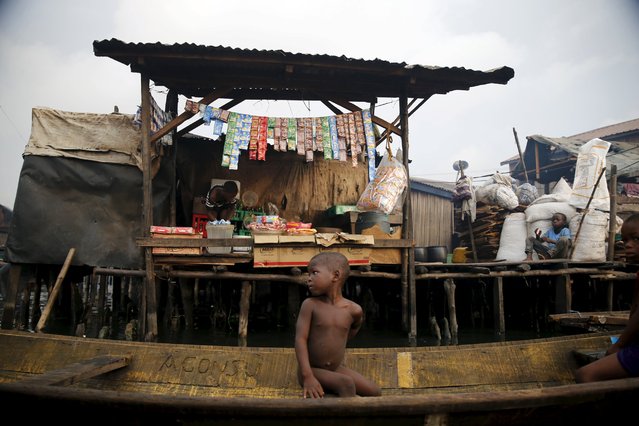
A boy sits in a canoe in front of a shed built on a raft in the Makoko fishing community on the Lagos Lagoon, Nigeria February 29, 2016. Makoko, a vast slum of houses on stilts in a Lagos lagoon, now boasts a new school – pyramid-shaped, floating and capable of withstanding the waterways' extreme weather, it is a beacon of hope for the nearly 100,000 Nigerians who live there.  (Photo by Akintunde Akinleye/Reuters)

A boy sits in a canoe in front of a shed built on a raft in the Makoko fishing community on the Lagos Lagoon, Nigeria February 29, 2016. In Makoko, a sprawling slum of Nigeria's megacity Lagos, a floating school capable of holding up to a hundred pupils has since November brought free education to the waterways known as the Venice of Lagos. It offers the chance of social mobility for youngsters who, like most of the city's 21 million inhabitants, lack a reliable electricity and water supply and whose water-based way of life is threatened by climate change as well as rapid urbanisation. (Photo by Akintunde Akinleye/Reuters)
Details
05 Mar 2016 12:01:00
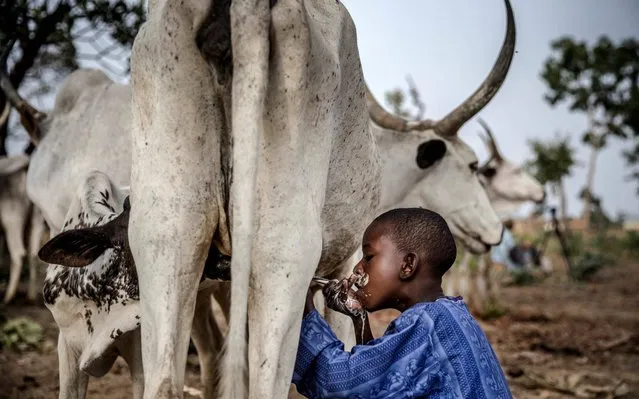
8-year-old Fulani boy Suleiman Yusuf drinks milk from a cow belonging to his father cattle near his family's house at Kachia Grazing Reserve, Kaduna State, Nigeria, on April 16, 2019. Kachia Grazing Reserve is an area set aside for the use of Fulani pastoralist and it is intended to be the foci of livestock development. The purpose for the grazing reserves is the settlement of nomadic pastoralists and inducement to sedentarisation through the provision of land for grazing and permanent water as way to avoid conflict. (Photo by Luis Tato/AFP Photo)

8-year-old Fulani boy Suleiman Yusuf drinks milk from a cow belonging to his father cattle near his family's house at Kachia Grazing Reserve, Kaduna State, Nigeria, on April 16, 2019. Kachia Grazing Reserve is an area set aside for the use of Fulani pastoralist and it is intended to be the foci of livestock development. The purpose for the grazing reserves is the settlement of nomadic pastoralists and inducement to sedentarisation through the provision of land for grazing and permanent water as way to avoid conflict. (Photo by Luis Tato/AFP Photo)
Details
10 Jul 2019 00:01:00
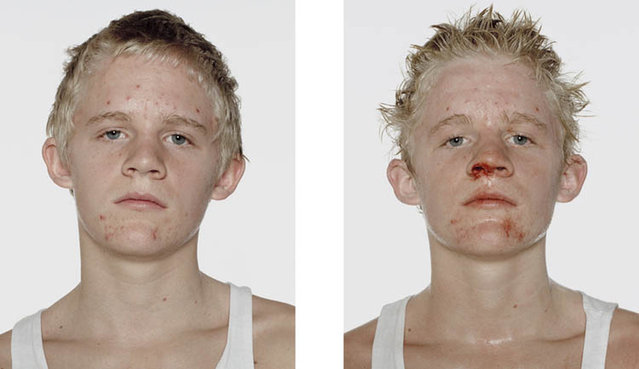
Portraits Of Boxers, Before And After By Nicolai Howalt

141 boxers’ by Danish visual artist and photographer Nicolai Howalt is a series of diptychs portraying boxers before and after their fight. Ranging from young boys to women, the collection of images delineates not only the brutal aftermath of a match but the more subtle changes in the subject’s physiology due to adrenaline, struggle, and the complex emotions that come with victory and loss.
Details
11 Jun 2014 13:26:00
Cristian Girotto – Adults As Children

Without bothering Jung and its "Puer aeternus" or Pascoli with its "Little Boy", we can certainly agree that, somewhere inside each of us, there's a young core, instinctive, creative but also innocent and naïve. What would happen if this intimate essence would be completely revealed?
Details
02 Dec 2012 10:56:00
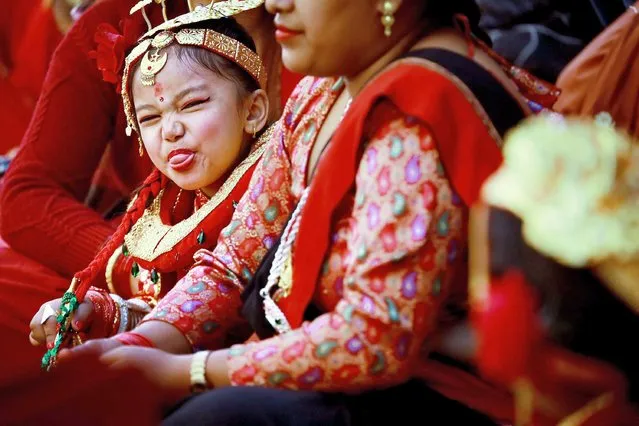
Girl in newari attire makes a funny face to her friend as she performs a Mass Bel Bibaha (marriage) ceremony in Bhaktapur, Bagmati, Nepal on December 7, 2021. The two-day ceremony, usually held several times a year, sees pre-adolescent “marry” the Hindu deity, Vishnu, symbolised by the local “bael” (wood apple) fruit. Normally Newar girls marry thrice time in there life as first marriage with Bael fruit, second with sun and third with human. (Photo by Amit Machamasi/ZUMA Wire/Alamy Live News)

Girl in newari attire makes a funny face to her friend as she performs a Mass Bel Bibaha (marriage) ceremony in Bhaktapur, Bagmati, Nepal on December 7, 2021. The two-day ceremony, usually held several times a year, sees pre-adolescent “marry” the Hindu deity, Vishnu, symbolised by the local “bael” (wood apple) fruit. Normally Newar girls marry thrice time in there life as first marriage with Bael fruit, second with sun and third with human. (Photo by Amit Machamasi/ZUMA Wire/Alamy Live News)
Details
05 Jan 2022 07:49:00
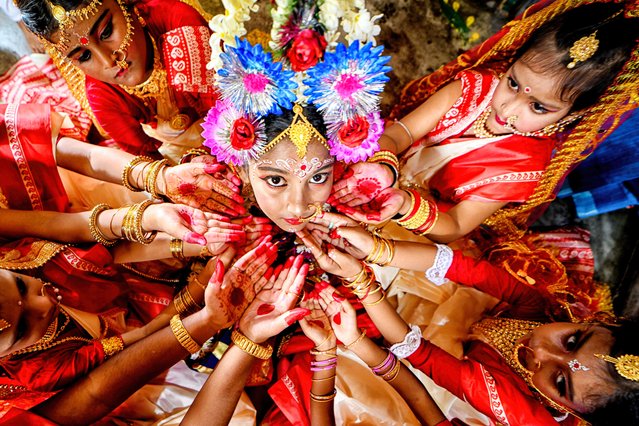
Young girls pose for a photo during the Kumari Puja Ritual on the 9th day of the Durga puja festival at a Pandal (Temporary place for worship) in Kolkata on October 4, 2022. Kumari Puja is an Indian Hindu Tradition mainly celebrated during the Durga Puja according to the Hindu Calendar. The philosophical basis of Kumari Puja is to establish the value of women. Devotees believe it will overcome all barriers, dangers for the young girls in the coming future and also, they will be empowered to handle any stress and obstruction in their coming life. (Photo by Avishek Das/SOPA Images/Rex Features/Shutterstock)

Young girls pose for a photo during the Kumari Puja Ritual on the 9th day of the Durga puja festival at a Pandal (Temporary place for worship) in Kolkata on October 4, 2022. Kumari Puja is an Indian Hindu Tradition mainly celebrated during the Durga Puja according to the Hindu Calendar. The philosophical basis of Kumari Puja is to establish the value of women. Devotees believe it will overcome all barriers, dangers for the young girls in the coming future and also, they will be empowered to handle any stress and obstruction in their coming life. (Photo by Avishek Das/SOPA Images/Rex Features/Shutterstock)
Details
13 Oct 2022 04:25:00
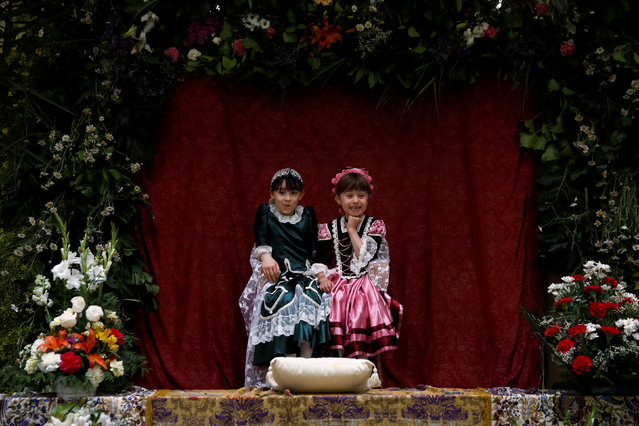
“Maya” girl Ines de la Paloma, 9, (L), sits with her friend Nuria Sanchez Caballero, 6, at an altar during “Las Mayas” festivity in Madrid, Spain, May 8, 2016. “Las Mayas” festival is held annually at the beginning of May to celebrate the awakening of nature in Spring. Young girls are chosen to become “Mayas” and sit at altars decorated with flowers so that people can admire them. The “Mayas” are dressed in traditional costumes, often displaying shawls and a wreath of flowers on their heads. (Photo by Susana Vera/Reuters)

“Maya” girl Ines de la Paloma, 9, (L), sits with her friend Nuria Sanchez Caballero, 6, at an altar during “Las Mayas” festivity in Madrid, Spain, May 8, 2016. “Las Mayas” festival is held annually at the beginning of May to celebrate the awakening of nature in Spring. Young girls are chosen to become “Mayas” and sit at altars decorated with flowers so that people can admire them. (Photo by Susana Vera/Reuters)
Details
11 May 2016 11:36:00
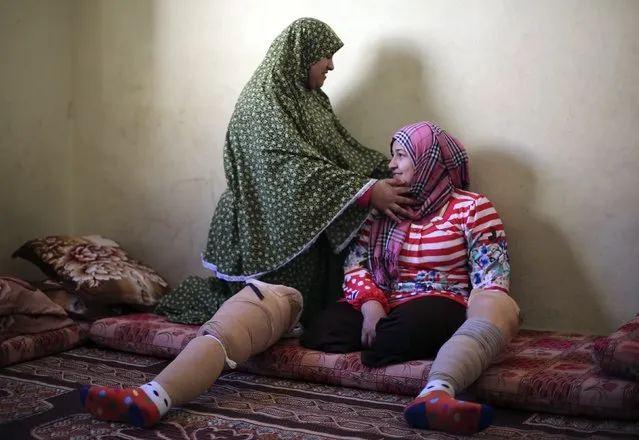
Palestinian girl Manar Al-Shinbari (R), 15, who lost her both legs by what medics said was Israeli shelling at a UN-run school where she was taking refuge during the 50-day war last summer, is helped by her sister to put on her headscarf in an apartment in Jabaliya refugee camp in the northern Gaza Strip January 13, 2015. (Photo by Mohammed Salem/Reuters)

Palestinian girl Manar Al-Shinbari (R), 15, who lost her both legs by what medics said was Israeli shelling at a UN-run school where she was taking refuge during the 50-day war last summer, is helped by her sister to put on her headscarf in an apartment in Jabaliya refugee camp in the northern Gaza Strip January 13, 2015. Manar's mother and three of her brothers were killed in the same incident. The girl's family house was destroyed by Israeli shelling during the war. (Photo by Mohammed Salem/Reuters)
Details
14 Jan 2015 12:34:00