Loading...
Done
21 year-old Chanel Tapper, with the amazing tongue and 35 year-old Aevin Dugas, with the beautiful hair was certified as world record breakers for the world’s longest tongue and the world’s biggest afro in the Guinness Book of World Records. (Photo by Guinness World Records)

21 year-old Chanel Tapper, with the amazing tongue and 35 year-old Aevin Dugas, with the beautiful hair was certified as world record breakers for the world’s longest tongue and the world’s biggest afro in the Guinness Book of World Records. (Photo by Guinness World Records)
Details
10 Jan 2013 14:45:00
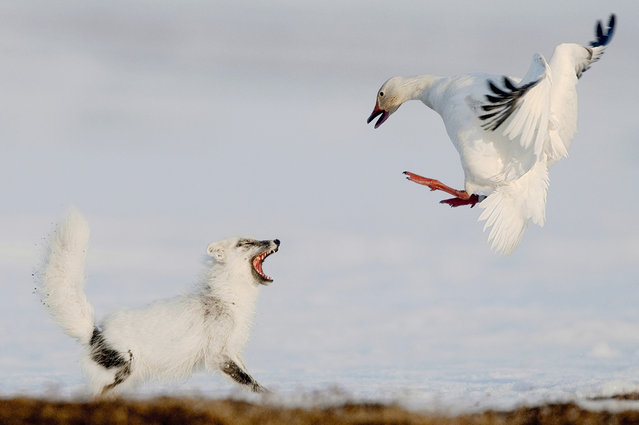
Commended. In late May, about a quarter of a million snow geese arrive from North America to nest on Wrangel Island, in northeastern Russia. They form the world's largest breeding colony of snow geese. Photographer Sergey Gorshkov spent two months on the remote island photographing the unfolding dramas. (Photo by Sergey Gorshkov/Veolia Environnement Wildlife Photographer)

Commended. In late May, about a quarter of a million snow geese arrive from North America to nest on Wrangel Island, in northeastern Russia. They form the world's largest breeding colony of snow geese. Photographer Sergey Gorshkov spent two months on the remote island photographing the unfolding dramas. Arctic foxes take advantage of the abundance of eggs, caching surplus eggs for leaner times. But a goose (here the gander) is easily a match for a fox, which must rely on speed and guile to steal eggs. “The battles were fairly equal”, notes Sergey, “and I only saw a fox succeed in grabbing an egg on a couple of occasions, despite many attempts”. Surprisingly, “the geese lacked any sense of community spirit”, he adds, “and never reacted when a fox harassed a neighboring pair nesting close by”. (Photo by Sergey Gorshkov/Veolia Environnement Wildlife Photographer)

Details
16 Jun 2015 12:30:00
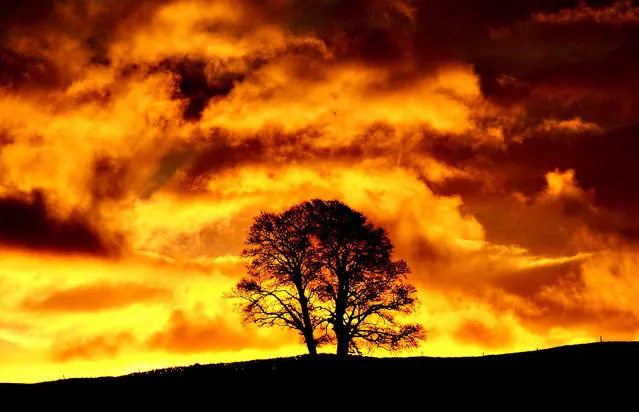
A general view of the sunrise over Hawes, Wensleydale, UK on November 24, 2014. (Photo by Neil Squires/PA Wire)

A general view of the sunrise over Hawes, Wensleydale, UK on November 24, 2014. (Photo by Neil Squires/PA Wire)
Details
11 Dec 2014 13:50:00
This artist image released from Japan's airline All Nippon Airways (ANA) on April 17, 2015 shows ANA's Boeing 787-9 aircraft into the colors of R2-D2 robot of Star Wars. Japanese air carrier ANA will place the special colored jetliner in service in this autumn. (Photo by AFP Photo/All Nippon Airways)

This artist image released from Japan's airline All Nippon Airways (ANA) on April 17, 2015 shows ANA's Boeing 787-9 aircraft into the colors of R2-D2 robot of Star Wars. Japanese air carrier ANA will place the special colored jetliner in service in this autumn. (Photo by AFP Photo/All Nippon Airways)
Details
18 Apr 2015 10:24:00
Pedestrians look at “doll” model Lulu Hashimoto standing on the street during a photo opportunity for Reuters in Tokyo, Japan August 23, 2017. (Photo by Kim Kyung-Hoon/Reuters)

Pedestrians look at “doll” model Lulu Hashimoto standing on the street during a photo opportunity for Reuters in Tokyo, Japan August 23, 2017. (Photo by Kim Kyung-Hoon/Reuters)
Details
25 Aug 2017 08:27:00
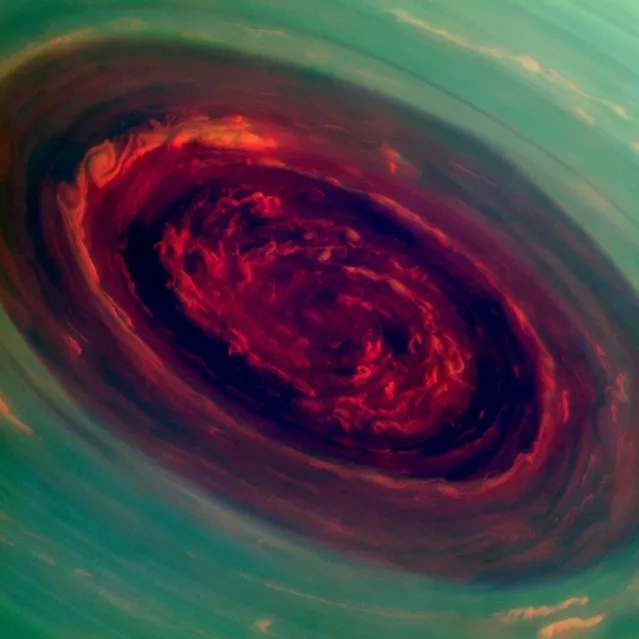
The spinning vortex of Saturn's north polar storm resembles a deep red rose of giant proportions surrounded by green foliage in this false-color image from NASA's Cassini spacecraft. (Photo by NASA/JPL-Caltech/SSI)

NASA's Cassini spacecraft has provided scientists the first close-up, visible-light views of a behemoth hurricane swirling around Saturn's north pole. In high-resolution pictures and video, scientists see the hurricane's eye is about 1,250 miles (2,000 kilometers) wide, 20 times larger than the average hurricane eye on Earth. Thin, bright clouds at the outer edge of the hurricane are traveling 330 mph(150 meters per second). The hurricane swirls inside a large, mysterious, six-sided weather pattern known as the hexagon. Photo: The spinning vortex of Saturn's north polar storm resembles a deep red rose of giant proportions surrounded by green foliage in this false-color image from NASA's Cassini spacecraft. (Photo by NASA/JPL-Caltech/SSI)
Details
31 May 2015 09:11:00
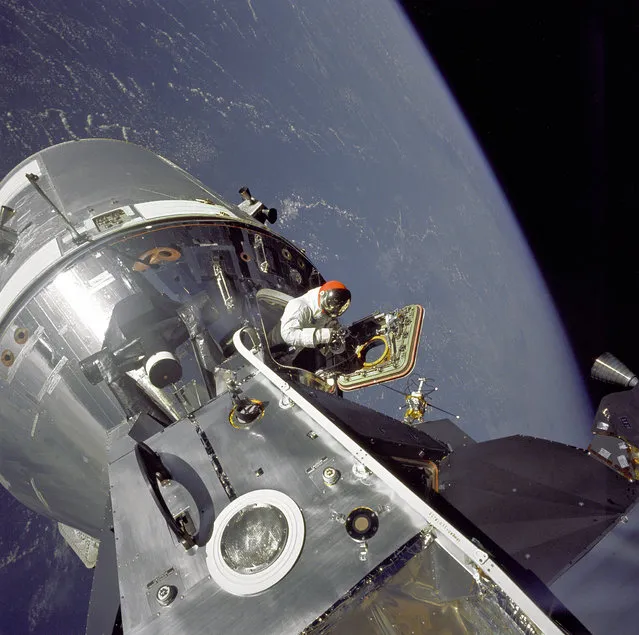
Apollo 9 Command/Service Modules (CSM) nicknamed “Gumdrop” and Lunar Module (LM), nicknamed “Spider” are shown docked together as Command Module pilot David R. Scott stands in the open hatch. Astronaut Russell L. Schweickart, Lunar Module pilot, took this photograph of Scott during his EVA as he stood on the porch outside the Lunar Module. Apollo 9 was an Earth orbital mission designed to test docking procedures between the CSM and LM as well as test fly the Lunar Module in the relative safe confines of Earth orbit. (Photo by NASA)

Apollo 9 Command/Service Modules (CSM) nicknamed “Gumdrop” and Lunar Module (LM), nicknamed “Spider” are shown docked together as Command Module pilot David R. Scott stands in the open hatch. Astronaut Russell L. Schweickart, Lunar Module pilot, took this photograph of Scott during his EVA as he stood on the porch outside the Lunar Module. Apollo 9 was an Earth orbital mission designed to test docking procedures between the CSM and LM as well as test fly the Lunar Module in the relative safe confines of Earth orbit. (Photo by NASA)
Details
20 Jul 2014 11:47:00
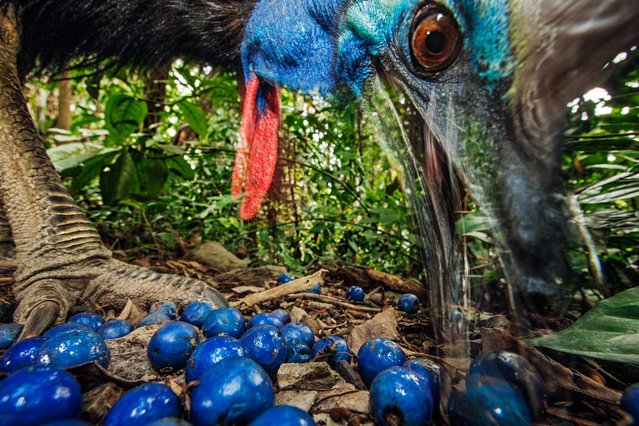
“Cassowaries are large, flightless birds related to emus and (more distantly) to ostriches, rheas, and kiwis”, writes Olivia Judson in the September issue of National Geographic magazine. (Photo by Christian Ziegler/National Geographic)

“Cassowaries are large, flightless birds related to emus and (more distantly) to ostriches, rheas, and kiwis”, writes Olivia Judson in the September issue of National Geographic magazine. How large? People-size: Adult males stand well over five foot five and top 110 pounds. Females are even taller, and can weigh more than 160 pounds. Dangerous when roused, they’re shy and peaceable when left alone. But even birds this big and tough are prey to habitat loss. The dense New Guinea and Australia rain forests where they live have dwindled. Today cassowaries might number 1,500 to 2,000. And because they help shape those same forests – by moving seeds from one place to another – “if they vanish”, Judson writes, “the structure of the forest would gradually change” too. (Photo by Christian Ziegler/National Geographic)
Details
06 Jan 2014 12:21:00