Loading...
Done
Chicago: 35 photographs, 15 minutes. (Photo by Daniel Marker-Moors/Caters News)

A photographer is using a unique method to show the shift from day to night across famous cities in spectacular images. Daniel Marker-Moors' take on time-lapse photography – which he calls time slice – sees the photographer snap image after image, before combining them to create beautiful, vibrant works. His images usually focus on a point in the day with the most dramatic change in light, such as sunrise or sunset. Marker-Moors, from Los Angeles, begins by shooting hundreds and sometimes thousands of images from the same spot. Here: Chicago – 35 photographs, 15 minutes. (Photo by Daniel Marker-Moors/Caters News)
Details
21 Dec 2015 08:04:00
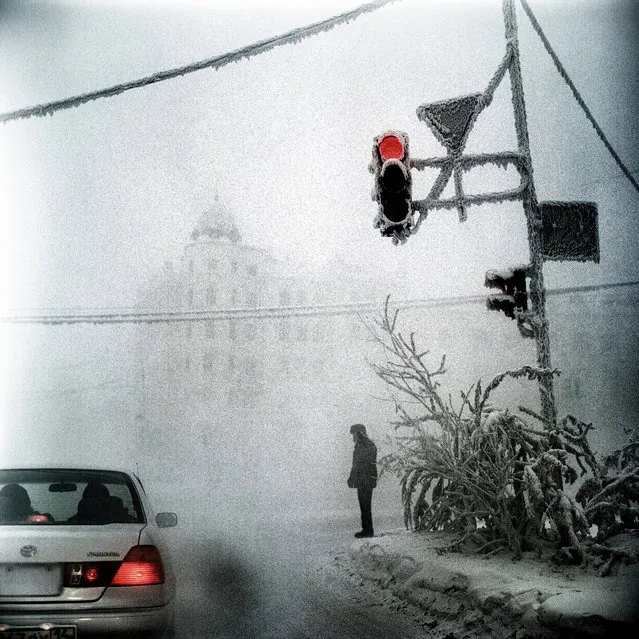
January 2013. A scene in Yakutsk, Siberia, the coldest city in the world. (Photo by Steeve Iuncker/Agence VU)

Yakutsk, a remote city in Eastern Siberia along the Lena River, is the coldest city in the world. Located 1840 km away from Irkoustk and 5000 km away from Moscow, this city founded in 1632 by the Cossacks imposes upon its inhabitants an extreme way of life. And yet, despite particularly harsh conditions, Yakutsk boasts a population of 270,000, or a quarter of the entire population of Siberia. No other place on the planet experiences the temperature extreme found here: in winter, the temperatures regularly fall to minus 40° (the coldest temperature recorded was –64°C) and in summer often reaches temperatures above 30°C. Photo: January 2013. A scene in Yakutsk, Siberia, the coldest city in the world. (Photo by Steeve Iuncker/Agence VU)
Details
29 Apr 2013 10:30:00
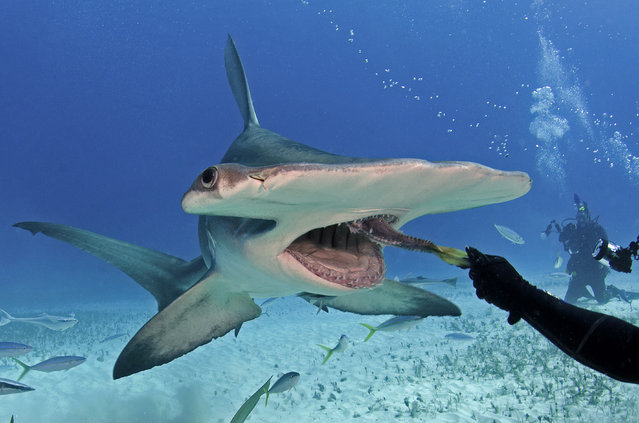
Eli Martinez with hammerhead shark. (Photo by J. P. Zegarra/Caters News)

“This is the terrifying moment a diver came head to head with a shark as it swims inches away snatching a bite for dinner. The close encounter, captured off Bimini Island in the Bahamas, shows the hammerhead approaching diver Eli Martinez who bravely stands his ground as the giant beast approaches. Eli, free diving outside of a protective cage, carefully handled the sea creature despite its menacing razor-sharp teeth – but admitted they are extremely shy and need a lot of work to allow divers close to them. After multiple trips and hours of diving nearby they finally got used to Eli in January this year – hammerheads regularly visit these waters during the winter season”. – Caters News. Photo: Eli Martinez with hammerhead shark. (Photo by J. P. Zegarra/Caters News)
Details
11 Mar 2014 09:24:00
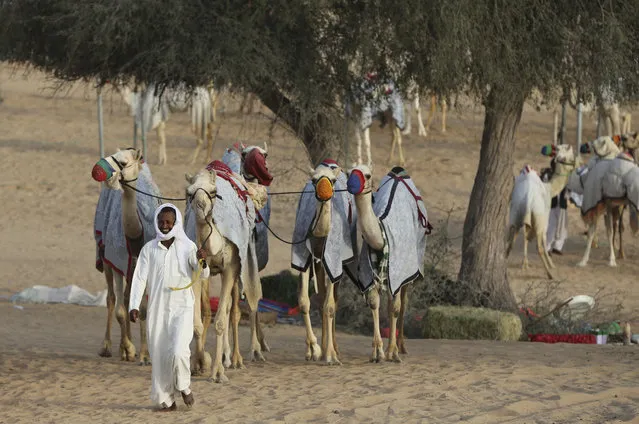
In this Saturday, April 8, 2017 photo, a keeper walks camels to the Al Marmoom Camel Racetrack, in al-Lisaili about 40 km (25  miles) southeast of Dubai, United Arab Emirates. (Photo by Kamran Jebreili/AP Photo)

In this Saturday, April 8, 2017 photo, a keeper walks camels to the Al Marmoom Camel Racetrack, in al-Lisaili about 40 km (25 miles) southeast of Dubai, United Arab Emirates. Camel racing is a big-money sport and fast thoroughbreds can fetch well over a million dollars. As rising temperatures across Gulf Arab countries signal the end of the winter camel racing season, Dubai is wrapping up its races with the annual Al Marmoom Heritage Festival that has drawn thousands of camels from across the oil-rich Gulf. (Photo by Kamran Jebreili/AP Photo)
Details
19 Apr 2017 08:44:00
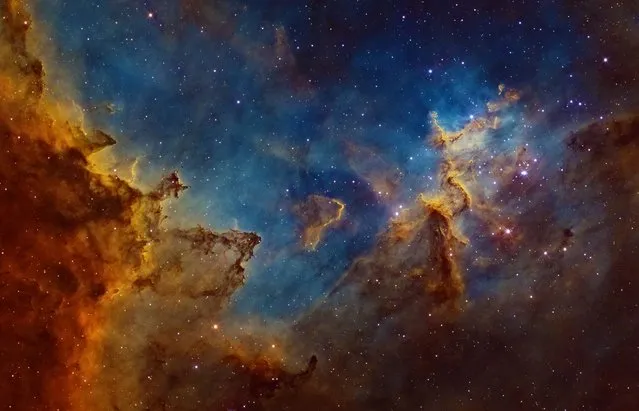
Centre of the Heart Nebula by Ivan Eder (Hungary). Situated 7500 light years away in the ‘W’-shaped constellation of Cassiopeia, the Heart Nebula is a vast region of glowing gas, energized by a cluster of young stars at its centre. The image depicts the central region, where dust clouds are being eroded and moulded into rugged shapes by the searing cosmic radiation. (Photo by Ivan Eder)

The competition, which is run by the Royal Observatory Greenwich in association with BBC Sky at Night Magazine, is now in its sixth year and has received over 2,500 entries. Photo: Centre of the Heart Nebula by Ivan Eder (Hungary). Situated 7500 light years away in the “W”-shaped constellation of Cassiopeia, the Heart Nebula is a vast region of glowing gas, energized by a cluster of young stars at its centre. The image depicts the central region, where dust clouds are being eroded and moulded into rugged shapes by the searing cosmic radiation. (Photo by Ivan Eder)
Details
03 Jul 2014 11:59:00
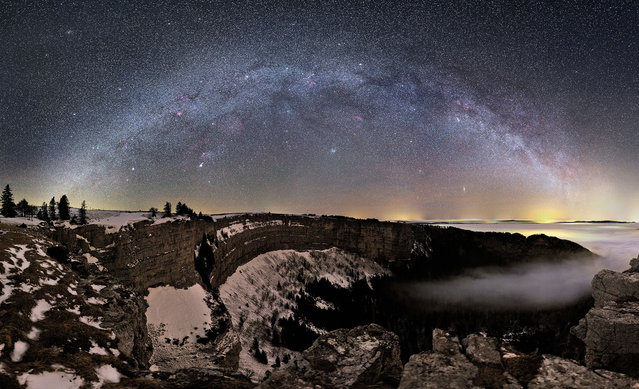
Milky Way over Switzerland

Milky Way over Switzerland

The Milky Way is the galaxy in which Earth is contained. This name derives from its appearance as a dim “milky” glowing band arching across the night sky, in which the naked eye cannot distinguish individual stars. The term “Milky Way” is a translation of the Classical Latin via lactea, from the Hellenistic Greek γαλαξίας κύκλος (pr. galaxías kýklos, “milky circle”). The Milky Way appears like a band because it is a disk-shaped structure being viewed from inside. The fact that this faint band of light is made up of stars was proven in 1610 when Galileo Galilei used his telescope to resolve it into individual stars. In the 1920s, observations by astronomer Edwin Hubble showed that the Milky Way is just one of many galaxies.


Details
20 Jun 2012 10:11:00
Waterdrop Sculptures by Josh Fancher

“I'm Josh Fancher, a 21 year old with an avid interest in photography, including macro, nature and wildlife, night photography, landscapes, cityscapes and architectural photography. Inspired by the beautiful and amazing water drop photography of Martin Waugh, I started doing water drop collisions in December of 2007. I use a 105mm Micro Nikkor lens for water drops, along with a pair of Nikon SB 600 flashes. I recently got a StopShot system (Nov 2009), which makes timing a lot easier. Before then, timing was manual, with an eye dropper, eye-hand coordination, and a lot of patience” – Josh Fancher. (Photo by Josh Fancher)
Details
19 Aug 2012 10:30:00


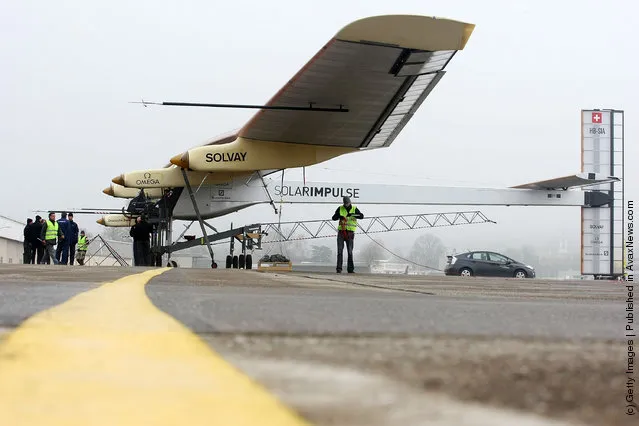
“Solar Impulse is a European long-range solar powered plane project being undertaken by Bertrand Piccard and André Borschberg. The project eventually hopes to succeed in the first circling of the earth with a piloted fixed-wing aircraft using only solar power. The first aircraft, bearing the Swiss aircraft registration code of HB-SIA, is a single-seater, capable of taking off under its own power, and intended to remain airborne up to 36 hours. This aircraft first flew an entire diurnal solar cycle, including nearly 9 hours of night flying, in a 26-hour flight on 7–8 July 2010”. – Wikipedia


Photo: Workers prepare the Solar Impulse airplane HB-SIA for a first runway test on November 19, 2009 in Dubendorf, Switzerland. Solar Impulse chairman Bertrand Piccard, psychatrist and aeronaut, who made the first non-stop round-the-world balloon flight, and CEO and former fighter pilot Andrй Borschberg plan a round-the-world flight, driven only by solar energy, for 2012. (Photo by Johannes Simon/Getty Images)
Details
16 May 2011 08:13:00