Loading...
Done
An Iraqi Kurdish Peshmerga takes part in a graduation ceremony at the Zakho military academy in the Iraqi Kurdish town of Zakho, some 500 kilometres north of Baghdad, on January 30, 2018. (Photo by Safin Hamed/AFP Photo)

An Iraqi Kurdish Peshmerga takes part in a graduation ceremony at the Zakho military academy in the Iraqi Kurdish town of Zakho, some 500 kilometres north of Baghdad, on January 30, 2018. (Photo by Safin Hamed/AFP Photo)
Details
01 Feb 2018 07:12:00
Waura Indians wrestle during this year's “quarup”, a ritual held over several days to honour in death a person of great importance to them, in Xingu National Park, Mato Grosso State, Brazil August 25, 2013. (Photo by Ueslei Marcelino/Reuters)

Waura Indians wrestle during this year's “quarup”, a ritual held over several days to honour in death a person of great importance to them, in Xingu National Park, Mato Grosso State, Brazil August 25, 2013. (Photo by Ueslei Marcelino/Reuters)
Details
09 Aug 2015 10:26:00
“Stacked Supercell with Lightning”. This huge mesocyclone supercell was near the Nebraska / Kansas border on the night of June 22nd, 2012. What a stunning structure! (Photo and caption by Jennifer Brindley/National Geographic Traveler Photo Contest)

“Stacked Supercell with Lightning”. This huge mesocyclone supercell was near the Nebraska / Kansas border on the night of June 22nd, 2012. What a stunning structure! (Photo and caption by Jennifer Brindley/National Geographic Traveler Photo Contest)

ATTENTION! All pictures are presented in high resolution. To see Hi-Res images – just TWICE click on any picture. In other words, click small picture – opens the BIG picture. Click BIG picture – opens VERY BIG picture.
Details
25 Jun 2013 13:12:00
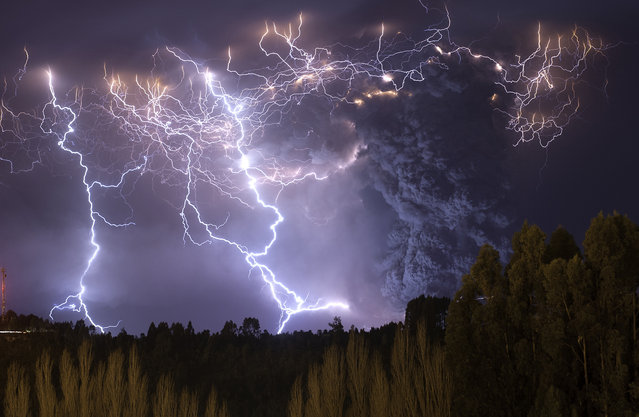
The eruption of Cordon Caulle began on June 4, 2011, located in the Region of Los Rios in Chile. For about 12 months, people and animals became accustomed to living with the daily fall of ash, which also caused problems in the air traffic in South America. The explosions and lightning during first days of the eruption could be seen from hundreds of miles around. This photograph was taken on the second night of eruption from the town of Lago Ranco. (Photo and caption by Francisco Negroni/National Geographic Traveler Photo Contest)

The eruption of Cordon Caulle began on June 4, 2011, located in the Region of Los Rios in Chile. For about 12 months, people and animals became accustomed to living with the daily fall of ash, which also caused problems in the air traffic in South America. The explosions and lightning during first days of the eruption could be seen from hundreds of miles around. This photograph was taken on the second night of eruption from the town of Lago Ranco. (Photo and caption by Francisco Negroni/National Geographic Traveler Photo Contest)

ATTENTION! All pictures are presented in high resolution. To see Hi-Res images – just TWICE click on any picture. In other words, click small picture – opens the BIG picture. Click BIG picture – opens VERY BIG picture.
Details
23 Jun 2013 11:24:00
The new Toyota Concept-i concept car, designed to learn about its driver is unveiled during the Toyota press conference at CES in Las Vegas, January 4, 2017. (Photo by Rick Wilking/Reuters)

The new Toyota Concept-i concept car, designed to learn about its driver is unveiled during the Toyota press conference at CES in Las Vegas, January 4, 2017. (Photo by Rick Wilking/Reuters)
Details
05 Jan 2017 13:20:00
The Sifaka jumps along the road. (Photo by Shannon Wild/Caters News Agency)

The Verreauxs Sifaka, otherwise known as Dancing Sifaka, who was caught strutting its stuff in Madagascar, has definitely learnt a lesson or two from King Julian – from the 2005 film “Madagascar”. Raising both of its arms and lunging from side to side, this lemur definitely likes to move it, move it. (Photo by Shannon Wild/Caters News Agency)
Details
24 Jan 2018 06:17:00
A South Korean man and a woman eat a live octopus during an event to promote a local food festival in Seoul on September 12, 2013. (Photo by Jung Yeon-Je/AFP Photo)

Live octopus is a delicacy in South Korea but is a known choking hazard, since the still-moving suction cups can cause tentacle pieces to stick in a person's throat. A baby octopus is often consumed whole, while larger varieties are cut up and the still-wriggling tentacles eaten with a splash of sesame oil. Photo: A South Korean man and a woman eat a live octopus during an event to promote a local food festival in Seoul on September 12, 2013. (Photo by Jung Yeon-Je/AFP Photo)
Details
13 Sep 2013 09:40:00


Simply – two pleasant Korean videoclips by Davichi (다비치), SeeYa (씨야) and T-ara (티아라). Have a nice week-end!

P.S. Hint: You want even more music? Use a music video tag!
Details
15 Jun 2013 13:25:00