Loading...
Done


Eight-year-old handicapped Chinese girl Qian Hongyan crawls with two home-made props and part of a basketball at Zhuangxia Village on January 5, 2005 in Luliang County of Qujing City, Yunnan Province, China. The girl who lost both of her legs in a traffic accident in 2000 at the age of three, struggles to live her life with a basketball as an underprop, “walking” between school and home by herself. The girl's story is widely reported in the country, and experts from China Rehabilitation Research Center has come to Qian's home to help her for rehabilitative treatment early 2005. (Photo by China Photos/Getty Images)
Details
29 Jun 2011 11:33:00
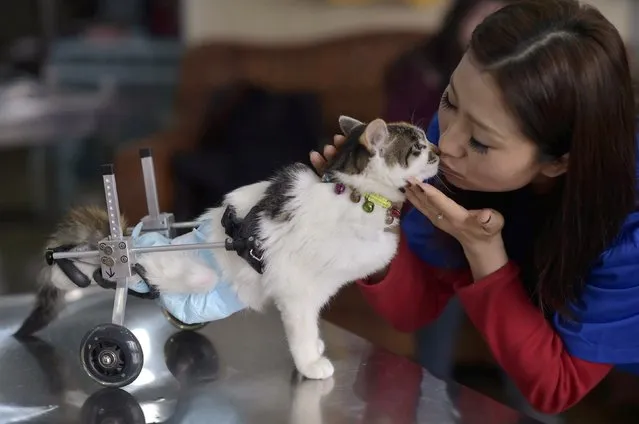
A veterinarian kisses an 8-month-old cat, wearing a prosthetic two-wheel device, at a veterinary hospital in Chongqing municipality, March 16, 2015. (Photo by Reuters/China Daily)

A veterinarian kisses an 8-month-old cat, wearing a prosthetic two-wheel device, at a veterinary hospital in Chongqing municipality, March 16, 2015. The cat's rear legs lost the abilty to walk after falling from the ninth to fifth floor of a building last November, its since undergone four major surgeries which included removing parts of its organs, local media reported. (Photo by Reuters/China Daily)
Details
19 Mar 2015 13:27:00
A man walking his dog in a park made using chalk and keys. (Photo by Stanislav Aristov/Caters News)

“This quirky collection of photos proves that a little imagination is the key to a good a picture. By simply using a collection of keys and a strip of chalk, photographer, Stanislav Aristov, 32, is able to re-create everyday scenes and objects. Stanislav wanted to show that even the simplest of items can help change your view on the world. After acquiring a large selection of keys from friends and family as well as local charity shops, Stanislav then went about scrawling anything from a key shaped rain drops to a key-eyed crab”. – Caters News. Photo: A man walking his dog in a park made using chalk and keys. (Photo by Stanislav Aristov/Caters News)
Details
22 Aug 2014 12:11:00
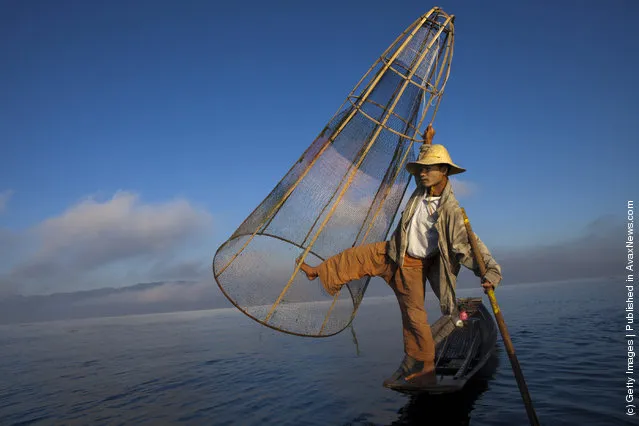
Intha leg rowing fishermen starts to fish in the early morning hours on Inle Lake in Myanmar

An Intha leg rowing fisherman paddles on Inle Lake December 17, 2011 in Inle Lake, Myanmar. The famous lake is 22 kilometers long and 11 wide and has been a fisherman's paradise for years where they use their leg rowing technique, standing on the stern on one leg and wrapping the other leg around the oar. (Photo by Paula Bronstein /Getty Images)
Details
22 Dec 2011 12:17:00
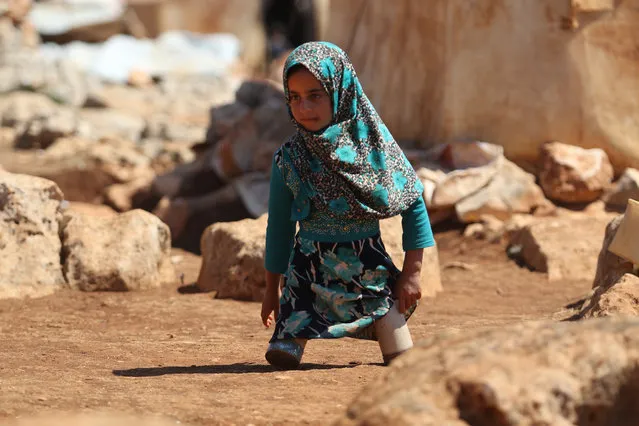
Eight year-old Maya Mohammad Ali Merhi walks using prosthetic legs made by her father from tin cans in a camp for displaced people, in the northern Syrian province of Idlib on June 20, 2018. Maya and her father were both born without lower limbs. Unable to afford real prosthetic limbs, her father made her a pair out of tin cans filled with cotton and scrap pieces of cloth. Maya's family had to leave their home in the Aleppo province to flee battles. (Photo by Aaref Watad/AFP Photo)

Eight year-old Maya Mohammad Ali Merhi walks using prosthetic legs made by her father from tin cans in a camp for displaced people, in the northern Syrian province of Idlib on June 20, 2018. Maya and her father were both born without lower limbs. Unable to afford real prosthetic limbs, her father made her a pair out of tin cans filled with cotton and scrap pieces of cloth. Maya's family had to leave their home in the Aleppo province to flee battles. (Photo by Aaref Watad/AFP Photo)
Details
09 Aug 2018 00:01:00
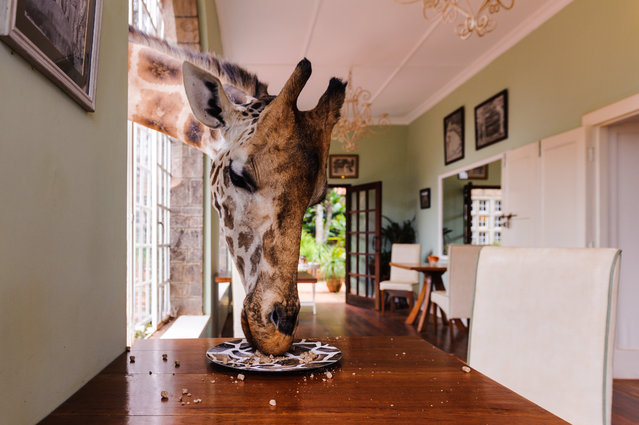
“Don't Leave Any Food On Your Plate”. The giraffes at Nairobi's Giraffe Manor are totally at home with humans. They will eat out of your hand, or even off your plate. Photo location: Giraffe Manor, Nairobi, Kenya. (Photo and caption by Gavin Werbeloff/National Geographic Photo Contest)

“Don't Leave Any Food On Your Plate”. The giraffes at Nairobi's Giraffe Manor are totally at home with humans. They will eat out of your hand, or even off your plate. Photo location: Giraffe Manor, Nairobi, Kenya. (Photo and caption by Gavin Werbeloff/National Geographic Photo Contest)
Details
20 Jun 2014 10:23:00
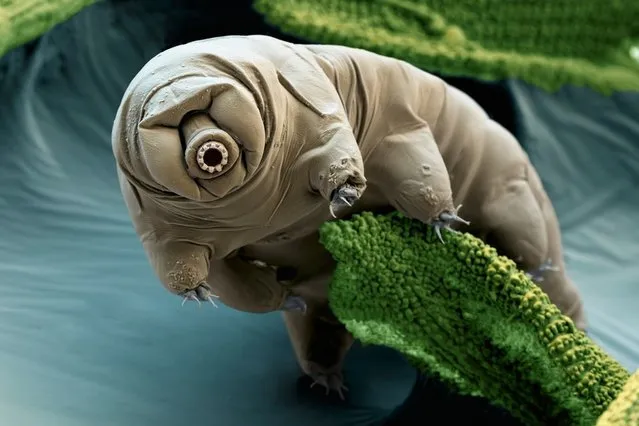
Tardigrades (commonly known as waterbears or moss piglets). (Photo by SPL/East News)

“Tardigrades (commonly known as waterbears or moss piglets) are small, water-dwelling, segmented animals with eight legs. Tardigrades were first discovered in 1773 by Johann August Ephraim Goeze, who called them kleiner Wasserbär, meaning “little water bear” in German. The name Tardigrada means “slow walker” and was given by Lazzaro Spallanzani in 1777. The name water bear comes from the way they walk, reminiscent of a bear's gait. The biggest adults may reach a body length of 1.5 millimetres (0.059 in), the smallest below 0.1 mm. Freshly hatched tardigrades may be smaller than 0.05 mm”. – Wikipedia. Photo: Tardigrades. (Photo by SPL/East News)
Details
26 Sep 2012 09:55:00
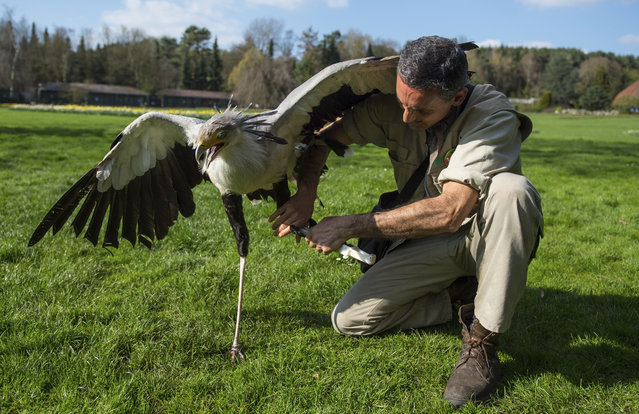
In this April 4, 2017 photo keeper German Alonso straps a leg prothesis to on the left leg of secretarybird Soeckchen (Sagittarius seprentarius) at the bird park in Walsrode, northern Germany. The prothesis was made in a 3D-printer after his left leg was amputated. (Photo by Philipp Schulze/DPA via AP Photo)

In this April 4, 2017 photo keeper German Alonso straps a leg prothesis to on the left leg of secretarybird Soeckchen (Sagittarius seprentarius) at the bird park in Walsrode, northern Germany. The prothesis was made in a 3D-printer after his left leg was amputated. (Photo by Philipp Schulze/DPA via AP Photo)
Details
11 Apr 2017 09:53:00