Loading...
Done


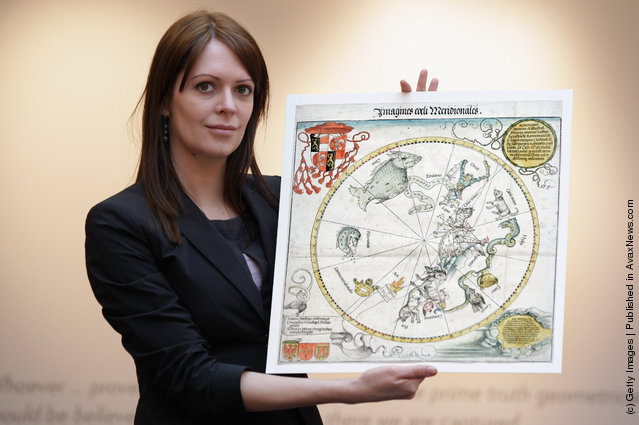
Head of European Prints, Severine Nackers holds a celestial Map of the Southern Sky by Albrecht Durer, at Sotheby's Auction House on March 25, 2011 in London, England. The two woodcut maps depicting the Northern and Southern skies circa 1515, are the earliest printed star charts of their kind ever published in Europe, and are expected to fetch between Ј120,000-180,000 GBP when they go on sale at the “London sale of Old Master, Modern and Contemporary prints” at Sotheby's Auction house on March 30, 2011. (Photo by Dan Kitwood/Getty Images)
Details
25 Mar 2011 14:57:00
A Buddhist monk uses a traditional needle to tattoo the body of a man at Wat Bang Phra in Nakhon Pathom province on the outskirts of Bangkok, Thailand,  March 18, 2016. (Photo by Chaiwat Subprasom/Reuters)

A Buddhist monk uses a traditional needle to tattoo the body of a man at Wat Bang Phra in Nakhon Pathom province on the outskirts of Bangkok, Thailand, March 18, 2016. Believers from across Thailand travel to the monastery to have their bodies adorned with tattoos and to pay their respects to the temple's master tattooist. They believe the tattoos have mystical powers, ward off bad luck and protect them from harm. (Photo by Chaiwat Subprasom/Reuters)
Details
19 Mar 2016 12:44:00
Amazing World By Al Hogue

Light is the sole reason why life exists. It provides us with warmth; it allows us to see; it nourishes all the living things on this planet. Many painters, especially the masters of Old Renaissance Period, have recognized the importance of light and its intimate connection with nature and life itself. In their paintings they gave tribute to light, giving the impression that their paintings had a light source hidden within them. Al Hogue, the artist who created the paintings that you see before you, has studied their techniques for many years. As time went by, light permeated not only his paintings by also his life, becoming his sole philosophy.
Details
06 Mar 2015 06:03:00


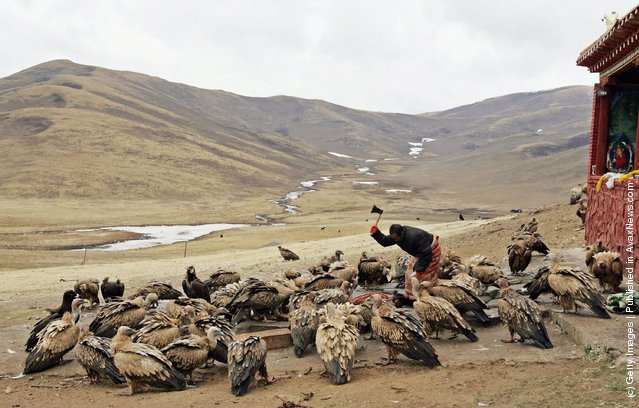
“Sky burial or ritual dissection was once a common funerary practice in Tibet wherein a human corpse is cut in specific locations and placed on a mountaintop, exposing it to the elements or the mahabhuta and animals – especially to birds of prey. The location of the sky burial preparation and place of execution are understood in the Vajrayana traditions as charnel grounds. In Tibet the practice is known as jhator, which literally means, «giving alms to the birds»”. – Wikipedia

Photo: A burial master chops bones of a body to feed vultures during a celestial burial ceremony on April 19, 2006 in Dari County of Guoluo Prefecture, Qinghai Province, northwest China. Celestial burial is a traditional funeral of Tibetan people, which began in the 7th century. (Photo by China Photos/Getty Images)
Details
18 Jun 2011 12:12:00
This photo taken on November 6, 2023 shows people posing for photos next to the statue of “Hachiko” in front of Shibuya station in central Tokyo, ahead of the 100th anniversary of the legendary dog's birth this month. A century since its birth, the tale of the loyal companion who had waited at the Shibuya train station for its master to come home – not knowing he had already died – continues to inspire the public, who have made the statue a singular landmark at a glitzy hub of Tokyo's street culture. (Photo by Richard A. Brooks/AFP Photo)

This photo taken on November 6, 2023 shows people posing for photos next to the statue of “Hachiko” in front of Shibuya station in central Tokyo, ahead of the 100th anniversary of the legendary dog's birth this month. A century since its birth, the tale of the loyal companion who had waited at the Shibuya train station for its master to come home – not knowing he had already died – continues to inspire the public, who have made the statue a singular landmark at a glitzy hub of Tokyo's street culture. (Photo by Richard A. Brooks/AFP Photo)
Details
27 Nov 2023 00:06:00
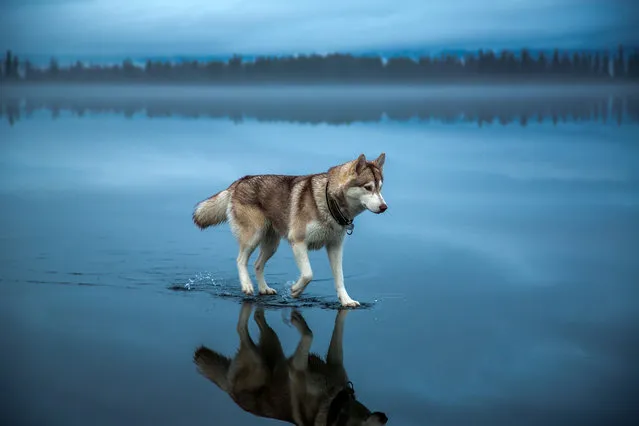
This graceful husky appears to be smarter than your average dog having apparently mastered the art of walking on water. The soft-footed canine was photographed while making its way across a lake in northern Russia. Photographer Fox Grom captured a remarkable set of images after heavy rain fell on a frozen lake to create the amazing illusion. Here: Husky dog Alaska walks on water in Northern Russia, January 2015. (Photo by Fox Grom/Visual Press Agency)

This graceful husky appears to be smarter than your average dog having apparently mastered the art of walking on water. The soft-footed canine was photographed while making its way across a lake in northern Russia. Photographer Fox Grom captured a remarkable set of images after heavy rain fell on a frozen lake to create the amazing illusion. The 40-year-old, who works as an all-terrain vehicle driver, regularly walks his pet dogs, Alaska and Blizzard, near the natural beauty spot. “I always take pictures of my dogs whilst walking them but on this occasion there was an extraordinary phenomenon“, he said. “The ice was already very thick when it rained heavily making for a spectacular scene”. Here: Husky dog Alaska walks on water in Northern Russia, January 2015. (Photo by Fox Grom/Visual Press Agency)
Details
20 Mar 2015 11:46:00
Art by Christian Faur

Christian Faur is an artist based in Granville, Ohio. Looking for a new technique, he experimented with painting with wax, but he didn’t feel the results were satisfactory.Then, at Christmas in 2005, his young daughter opened a box of 120 Crayola crayons he’d bought her, and everything clicked into place. Faur decided he would create pictures out of the crayons themselves, packing thousands of them together so they become like the colored pixels on a TV screen. He starts each work by scanning a photo into a computer and breaking the image down into colored blocks He then draws a grid that shows him exactly where to place each crayon The finished artworks are packed tightly into wooden frames. He actually makes the crayons himself, hand-casting each one in a mould.
Details
28 Jul 2012 10:03:00
Tridacna Gigas, or Giant Clams

“The giant clam, Tridacna gigas (known as pā’ua in Cook Islands Māori), is the largest living bivalve mollusc. T. gigas is one of the most endangered clam species. It was mentioned as early as 1825 in scientific reports. One of a number of large clam species native to the shallow coral reefs of the South Pacific and Indian oceans, they can weigh more than 200 kilograms (440 lb) measure as much as 120 cm (47 in) across, and have an average lifespan in the wild of 100 years or more”. – Wikipedia

Photo: Tridacna Gigas, or Giant Clams spew water as a traditional fisherman passes by a small sanctuary on January 23, 2004 near Bolinao in the Northern Philippines. The clams, prime builders for coral reefs and providing shelter for spawning fish and other marine life, are exposed by low tides in the sanctuary. Overfishing and pollution throughout the country are not only threatening food security, but are also starting to choke one of the few working clam sanctuaries in the world. (Photo by David Greedy/Getty Images)
Details
01 Oct 2011 13:10:00