Loading...
Done
Skulls By Jim Skull

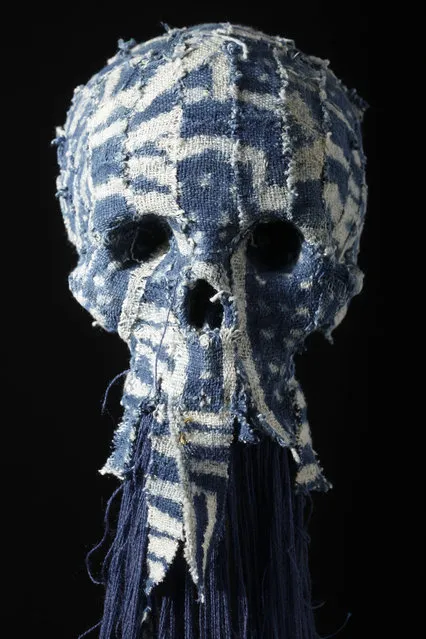
Inspired by personal experiences, a mix of cultures, rituals, and travelling the world, artist Jim Skull creates elaborate woven skull sculptures. He likes to be referred to as Jim Skull as a reflection of his interest in skulls; a symbol that he has been working with since the 1980s. He is currently living in France where he creates beautifully crafted sculptures out of rope, Papier-mâché, and other natural materials. He was born in New Caledonia and there’s no doubt that the influences of the tribal arts from Oceania, Africa, and North America are evident within his technique.
Details
11 Apr 2014 13:30:00
Bloodwood Tree

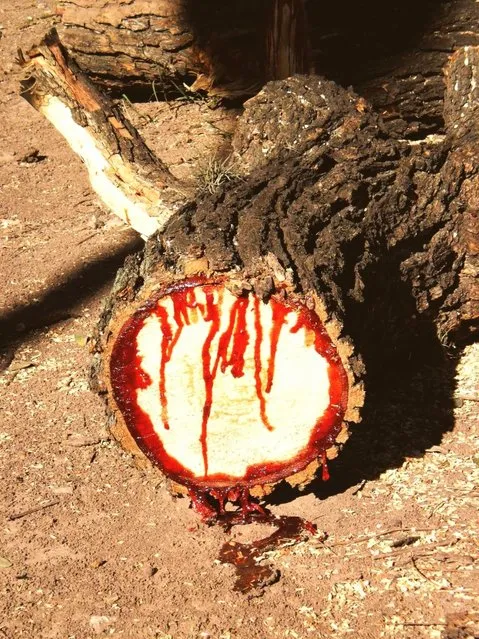
The bloodwood tree (Pterocarpus angolensis) is a deciduous tree with a high canopy, reaching about 15m in height and has dark bark. The red sap is used traditionally as a dye and in some areas mixed with animal fat to make a cosmetic for faces and bodies. It is also believed to have magical properties for the curing of problems concerning blood, apparently because of its close resemblance to blood. The name bloodwood for these trees stems from the dark red to brown sap that accumulates on wounds on the trunks.
Details
14 May 2014 12:44:00
Drawing By Andrew Ferez

Andrew Ferez, born and raised in Russia is an artist who inherited his creativity and interest in the arts early on and trained his artistic skills and knowledge ever since, in a never-ending process.
Andrew’s genre is a mix between macabre and horror with a poetic hint. His illustrations transports us into the deepest recesses of our mind, showing us impossible worlds that are both scary yet surprisingly familiar or enticing. Most of his artworks are two dimensional but in some of his latest artworks he used the help of some 3D software as well.
Details
28 May 2014 18:26:00
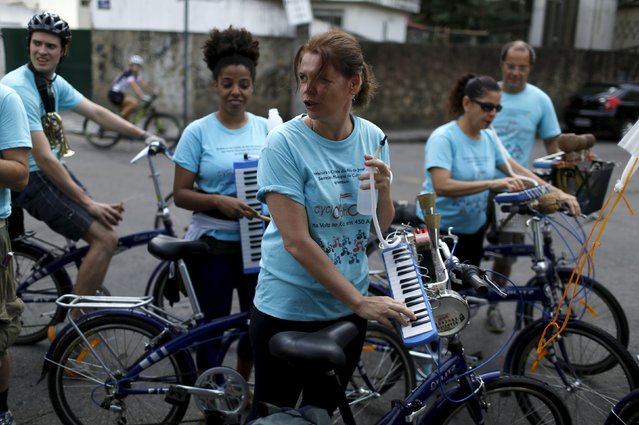
Members of the Cyclophonica band play instruments as they make a stop during a ride in Rio de Janeiro May 17, 2015. (Photo by Pilar Olivares/Reuters)

Members of the Cyclophonica band play instruments as they make a stop during a ride in Rio de Janeiro May 17, 2015. The Cyclophonica band was formed by a group of musicians riding bicycles around the city, mixing sport and culture and entertaining people on the streets, according to its founder Leonardo Fuks. (Photo by Pilar Olivares/Reuters)
Details
19 May 2015 11:46:00
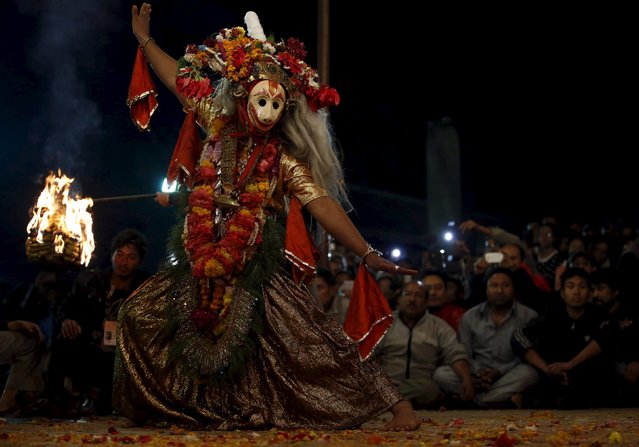
A medium performs the religious dance "Narsingh Avatar" during the traditional Kartik dance festival at Patan Durbar Square in Lalitpur, Nepal November 24, 2015. (Photo by Navesh Chitrakar/Reuters)

A medium performs the religious dance "Narsingh Avatar" during the traditional Kartik dance festival at Patan Durbar Square in Lalitpur, Nepal November 24, 2015. Observed for eight days, the festival is the longest dance festival in Nepal, and features a mix of drama, music and dialogues introduced by King Siddhinarsingh Malla in 1637 AD. (Photo by Navesh Chitrakar/Reuters)
Details
26 Nov 2015 08:04:00
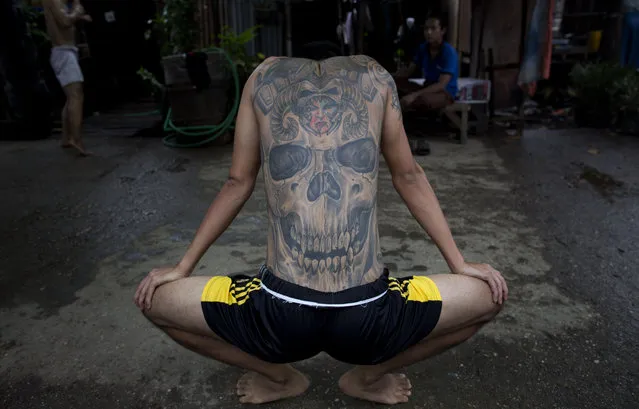
In this Tuesday, July 14, 2015, photo, Phoe Thaw, center, a member of the White New Blood lethwei fighters club, a Myanmar traditional martial-arts club which practices a rough form of kickboxing, stretches during a practice session in their gym on a street in Oakalarpa, north of Yangon, Myanmar. (Photo by Gemunu Amarasinghe/AP Photo)

In this Tuesday, July 14, 2015, photo, Phoe Thaw, center, a member of the White New Blood lethwei fighters club, a Myanmar traditional martial-arts club which practices a rough form of kickboxing, stretches during a practice session in their gym on a street in Oakalarpa, north of Yangon, Myanmar. Three of the club's members competed this summer on a stage a world away from the street gym: a mixed-martial-arts “One Championship” event broadcast globally on cable television networks, where fighters could receive $1,000 for each fight, according to coach Myint Zaw who started the traditional fighters' club 15 years ago. (Photo by Gemunu Amarasinghe/AP Photo)
Details
07 Sep 2015 14:00:00


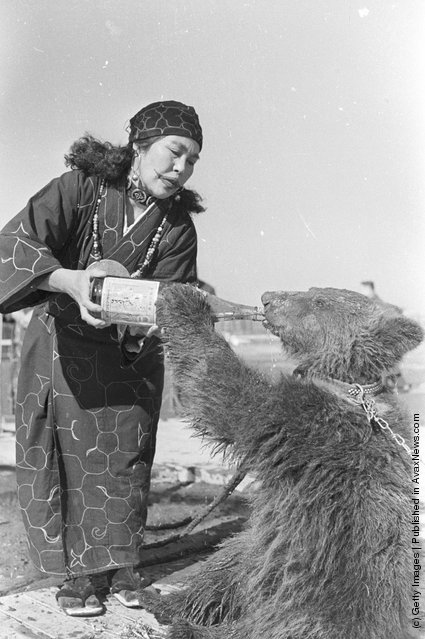
“The Ainu (アイヌ?), also called Aynu, Aino (アイノ), and in historical texts Ezo (蝦夷), are indigenous people or groups in Japan and Russia. Historically they spoke the Ainu language and related varieties and lived in Hokkaidō, the Kuril Islands, and much of Sakhalin. Most of those who identify themselves as Ainu still live in this same region, though the exact number of living Ainu is unknown. This is due to ethnic issues in Japan resulting in those with Ainu backgrounds hiding their identities and confusion over mixed heritages. In Japan, because of intermarriage over many years with Japanese, the concept of a 'pure Ainu' ethnic group is no longer feasible. Official estimates of the population are of around 25,000, while the unofficial number is upwards of 200,000 people”. – Wkipedia

Photo: A captive bear drinking from a large bottle held by an Ainu tribeswoman. (Photo by Evans/Three Lions/Getty Images). Circa 1955
Details
24 Mar 2011 14:01:00
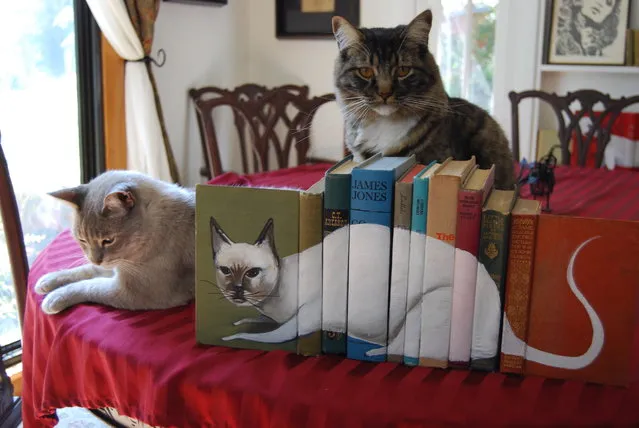
“Cats”. I really love animals and I think they are often overlooked or underestimated.  Sometimes I can see the feelings and emotions in animals when I can’t see them in humans, so it’s easier for me to express the feelings in a lot of my animal characters. (Photo and caption by Mike Stilkey)

Los Angeles native Mike Stilkey has always been attracted to painting and drawing not only on vintage paper, record covers and book pages, but on the books themselves. Using a mix of ink, colored pencil, paint and lacquer, Stilkey depicts a melancholic and at times a whimsical cast of characters inhabiting ambiguous spaces and narratives of fantasy and fairy tales. A lingering sense of loss and longing hints at emotional depth and draws the viewer into their introspective thrall with a mixture of capricious poetry, wit, and mystery. (Photo by Mike Stilkey)
Details
31 Jul 2014 10:17:00