Loading...
Done
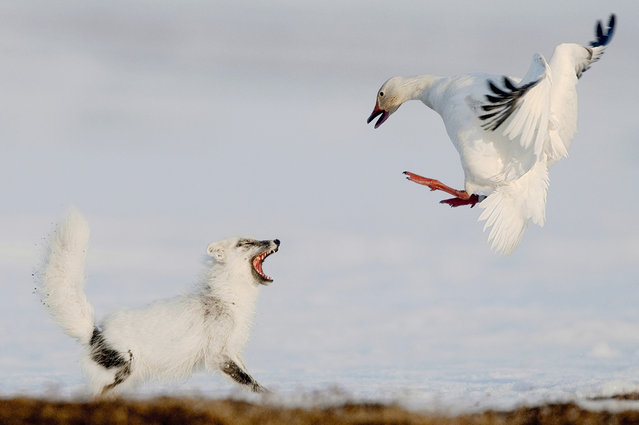
Commended. In late May, about a quarter of a million snow geese arrive from North America to nest on Wrangel Island, in northeastern Russia. They form the world's largest breeding colony of snow geese. Photographer Sergey Gorshkov spent two months on the remote island photographing the unfolding dramas. (Photo by Sergey Gorshkov/Veolia Environnement Wildlife Photographer)

Commended. In late May, about a quarter of a million snow geese arrive from North America to nest on Wrangel Island, in northeastern Russia. They form the world's largest breeding colony of snow geese. Photographer Sergey Gorshkov spent two months on the remote island photographing the unfolding dramas. Arctic foxes take advantage of the abundance of eggs, caching surplus eggs for leaner times. But a goose (here the gander) is easily a match for a fox, which must rely on speed and guile to steal eggs. “The battles were fairly equal”, notes Sergey, “and I only saw a fox succeed in grabbing an egg on a couple of occasions, despite many attempts”. Surprisingly, “the geese lacked any sense of community spirit”, he adds, “and never reacted when a fox harassed a neighboring pair nesting close by”. (Photo by Sergey Gorshkov/Veolia Environnement Wildlife Photographer)
Details
16 Jun 2015 12:30:00
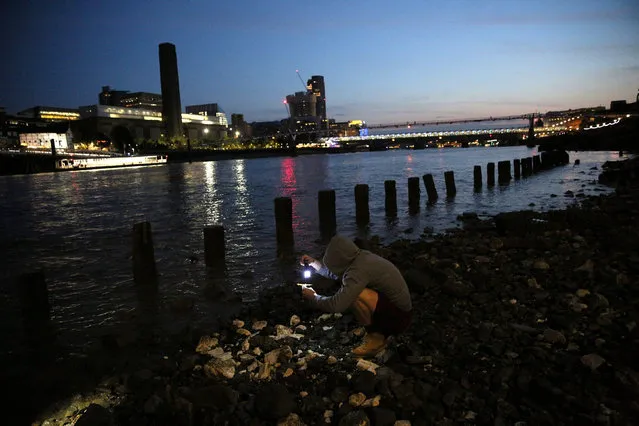
A mudlark uses a torch to look for items on the bank of the River Thames in London, Britain June 06, 2016. Mudlarking is believed to trace its origins to the 18th and 19th century, when scavengers searched the Thames' shores for items to sell. These days, history and archaeology fans are the ones hoping to find old relics such as coins, ceramics, artifacts or everyday items from across centuries. They wait for the low tide and then scour specific areas of exposed shores. "If you're in a field you could be out all day long, with the river you're restricted to about two or three hours," mudlark Nick Stevens said. While many just use the naked eye for their searches, others rely on metal detectors for which a permit from the Port of London Authority is needed. Digging also requires consent. (Photo by Neil Hall/Reuters)

A mudlark uses a torch to look for items on the bank of the River Thames in London, Britain June 06, 2016. Mudlarking is believed to trace its origins to the 18th and 19th century, when scavengers searched the Thames' shores for items to sell. These days, history and archaeology fans are the ones hoping to find old relics such as coins, ceramics, artifacts or everyday items from across centuries. their finds with the Portable Antiquities Scheme. Any item over 300 years old must be recorded. (Photo by Neil Hall/Reuters)
Details
27 Aug 2016 10:43:00
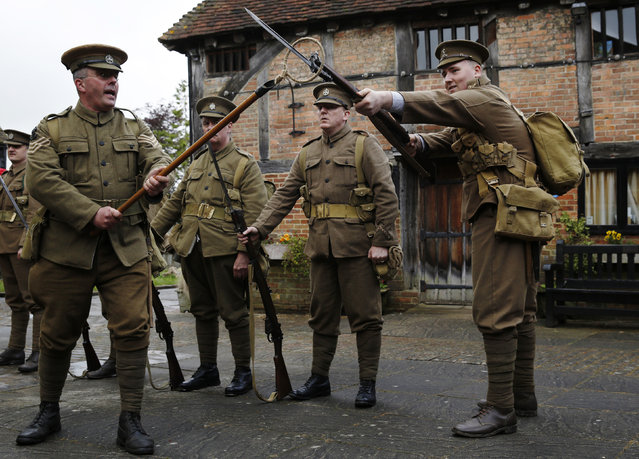
Factory landlord Lawrence Taylor (L), portraying a Colour Sergeant from the King's Royal Rifle Corps, part of the Rifles Living History Society, performs a drill with Connor Young (R) of the Queen's Own Royal West Kent Regiment Living History Group as they recreate the life of a First World War soldier at the Eden Valley Museum in Edenbridge in southeast England May 10, 2014. (Photo by Luke MacGregor/Reuters)

Factory landlord Lawrence Taylor (L), portraying a Colour Sergeant from the King's Royal Rifle Corps, part of the Rifles Living History Society, performs a drill with Connor Young (R) of the Queen's Own Royal West Kent Regiment Living History Group as they recreate the life of a First World War soldier at the Eden Valley Museum in Edenbridge in southeast England May 10, 2014. Lawrence has always had an interest in military history and specifically “The Rifles” – his veteran father's WWII regiment. When he became a re-enactor he chose not to re-enact WWII as many of the veterans are still alive, and he felt uncomfortable as he remembers his father would have flashbacks and nightmares about the war. United by a fascination with military history and a fondness for dressing up, groups such as the Rifles Living History Society and the Queen's Own Royal West Kent Regiment Living History Group get together to recreate aspects of life during the First World War. Reuters photographer Luke MacGregor photographed members of the groups, both as they took part in living history events and at their day jobs. (Photo by Luke MacGregor/Reuters)
Details
26 Aug 2014 10:12:00
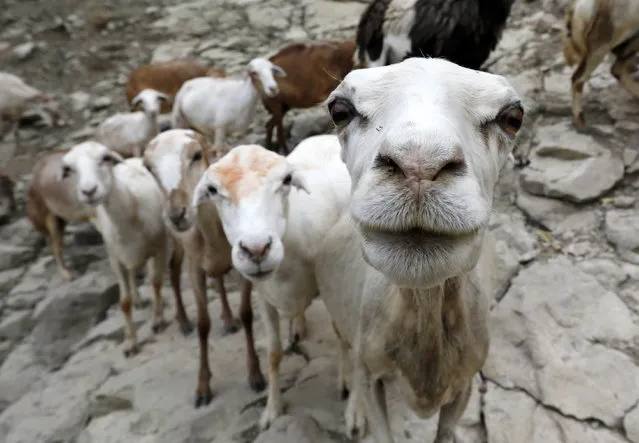
A flock of sheep and goats is led by shepherds to pastures at a mountain village on the outskirts of Sana'a, Yemen, 27 July 2023. At least eight million sheep and goats from about 470,000 pastoralist and agro pastoralist households across Yemen will be treated and vaccinated over the two years 2023 and 2024, in an effort to reduce livestock losses, improve production efficiency, and household income generation amid an acute food insecurity, the UN Food and Agriculture Organization (FAO) has reported. Livestock production in Yemen is a main income-generating activity for many rural and poor households. Yemen remains one of the worst humanitarian crises in the world with over 17 million people out of its 30-million population are food insecure due to a combination of prolonged conflicts and economic crisis. (Photo by Yahya Arhab/EPA)

A flock of sheep and goats is led by shepherds to pastures at a mountain village on the outskirts of Sana'a, Yemen, 27 July 2023. At least eight million sheep and goats from about 470,000 pastoralist and agro pastoralist households across Yemen will be treated and vaccinated over the two years 2023 and 2024, in an effort to reduce livestock losses, improve production efficiency, and household income generation amid an acute food insecurity, the UN Food and Agriculture Organization (FAO) has reported. (Photo by Yahya Arhab/EPA)
Details
01 Aug 2023 03:44:00
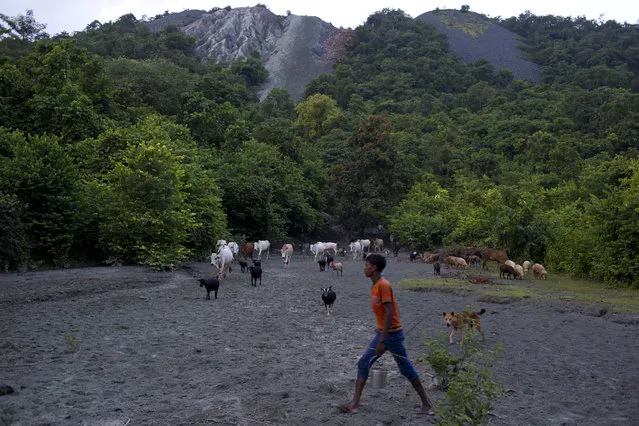
In this September 11, 2014 photo, villagers climb down the side of a hill used earlier as a dumping ground of asbestos waste on Roro hills in Roro, India. (Photo by Saurabh Das/AP Photo)

In this September 11, 2014 photo, villagers climb down the side of a hill used earlier as a dumping ground of asbestos waste on Roro hills in Roro, India. An asbestos mine, abandoned nearly three decades ago still affects the people around it and 18 along with Jema were diagnosed with asbestosis in 2012. Tens of thousands more, some former mine workers, remain untested and at risk. (Photo by Saurabh Das/AP Photo)
Details
26 Dec 2014 14:44:00
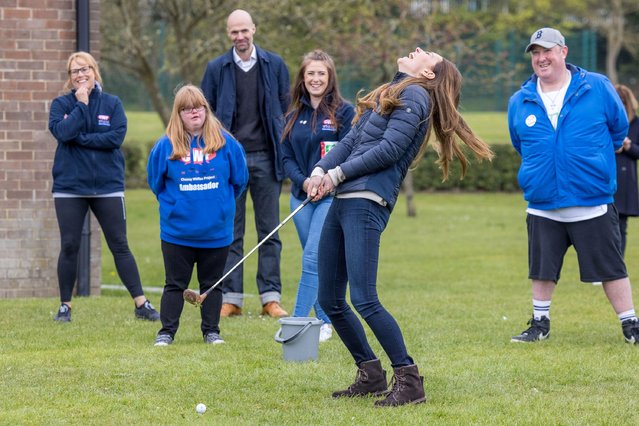
Britain's Catherine, Duchess of Cambridge plays a stroke of golf during a visit to meet young people supported by the Cheesy Waffles Project, a charity for children, young people and adults with additional needs across County Durham, at the Belmont Community Centre, in Durham, north east England on April 27, 2021. (Photo by Andy Commins/Pool via AFP Photo)

Britain's Catherine, Duchess of Cambridge plays a stroke of golf during a visit to meet young people supported by the Cheesy Waffles Project, a charity for children, young people and adults with additional needs across County Durham, at the Belmont Community Centre, in Durham, north east England on April 27, 2021. (Photo by Andy Commins/Pool via AFP Photo)
Details
29 Apr 2021 08:57:00
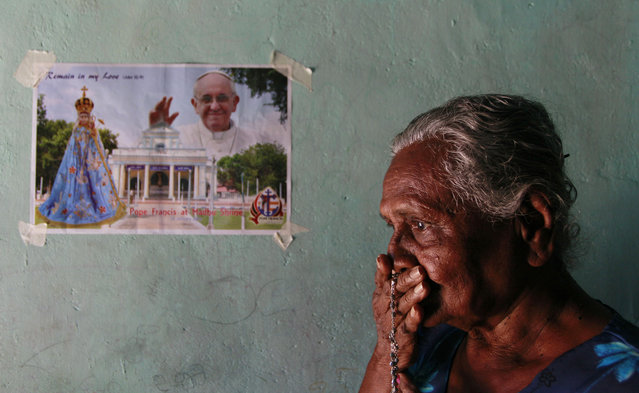
In this Wednesday, January 7, 2015 photo, a Sri Lankan Catholic devotee Rita Anthony kisses her rosary as she prays inside her house in Colombo, Sri Lanka. The Vatican has said that it hopes that Sri Lanka's Christians can play a role in helping heal the wounds of the island nation's bloody 25-year civil war, when the Tamil Tiger rebels fought to create a separate homeland in the north for the minority Tamils, who are mostly Hindu. (Photo by Eranga Jayawardena/AP Photo)

In this Wednesday, January 7, 2015 photo, a Sri Lankan Catholic devotee Rita Anthony kisses her rosary as she prays inside her house in Colombo, Sri Lanka. The Vatican has said that it hopes that Sri Lanka's Christians can play a role in helping heal the wounds of the island nation's bloody 25-year civil war, when the Tamil Tiger rebels fought to create a separate homeland in the north for the minority Tamils, who are mostly Hindu. The war came to a bloody end in 2009, but many Tamils say they feel forgotten by the central government, which is dominated by the country's ethnic Sinhala majority, which is overwhelmingly Buddhist. Sri Lanka's Christians come from both the Tamil and the Sinhala communities, making them a natural bridge between the two sides. (Photo by Eranga Jayawardena/AP Photo)
Details
11 Jan 2015 13:40:00
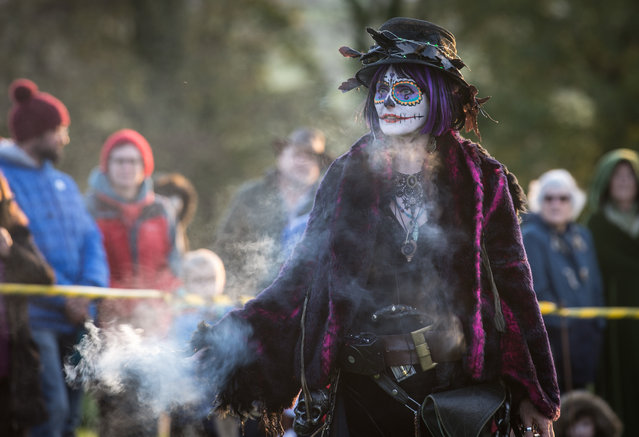
People take part in a sunset ceremony on the lower slopes of Glastonbury Tor as they celebrate Samhain at the Glastonbury Dragons Samhain Wild Hunt 2017 in Glastonbury on November 4, 2017 in Somerset, England. To celebrate Samhain, the Glastonbury Dragons, alongside Gwythyr Ap Greidal, the Summer King and the Winter King, Gwyn Ap Nudd, were paraded through the town to the lower slopes of Glastonbury Tor where the event was marked with ritual theatre, dancing and a fire to honour the dead. The Celtic festival of Samhain, which was later adopted by Christians and became Halloween, is a very important date in the Pagan calendar as it marks the division of the year between the lighter half (summer) and the darker half (winter). Pagans believe at Samhain, the division between this world and the otherworld was at its thinnest, allowing spirits to pass through. Many of the traditions of this ancient Celtic feast of the dead were later incorporated into the Christian calendar and Irish immigrants to America in the 19th century carried their customs, such as the wearing of costumes and masks to ward of harmful spirits and the harvest tradition of carving pumpkins, which have now blended into modern day Hallowee. (Photo by Matt Cardy/Getty Images)

People take part in a sunset ceremony on the lower slopes of Glastonbury Tor as they celebrate Samhain at the Glastonbury Dragons Samhain Wild Hunt 2017 in Glastonbury on November 4, 2017 in Somerset, England. To celebrate Samhain, the Glastonbury Dragons, alongside Gwythyr Ap Greidal, the Summer King and the Winter King, (Photo by Matt Cardy/Getty Images)
Details
07 Nov 2017 07:50:00