Loading...
Done
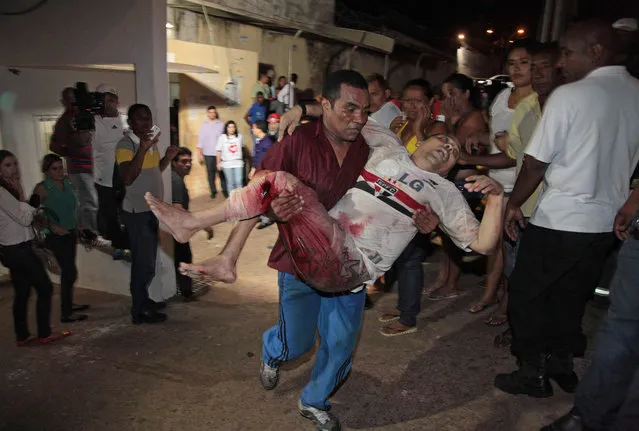
A prisoner from the Pedrinhas prison is carried to receive medical help after he was injured during a fight between rival gangs inside the jail, in Sao Luiz, capital of Maranhao state, January 8, 2014. (Photo by Douglas Cunha/Reuters/O Estado do Maranhão)

A prisoner from the Pedrinhas prison is carried to receive medical help after he was injured during a fight between rival gangs inside the jail, in Sao Luiz, capital of Maranhao state, January 8, 2014. The recent posting on a major Brazilian news website of a video filmed last December 17 by Pedrinhas prisoners of the decapitated and tortured bodies of rival inmates inside the jail has highlighted some of the problems present in the country's prison system which houses nearly twice as many prisoners as its capacity, according to official statistics. (Photo by Douglas Cunha/Reuters/O Estado do Maranhão)
Details
11 Jan 2014 13:03:00
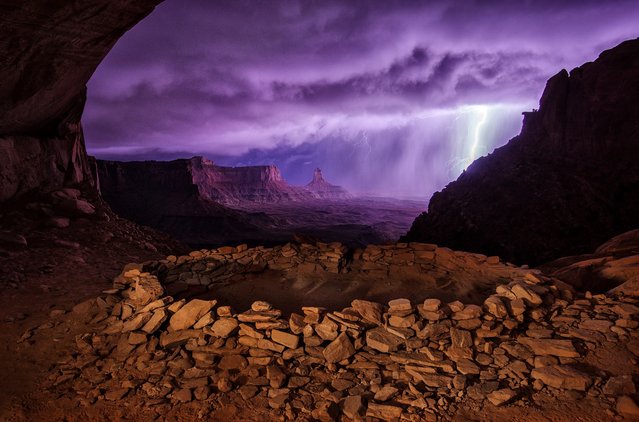
Second Place Winner: “Thunderstorm at False Kiva”. I hiked out to these ruins at night hoping to photograph them with the Milky Way, but instead a thunderstorm rolled through, creating this dramatic image. – Max Seigal. (Photo and caption by Max Seigal/National Geographic Traveler Photo Contest)

Second Place Winner: “Thunderstorm at False Kiva”. I hiked out to these ruins at night hoping to photograph them with the Milky Way, but instead a thunderstorm rolled through, creating this dramatic image. – Max Seigal. National Geographic Traveler Director of Photography Dan Westergren, one of this year's judges, shares his thoughts on the second place winner: “This photo combines two different scenes into one: the small kiva in a cliff dwelling and the grand vista of Canyonlands National Park across the valley. I really like the two different color palettes – warm inside and purple outside. This two-for-one scene was caused by the lightning storm outside the dwelling, which lit up the landscape like it was a huge electronic flash. Looking at this picture I can imagine what a wonderful sight it must have been for the ancient people who lived here. It doesn't seem too amazing now in our modern world, but might have been mind-blowing for the prehistoric residents”. Location: Utah. (Photo and caption by Max Seigal/National Geographic Traveler Photo Contest)
Details
02 Aug 2013 06:16:00
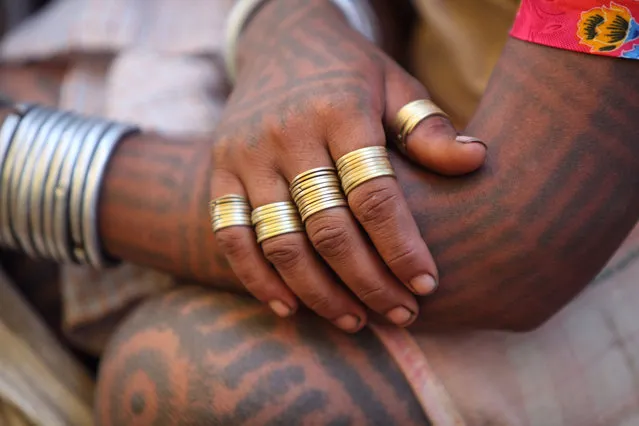
Once applied, the designs are washed using warm water and cow dung. Herbs are applied to promote faster healing. (Photo by Ronny Sen/WaterAid/The Guardian)

For more than 2,000 years, women from the Baiga tribe in the highland district of Dindori, in central India’s Madhya Pradesh state, have been tattooed. Sumintra, 25, from Bona village, has the markings across her forehead, legs and arms. The women who work as tattoo artists are knowledgable about the different types of designs and pigments preferred by various tribes, and their meanings are passed to them by their mothers. The tattooing ‘season’ begins with the approach of winter. (Photo by Ronny Sen/WaterAid/The Guardian)
Details
19 Aug 2017 08:48:00
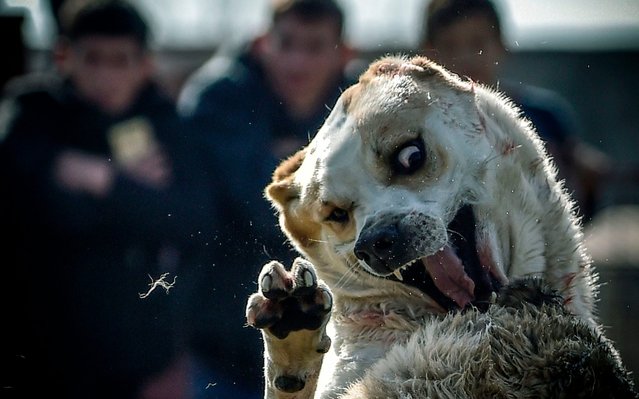
Two wolfhounds take part in a dogfight in a stadium in the Kyrgyzstan capital Bishkek on November 5, 2017, during fights organized by a local breeders aiming to improve the Asian Shepherd breed, organizers said. (Photo by Vyacheslav Oseledko/AFP Photo)

Two wolfhounds take part in a dogfight in a stadium in the Kyrgyzstan capital Bishkek on November 5, 2017, during fights organized by a local breeders aiming to improve the Asian Shepherd breed, organizers said. (Photo by Vyacheslav Oseledko/AFP Photo)
Details
12 Nov 2017 08:36:00
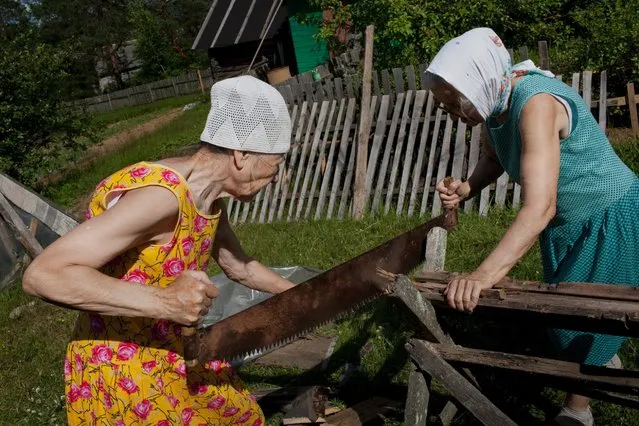
“Two-Handed Saw, 2014”. “Most of the neighbors have switched to power tools to run their households, the buzz of chain saws and weed-whackers overpowering the quieter sounds of country life, but my aunts hold on to the two-handed saw that's decades old, the sickle and scythe that need to be sharpened and polished after each use, the old axe that's becoming heavier each year. Each of these objects is familiar, holding memories of their brother, who succumbed to cancer a few years ago, of days before my grandfather lost his vision in the 50's, of busier days and longer futures”, Sablin told. (Photo by Nadia Sablin)

In northwest Russia, in a small village called Alekhovshchina, Nadia Sablin's aunts spend the warmer months together in the family home and live as the family has always lived, chopping wood to heat the house and making their own clothes. Sablin's book of photographs, “Aunties: The Seven Summers of Alevtina and Ludmila”, is published by Duke University Press. Here: “Two-Handed Saw, 2014”. (Photo by Nadia Sablin)
Details
25 Feb 2016 12:12:00
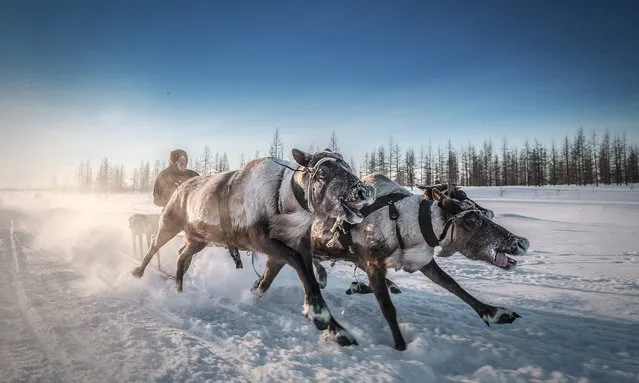
Take me away, deer, Russia. The Nenet people of Arctic Russia use reindeer and sledges as a prime mode of transport. The animals’ navigational ability means that in severe conditions they are sometimes the only hope of survival. (Photo by Kamil Nureev/Smithsonian Photo Contest)

Take me away, deer, Russia. The Nenet people of Arctic Russia use reindeer and sledges as a prime mode of transport. The animals’ navigational ability means that in severe conditions they are sometimes the only hope of survival. (Photo by Kamil Nureev/Smithsonian Photo Contest)
Details
06 Mar 2017 00:05:00
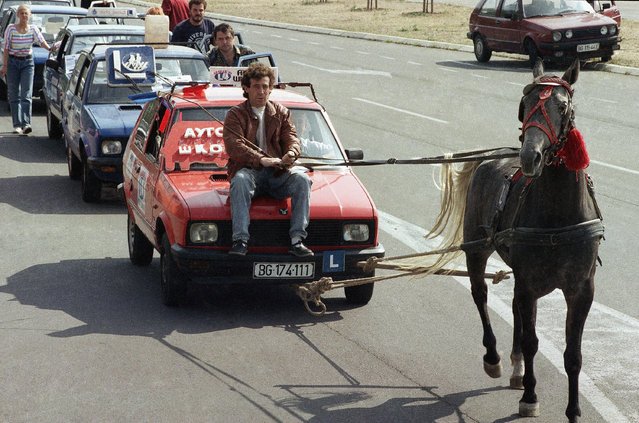
A horse pulls a driving school car as other drivers push their vehicles behind during a demonstration by driving instructors in Belgrade, September 25, 1992. Due to gasoline shortage in the Yugoslav capital, driving instructors are staying away from work. (Photo by AP Photo)

A horse pulls a driving school car as other drivers push their vehicles behind during a demonstration by driving instructors in Belgrade, September 25, 1992. Due to gasoline shortage in the Yugoslav capital, driving instructors are staying away from work. (Photo by AP Photo)
Details
26 Sep 2015 08:04:00
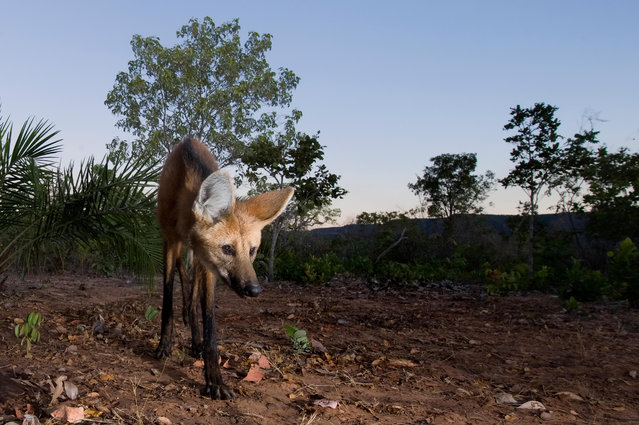
The maned wolf is among the large mammals in the Brazilian Cerrado that are threatened by the increasing conversion of grasslands into farmland for grazing and growing crops. (Photo by Ben Cranke/Nature Picture Library/Alamy Stock Photo)

Global wildlife populations will decline by 67% by 2020 unless urgent action is taken to reduce human impact on species and ecosystems, warns the biennial Living Planet Index report from WWF (World Wide Fund for Nature) and ZSL (Zoological Society of London). From elephants to eels, here are some of the wildlife populations most affected by human activity. Here: The maned wolf is among the large mammals in the Brazilian Cerrado that are threatened by the increasing conversion of grasslands into farmland for grazing and growing crops. (Photo by Ben Cranke/Nature Picture Library/Alamy Stock Photo)
Details
28 Oct 2016 10:47:00