Loading...
Done
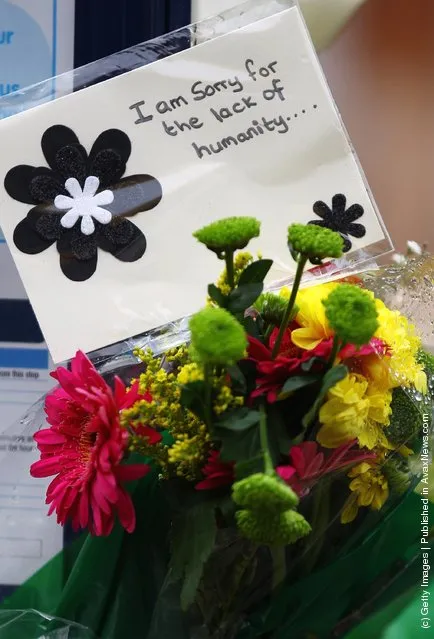
Respects Are Paid To Three Killed In Hit And Run During Birmingham Riot

Flowers are left at the scene of a hit and run following civil disturbances in the Winson Green area on August 11, 2011 in Birmingham, England. Police are continuing investigations after three people – reportedly trying to protect shops from rioting and looting in Dudley Road – were struck by a car. Police have so far arrested over 1,000 people following rioting which erupted over a four-day period across the UK. (Photo by Jeff J Mitchell/Getty Images)
Details
11 Aug 2011 14:14:00
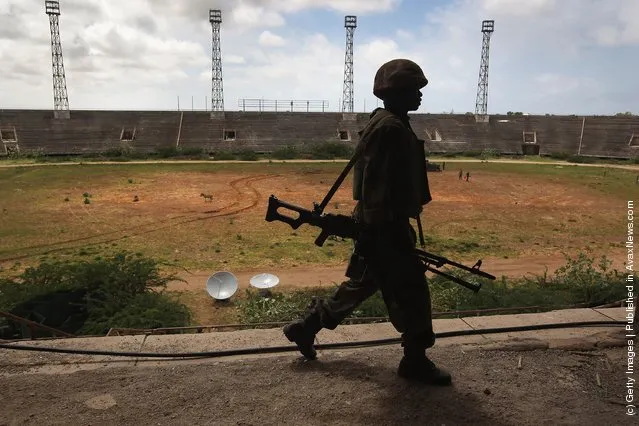
A Ugandan soldier, part of the 9,000-strong African Union Mission in Somalia, (AMISOM) walks through the Banadir soccer stadium in Mogadishu, Somalia

A Ugandan soldier, part of the 9,000-strong African Union Mission in Somalia, (AMISOM) walks through the Banadir soccer stadium on August 15, 2011 in Mogadishu, Somalia. The stadium, Somalia's largest soccer facility, had been under control by Islamic extremist Shabab militants for the past two years until they withdrew from the capital more than a week ago. (Photo by John Moore/Getty Images)
Details
18 Aug 2011 10:56:00


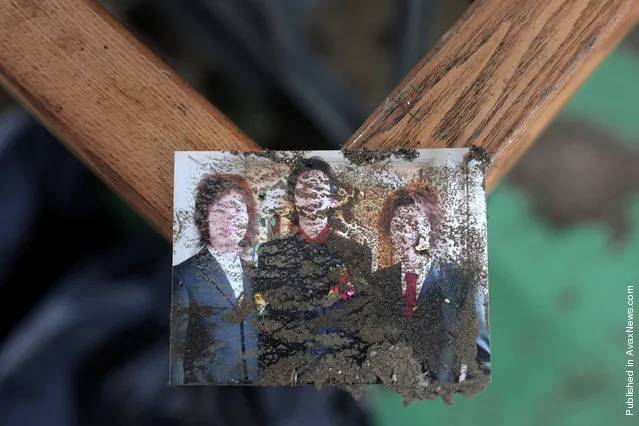
A muddied family photograph sits on a hallway stairwell in an apartment block on March 17, 2011 in Kensennuma, Japan. Residents were allowed back to their homes today and began the massive cleanup operation caused by a 9.0 magnitude strong earthquake that struck on March 11 off the coast of north-eastern Japan. The quake triggered a tsunami wave of up to 10 metres which engulfed large parts of north-eastern Japan. The death toll has risen past 5000 with at least 8600 people still missing. (Photo by Chris McGrath/Getty Images)
Details
17 Mar 2011 12:29:00


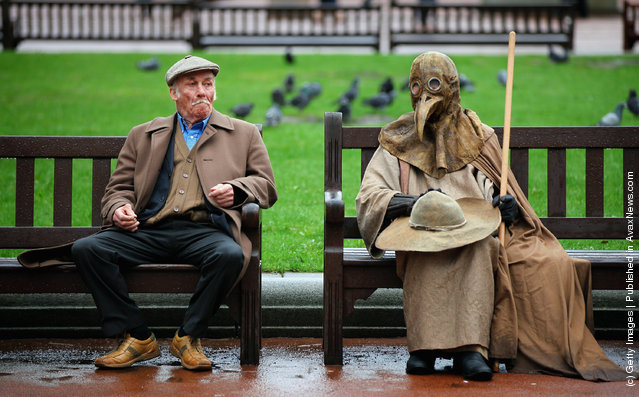
Glasgow based artist dressed Frank To dressed in a medieval Plague Doctor costume sits beside 72-year-old Willie Kennedy from Glasgow on March 31, 2011 in Glasgow, Scotland. The artist is promoting his first major exhibition in two years, “The Human Condition”, which opens tomorrow at the Leith Gallery in Edinburgh. The artist is showing a series of pictures which depict Mediaeval Plague Doctors, which have fascinated the artist for the last three years. (Photo by Jeff J Mitchell/Getty Images)
Details
01 Apr 2011 13:37:00


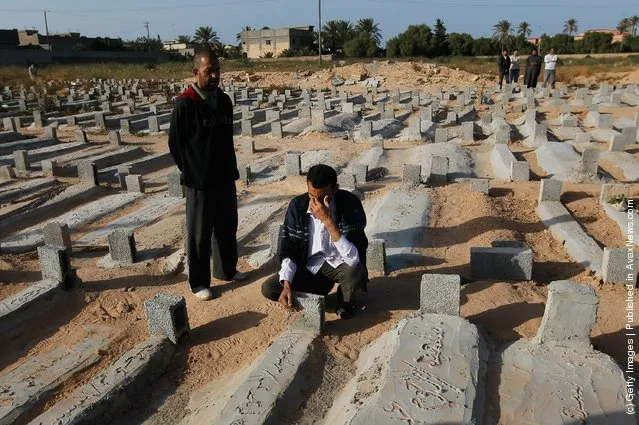
A man cries in a graveyard during the funeral of Nasser Ali Afglio, a young Libyan rebel killed during battle with government troops loyal to Libyan ruler Moammar Gaddafi April 19, 2011 in Misrata, Libya. The graveyard where Nasser was buried has hundreds of simple concrete graves; many dozens are those that have been killed during the last two months of fighting in the besieged town. Thousands of civilians are trapped in Misrata as fighting continues between Libyan government forces that have surrounded the city and anti-government rebels there. (Photo by Chris Hondros/Getty Images)
Details
22 Apr 2011 08:22:00


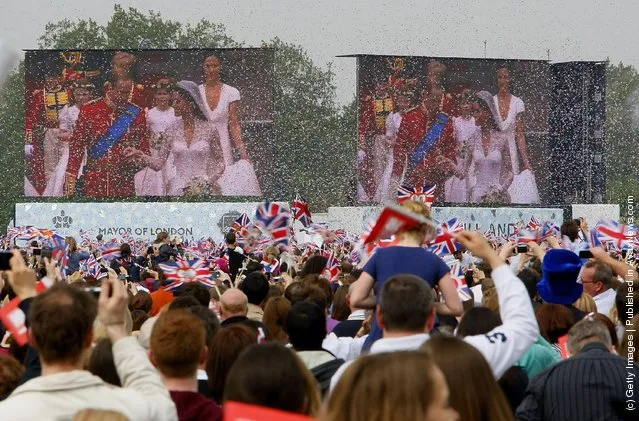
General view of the screens in Hyde Park to showing the Royal Wedding on April 29, 2011 in London, England. The marriage of Prince William, the second in line to the British throne, to Catherine Middleton is being held in London today. The Archbishop of Canterbury conducted the service which was attended by 1900 guests, including foreign Royal family members and heads of state. Thousands of well-wishers from around the world have also flocked to London to witness the spectacle and pageantry of the Royal Wedding and street parties are being held throughout the UK. (Photo by Tom Dulat/Getty Images)
Details
29 Apr 2011 12:45:00
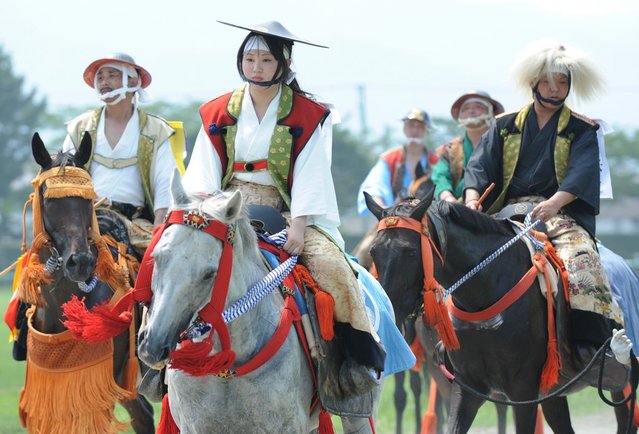
A young woman (C) clad in samurai costume leads other local poeple as she rides her horse during a parade at the annual Soma Nomaoi festival in Minamisoma, Fukushima Prefecture, on July 28, 2012.  The traditional full-scale festival kicked off for the first time after the accident of the Fukushima Dai-ichi Nuclear Power Plant following the massive earthquake and the tsunami on March 11, 2011. (Photo by Toru Yamanaka/AFP Photo)

Soma-Nomaoi is a festival that recreates a battle scene from more than 1,000 years ago. It is annually held for 4 days from July 22 to 25 in Haramachi City, Fukushima Prefecture, in the eastern part of Japan. In this historical event, 600 mounted samurai in traditional Japanese armor, with long swords at their side and ancestral flagstaffs streaming from their backs, ride across open fields. Soma-Nomaoi has been designated an Important Intangible Folk Cultural Property.

Photo: A young woman (C) clad in samurai costume leads other local poeple as she rides her horse during a parade at the annual Soma Nomaoi festival in Minamisoma, Fukushima Prefecture, on July 28, 2012. The traditional full-scale festival kicked off for the first time after the accident of the Fukushima Dai-ichi Nuclear Power Plant following the massive earthquake and the tsunami on March 11, 2011. (Photo by Toru Yamanaka/AFP Photo)
Details
02 Aug 2012 12:59:00


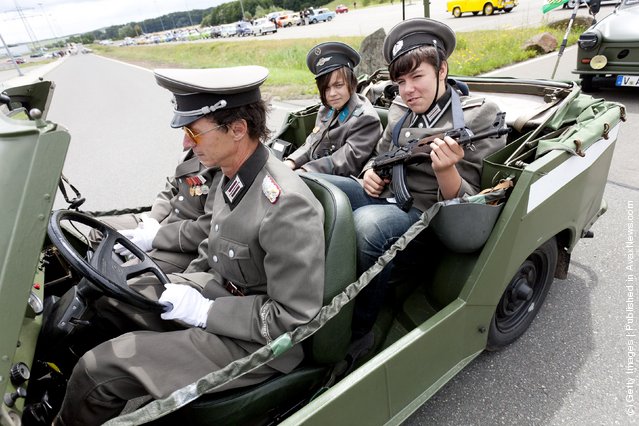
“The Trabant is a car that was produced by former East German auto maker VEB Sachsenring Automobilwerke Zwickau in Zwickau, Sachsen. It was the most common vehicle in East Germany, and was also exported to countries both inside and outside the communist bloc. The main selling points was that it had room for four adults and luggage in a compact, light and durable shell and that it was fast (when introduced) and durable. With its mediocre performance, smoky two-stroke engine, and production shortages, the Trabant is often cited as an example of the disadvantages of centralized planning; on the other hand, it is regarded with derisive affection as a symbol of the failed former East Germany and of the fall of communism (in former West Germany, as many East Germans streamed into West Berlin and West Germany in their Trabants after the opening of the Berlin Wall in 1989). It was in production without any significant changes for nearly 30 years with 3,096,099 Trabants produced in total”. – Wikipedia

Photo: Enthusiasts weared in uniforms of the former eastern german army trive in a military Trabant car as fans and owners of East German-era Trabant cars gather at the 2011 International Trabantfahrer Treffen (International Trabant Drivers Meeting) on June 26, 2011 in Zwickau, Germany. The Trabant, also known as the Trabi, was among the main cars produced in communist East Germany and built by VEB Sachsenring Automobilwerke in Zwickau for 30 years until 1989. Today the car has cult status for many followers and one company, IndiKar, is even seeking to revive the brand in a modern, electric version. (Photo by Carsten Koall/Getty Images)

Details
27 Jun 2011 12:21:00