Loading...
Done
Porcelain Figurines By Martin Klimas

From a height of three meters, porcelain figurines are dropped on the ground, and the sound they make when they hit trips the shutter release. The result: razor-sharp images of disturbing beauty—temporary sculptures made visible to the human eye by high-speed photography technology. The porcelain statuette bursting into pieces isn't what really captures the attention; the fascination lies in the genesis of a dynamic figure that replaces the static pose. In contrast to the inertness of the intact kitsch figurines Klimas started out with, the photographs of their destruction possess a powerfully narrative character.
Details
21 Apr 2014 12:59:00
Alfred Könner, “Bilderzoo” by Illustrator Mirko Hanák

Mirko Hanák was born in 1921 in Prague, Czech Republic and worked as a painter, graphic designer and illustrator. His specialties were animals and human figures that were full of life and fun. He also had a firm grasp on composition as his paintings were so well balanced despite his casual fluid line. He was working on “Charlotte's Web” the movie when he tragically died at the height of his career from leukemia in 1971.
Details
18 Mar 2013 10:13:00
Painting By Koday Laszlo

Laszlo Koday was born in Hungary in 1945. In 1970 he began as a self-tought painter. The life and work of Henri Rousseau made a deep impression on him. His pictures are fairy tales expressed by pictorial means, human, animal and nature are equally important in them. There are bright, with unmixed pure colours, compositions wich spread calmness and gaiety. Kaday's works are know not only in Hungary but in many countries and are included in many private and public collections. His paintings can be found in galleries abroad, for example the GINA Gallery.
Details
23 Jul 2013 09:00:00
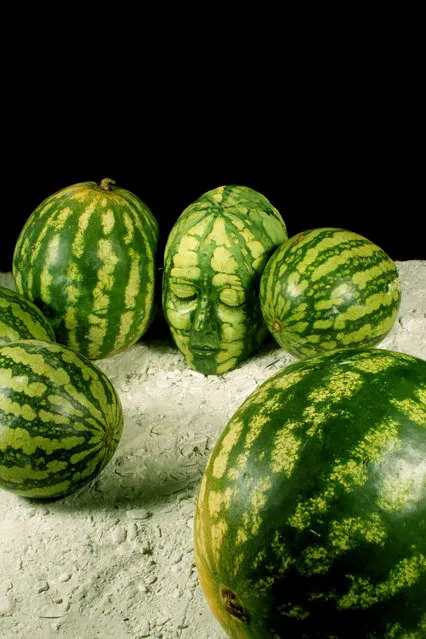
“Melon”. (Photo by Johannes Stötter)

Award winning Italian Bodypainter Johannes Stötter, paints his models to blend in to their backgrounds. The artist and musician based in Italy has created some of the most unique and life-like pieces of art we've ever seen. And yes, while some works like the ready-to-eat human melon heads creep us out, it's fair to say Stötter has owned his craft. Photo: “Melon”. (Photo by Johannes Stötter)
Details
02 Aug 2013 08:51:00
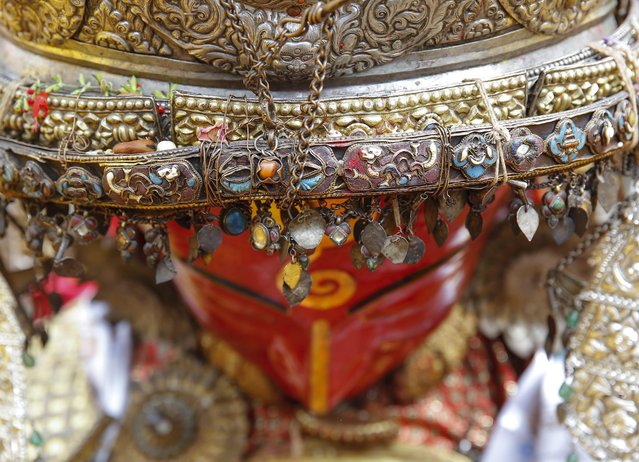
A close up of ornaments of centuries-old idols of Lord Buddha during the Pancha Daan, Five donation, festival in Bhaktapur, Nepal, 30 August 2016. (Photo by Narendra Shrestha/EPA)

A close up of ornaments of centuries-old idols of Lord Buddha during the Pancha Daan, Five donation, festival in Bhaktapur, Nepal, 30 August 2016. Thousands of Buddhist pilgrims observe the main day of the Pancha Daan also known as a five summer gifts (rice, grain, salt, money and fruits) festival which is observes for world peace and human welfare. (Photo by Narendra Shrestha/EPA)
Details
31 Aug 2016 12:18:00
Anne Lamb – Art

Allyson Anne Lamb is a Brooklyn based fine artist primarily working in photography. Her work uses the body to explore the complexity of human emotions and the continuous invisible transformations we experience, revealing them as monstrosities or fantastical beings. Through the assembling of body parts, bright colors and fictional spaces that exist in Lamb's magical realm where sexual anxiety, female identity and altered sensorial perceptions are explored, Lamb invites us to participate in an altered state of consciousness. We step in to quaint fragmented realities where we are welcomed to engage in lucid dreaming populated by colorful mutations.
Details
14 Jun 2012 12:51:00
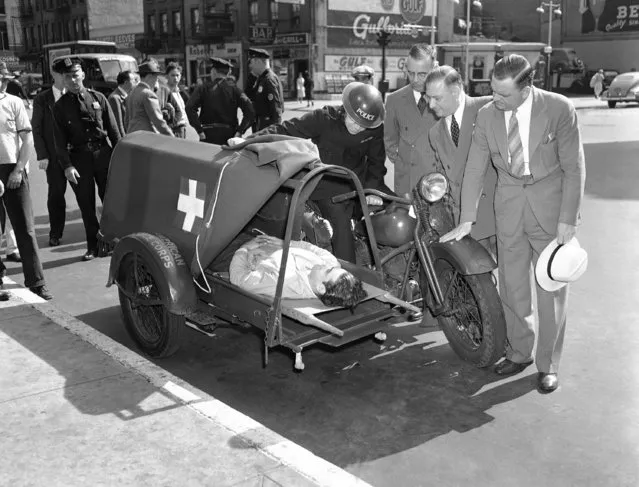
Developed for the British American Ambulance Corps, this new motorcycle ambulance is capable of speeding wounded soldiers 90 miles an hour from the front lines to field hospitals. Its springs are synchronized with the patient?s heartbeat to avoid increasing fever when traveling over various Terrain. Viewing it in New York  August 27, 1941, are left to right: constable Herbert Scott of England, driver; William E. Detlor, whose firm developed the vehicle; M. W. Stand, inspector-general of Civilian Defense, and Maj. Edward Riekert, also. (Photo by AP Photo)

Developed for the British American Ambulance Corps, this new motorcycle ambulance is capable of speeding wounded soldiers 90 miles an hour from the front lines to field hospitals. Its springs are synchronized with the patient's heartbeat to avoid increasing fever when traveling over various Terrain. Viewing it in New York August 27, 1941, are left to right: constable Herbert Scott of England, driver; William E. Detlor, whose firm developed the vehicle; M. W. Stand, inspector-general of Civilian Defense, and Maj. Edward Riekert, also. (Photo by AP Photo)
Details
28 Aug 2015 11:51:00
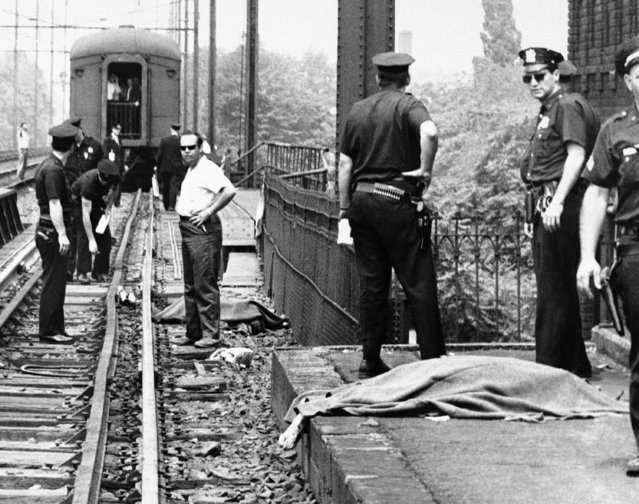
Blankets cover the bodies of a woman (right) and a man (left background) hit by a northbound Penn Central train (background) as they waited with a crowd at Pennsylvania Railroad station in Elizabeth, N.J. on June 8, 1968 to view the southbound train carrying the body of Sen. Robert F. Kennedy to Washington. The woman was identified as Mrs. Antoinette Severini, 54, and the man, John Curia (age unavailable), both of Elizabeth. (Photo by AP Photo)

Blankets cover the bodies of a woman (right) and a man (left background) hit by a northbound Penn Central train (background) as they waited with a crowd at Pennsylvania Railroad station in Elizabeth, N.J. on June 8, 1968 to view the southbound train carrying the body of Sen. Robert F. Kennedy to Washington. The woman was identified as Mrs. Antoinette Severini, 54, and the man, John Curia (age unavailable), both of Elizabeth. (Photo by AP Photo)
Details
09 Dec 2017 02:15:00