Loading...
Done
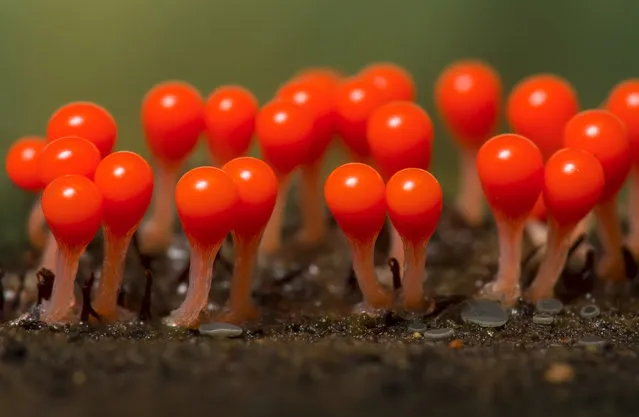
These may look like alien creatures from another planet, but the odd organisms are, in fact, colorful, microscopic life forms found in our forests. The bizarre slime molds, known as mycetozoa or fungus animals, were captured by geologist Valeriya Zvereva. (Photo by Valeriya Zvereva/Caters News)

These may look like alien creatures from another planet, but the odd organisms are, in fact, colorful, microscopic life forms found in our forests. The bizarre slime molds, known as mycetozoa or fungus animals, were captured by geologist Valeriya Zvereva. She spent months documenting the common life forms that are found beneath our feet – but are rarely seen. Incredibly, the organisms can move and hunt for other microscopic life forms on which to feed. Zvereva, who is from Moscow, used a special macro lens to capture the vibrant and up-close shots, which show off the organisms’ unlikely beauty. (Photo by Valeriya Zvereva/Caters News)
Details
20 Apr 2015 13:27:00
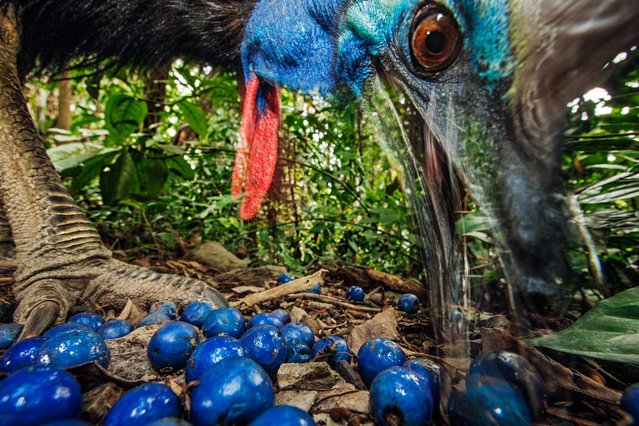
“Cassowaries are large, flightless birds related to emus and (more distantly) to ostriches, rheas, and kiwis”, writes Olivia Judson in the September issue of National Geographic magazine. (Photo by Christian Ziegler/National Geographic)

“Cassowaries are large, flightless birds related to emus and (more distantly) to ostriches, rheas, and kiwis”, writes Olivia Judson in the September issue of National Geographic magazine. How large? People-size: Adult males stand well over five foot five and top 110 pounds. Females are even taller, and can weigh more than 160 pounds. Dangerous when roused, they’re shy and peaceable when left alone. But even birds this big and tough are prey to habitat loss. The dense New Guinea and Australia rain forests where they live have dwindled. Today cassowaries might number 1,500 to 2,000. And because they help shape those same forests – by moving seeds from one place to another – “if they vanish”, Judson writes, “the structure of the forest would gradually change” too. (Photo by Christian Ziegler/National Geographic)
Details
06 Jan 2014 12:21:00
German artist Ha Schult stands with his trash people below the pyramids May 15, 2002 in Giza, Egypt

“HA Schult, born Hans-Jürgen Schult on June 24, 1939 in Parchim, Mecklenburg is a German installation, happening and conceptual artist known primarily for his object and performance art and more specifically his work with garbage”. – Wikipedia

Photo: German artist Ha Schult stands with his “trash people” below the pyramids May 15, 2002 in Giza, Egypt. Inspired by the statues of the terracotta army of Chinese Emperor Quin Shi Huangdi (247–206 B.C.), the thousand piece sulpture has stood in Red Square in Moscow, La Defense in Paris and the Great Wall in China. Schult, born in 1939 wants to bring the “trash war” to the world's attention beause trash is the greatest battle facing mankind. (Photo by Norbert Schiller/Getty Images)
Details
31 Jul 2011 13:37:00
Alexandr Kudlay, 33, and Viktoria Pustovitova, 28, have breakfast in their apartment in Kharkiv, Ukraine on March 5, 2021. Tired of occasional break-ups, this Ukrainian couple found an unusual solution to stay inseparable. On St. Valentine's Day, they decided to handcuff their hands together for three months and began documenting their experience on social media. (Photo by Gleb Garanich/Reuters)

Alexandr Kudlay, 33, and Viktoria Pustovitova, 28, have breakfast in their apartment in Kharkiv, Ukraine on March 5, 2021. Tired of occasional break-ups, this Ukrainian couple found an unusual solution to stay inseparable. On St. Valentine's Day, they decided to handcuff their hands together for three months and began documenting their experience on social media. (Photo by Gleb Garanich/Reuters)
Details
09 Apr 2021 10:14:00
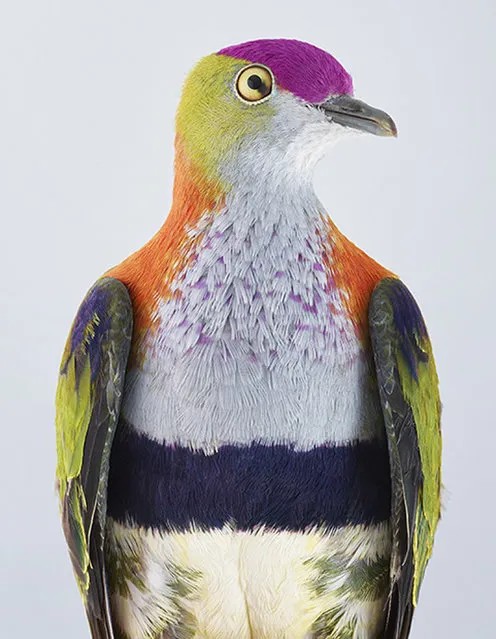
The series, which was photographed between 2015 and 2017, is currently on display at the Purdy Hicks Gallery in London, running through August 24, 2018. (Photo by Leila Jefferies/Caters News Agency)

This photographer has made it her mission to change people’s perception of pigeons – focusing on some of the most beautiful of the more than 300 species found globally. Rather than focus on the gray, nondescript birds people usually associate with the term “pigeon”, Leila Jeffreys has instead decided to snap the more vibrant varieties. Whether it be the wompoo pigeon, with its deep purple breast and green wings, or the rose-crowned fruit dove, with its pink head, Jeffreys, 46, gives the birds the same attention she would give a human model. (Photo by Leila Jefferies/Caters News Agency)
Details
14 Aug 2018 00:01:00
The sun begins to set over this rusty beachside mansion that has been left abandoned for more than 25 years in Thailand, June 2017. A deserted beachside mansion in southern Thailand has retained its beauty – despite no one living there for more than 25 years. In June this year abandoned photographer, Dax Ward, ventured to the Prachuap Khiri-Khan Province to capture the haunting attraction on camera. (Photo by Dax Ward/Barcroft Images)

The sun begins to set over this rusty beachside mansion that has been left abandoned for more than 25 years in Thailand, June 2017. A deserted beachside mansion in southern Thailand has retained its beauty – despite no one living there for more than 25 years. In June this year abandoned photographer, Dax Ward, ventured to the Prachuap Khiri-Khan Province to capture the haunting attraction on camera. (Photo by Dax Ward/Barcroft Images)
Details
07 Aug 2017 07:39:00
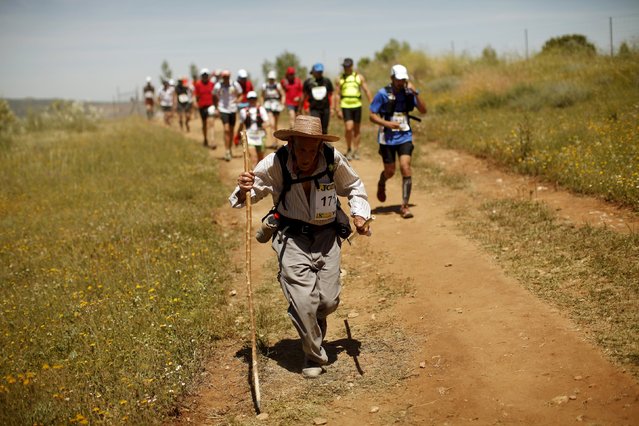
Spanish runner Francisco Contreras, 77, known as “Super Paco”, runs as he participates in the XVIII 101km international competition in the outskirts of Ronda, southern Spain, May 9, 2015. (Photo by Jon Nazca/Reuters)

Spanish runner Francisco Contreras, 77, known as “Super Paco”, runs as he participates in the XVIII 101km international competition in the outskirts of Ronda, southern Spain, May 9, 2015. About 7,000 participants, including runners, mountain bikers and duathletes, run a track of 101 km (63 miles) in less than 24 hours through the “Serrania de Ronda” (Ronda Mountain Range) during this competition organised by the 4th Tercio (Regiment) “Alejandro Farnesio” of the Spanish Legion. The Puente Nuevo is 120 metres (394 feet) high over the gorge of the river that divides the city of Ronda. Picture taken using long exposure. (Photo by Jon Nazca/Reuters)
Details
11 May 2015 12:17:00


“Snowflake (c. 1964 – November 24, 2003) was an albino gorilla. He was the only known albino gorilla so far, and the most popular resident of the Barcelona Zoo in Catalonia, Spain. Originally named Nfumu Ngui in Fang language ("white gorilla") by his captor, he was then nicknamed Floquet de Neu (Catalan for little snowflake) by his keeper Jordi Sabater Pi. On his arrival to Barcelona where he was given an official reception by the then Mayor of Barcelona, Josep Maria de Porcioles, in November 1966, he was called Blancanieves (“Snow White”) in the newspaper Tele/Exprés. But he became famous with the name given to him by Sabater when National Geographic Magazine featured him on the main page in March 1967, with the English name Snowflake. This name spread among the press (Stern, Life, Paris-Match) and was later translated to Spanish as Copito de Nieve. Sabater himself called the gorilla Floquet or Copi, and in the later years Nfumu. The asteroid 95962 Copito, discovered by Catalan astronomer J. Manteca, is named in his honour”.
Details
07 Mar 2011 15:50:00