Loading...
Done
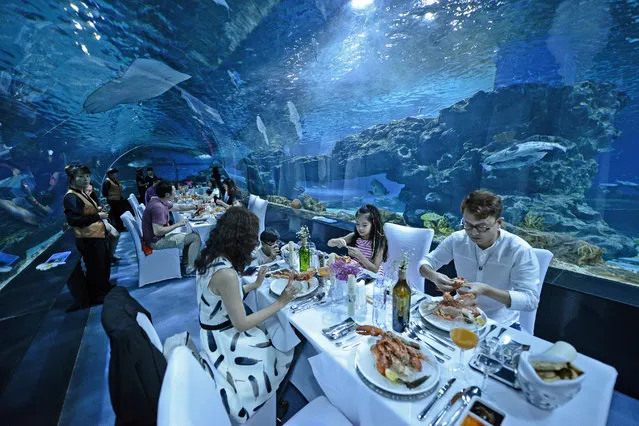
Aquarium visitors attend a dinner party in an underwater tunnel in Tianjin, China on September 15, 2016. (Photo by Feature China/Barcroft Images)

Aquarium visitors attend a dinner party in an underwater tunnel in Tianjin, China on September 15, 2016. Tianjin Haichang Polar Ocean World opened in the city of Tianjin, southeast of Beijing, in 2010. It gives visitors a chance to see more than 150 large animals from the Arctic and Antarctic regions, including polar bears. (Photo by Feature China/Barcroft Images)
Details
16 Sep 2016 11:18:00
A car made from parts taken from used vehicles is shown in street Hefei, Anhui Province in China, on Oktober 21, 2013. The machine, which reaches 60 km/h, is the brainchild of self-taught inventor Zhu Runqiang. (Photo by Reuters/China Daily)

A car made from parts taken from used vehicles is shown in street Hefei, Anhui Province in China, on Oktober 21, 2013. The machine, which reaches 60 km/h, is the brainchild of self-taught inventor Zhu Runqiang. (Photo by Reuters/China Daily)

P.S. All pictures are presented in high resolution. To see Hi-Res images – just TWICE click on any picture. In other words, click small picture – opens the BIG picture. Click BIG picture – opens VERY BIG picture (if available; this principle works anywhere on the site AvaxNews)
Details
26 Oct 2013 11:41:00
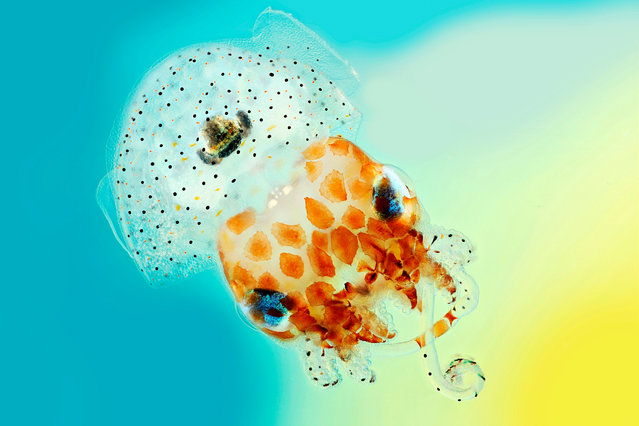
With its huge eyes, comical name and diminutive size, Mark R. Smith’s image of a baby Hawaiian bobtail squid can’t help but raise a smile. A curiously endearing creature, the cephalopod is just 1.5cm across, its mantle cavity bearing more than a passing resemblance to a rather natty shower cap. But it is also a beautiful example of symbiosis – nature’s version of “I’ll scratch your back if you scratch mine” – for on the underside of the squid is a light organ which houses bioluminescent bacteria. The squid offers the bacteria protection and food, while the bacteria emit a glow – a handy trait that the squid uses to offset its silhouette, helping it to evade predators in the depths below. Mark R. Smith’s entry combines several images of a Hawaiian bobtail squid with different focus lengths to create a final picture with greater depth of field than normal. (Photo by Mark R. Smith/Wellcome Images/Macroscopic Solutions)

With its huge eyes, comical name and diminutive size, Mark R. Smith’s image of a baby Hawaiian bobtail squid can’t help but raise a smile. A curiously endearing creature, the cephalopod is just 1.5cm across, its mantle cavity bearing more than a passing resemblance to a rather natty shower cap. But it is also a beautiful example of symbiosis – nature’s version of “I’ll scratch your back if you scratch mine” – for on the underside of the squid is a light organ which houses bioluminescent bacteria. The squid offers the bacteria protection and food, while the bacteria emit a glow – a handy trait that the squid uses to offset its silhouette, helping it to evade predators in the depths below. Mark R. Smith’s entry combines several images of a Hawaiian bobtail squid with different focus lengths to create a final picture with greater depth of field than normal. (Photo by Mark R. Smith/Wellcome Images/Macroscopic Solutions)
Details
08 Mar 2017 00:05:00
The 27 curvy candidates for this year's eagerly-awaited Miss Bumbum pageant showed off all their assets as they paraded on one of Sao Paulo's busiest streets – Avenida Paulista – for the launch promotional race on August 8, 2016. Unsurprisingly, they stopped traffic. The girls will be fighting it out for the coveted title in a public vote before being whittled down to 15 finalists for the grand finale in November. (Photo by Leo Marinho/Splash News and Pictures)

The 27 curvy candidates for this year's eagerly-awaited Miss Bumbum pageant showed off all their assets as they paraded on one of Sao Paulo's busiest streets – Avenida Paulista – for the launch promotional race on August 8, 2016. Unsurprisingly, they stopped traffic. The girls will be fighting it out for the coveted title in a public vote before being whittled down to 15 finalists for the grand finale in November. (Photo by Leo Marinho/Splash News and Pictures)
Details
10 Aug 2016 10:27:00
Unsettled life in Europe failed to change the slow pace of life on the Isle of Capri, off Naples, Italy. Some of the socialites who have come there to relax enjoy an aquatic luncheon serviced in the cool Mediterranean, September 1, 1939. Swimming waiters push out the floating tables bearing meals which include wine and spaghetti. In the background are the rocks of Faraglioni. (Photo by Hamilton Wright/AP Photo)

Unsettled life in Europe failed to change the slow pace of life on the Isle of Capri, off Naples, Italy. Some of the socialites who have come there to relax enjoy an aquatic luncheon serviced in the cool Mediterranean, September 1, 1939. Swimming waiters push out the floating tables bearing meals which include wine and spaghetti. In the background are the rocks of Faraglioni. (Photo by Hamilton Wright/AP Photo)
Details
18 Dec 2017 08:18:00
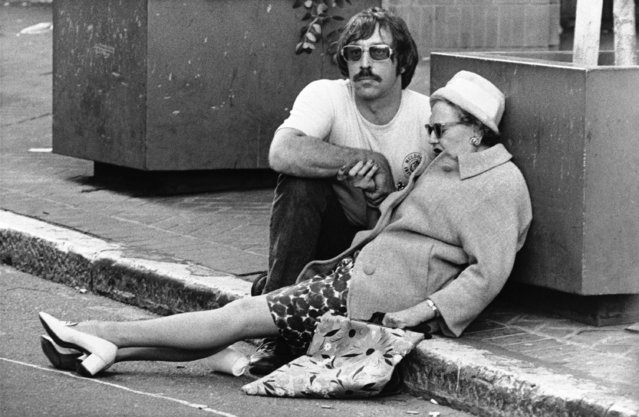
An unidentified elderly woman, who was knocked over during the melee after a shot was fired in the direction of President Ford, is comforted by a passerby in San Francisco, September 23, 1975. (Photo by AP Photo)

An unidentified elderly woman, who was knocked over during the melee after a shot was fired in the direction of President Ford, is comforted by a passerby in San Francisco, September 23, 1975. (Photo by AP Photo)
Details
05 Jan 2018 07:19:00
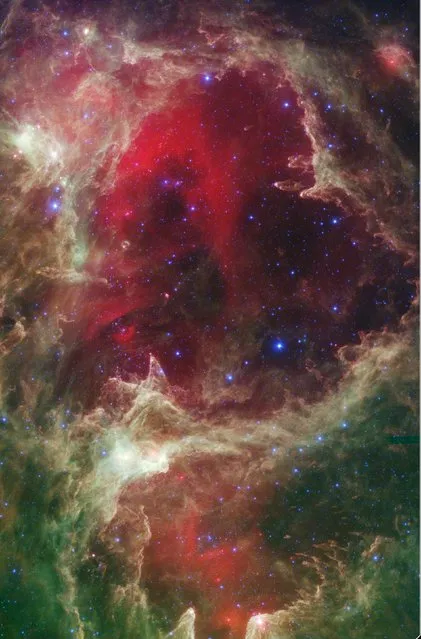
An infrared portrait from NASA's Spitzer Space Telescope which shows generations of stars is seen in this undated NASA handout image released February 14, 2013. In this wispy star-forming region, called W5, the oldest stars can be seen as blue dots in the centers of the two hollow cavities (other blue dots are background and foreground stars not associated with the region). Red shows heated dust that pervades the region's cavities, while green highlights dense clouds. (Photo by NASA/Reuters/JPL-Caltech/Harvard-Smithsonian/Handout)

An infrared portrait from NASA's Spitzer Space Telescope which shows generations of stars is seen in this undated NASA handout image released February 14, 2013. In this wispy star-forming region, called W5, the oldest stars can be seen as blue dots in the centers of the two hollow cavities (other blue dots are background and foreground stars not associated with the region). Red shows heated dust that pervades the region's cavities, while green highlights dense clouds. (Photo by NASA/Reuters/JPL-Caltech/Harvard-Smithsonian/Handout)
Details
03 Mar 2013 08:44:00
Going nowhere in a hurry, this friendly Javan Tree frog can be seen casually hopping aboard the slow-paced snail who like a lonely highway trucker is only too happy to have the company.  These cute critters chew the fat until froggy reaches his destination and alights at the top of the branch. (Photo by Kurit Afsheen/Media Drum World)

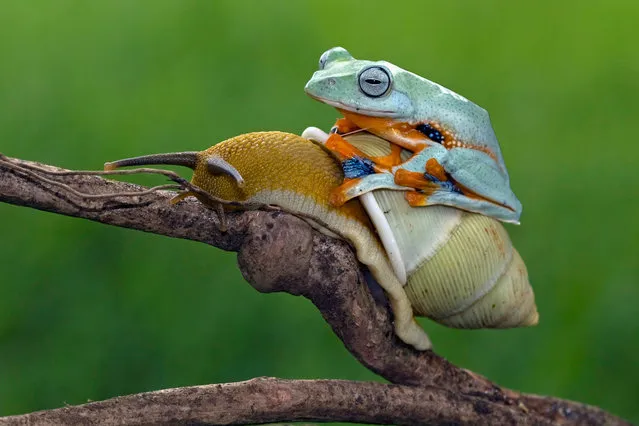
Going nowhere in a hurry, this friendly Javan Tree frog can be seen casually hopping aboard the slow-paced snail who like a lonely highway trucker is only too happy to have the company. These cute critters chew the fat until froggy reaches his destination and alights at the top of the branch. Creative Designer and amateur photographer Kurit Afsheen (34) was able to capture this special sequence while out in his back garden in Ciledug, Indonesia. (Photo by Kurit Afsheen/Media Drum World)
Details
19 Jul 2015 09:17:00