Loading...
Done
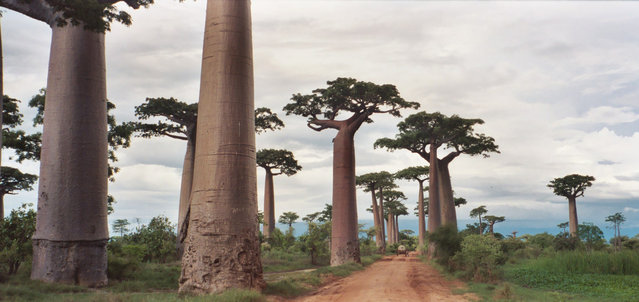
Avenue of the Baobabs

The Avenue or Alley of the Baobabs is a prominent group of baobab trees lining the dirt road between Morondava and Belon'i Tsiribihina in the Menabe region in western Madagascar. Its striking landscape draws travelers from around the world, making it one of the most visited locations in the region. It has been a center of local conservation efforts, and was granted temporary protected status in July 2007 by the Ministry of Environment, Water and Forests, the first step toward making it Madagascar's first natural monument.
Details
16 Nov 2012 10:05:00
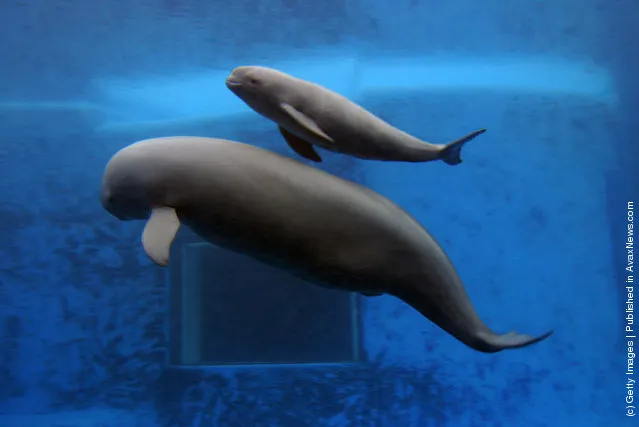
A newly born Yangtze finless porpoise (top) swims with his mother at the Hydrobiology Institute of the Chinese Academy of Sciences

“The finless porpoise (Neophocaena phocaenoides) is one of six porpoise species. In the waters around Japan, at the northern end of its range, it is known as the sunameri. A freshwater population found in the Yangtze River in China is known locally as the jiangzhu or «river pig»”. – Wikipedia

Photo: A newly born Yangtze finless porpoise (top) swims with his mother at the Hydrobiology Institute of the Chinese Academy of Sciences on June 3, 2007 in Wuhan of Hubei Province, China. (Photo by China Photos/Getty Images)
Details
20 Feb 2012 12:23:00
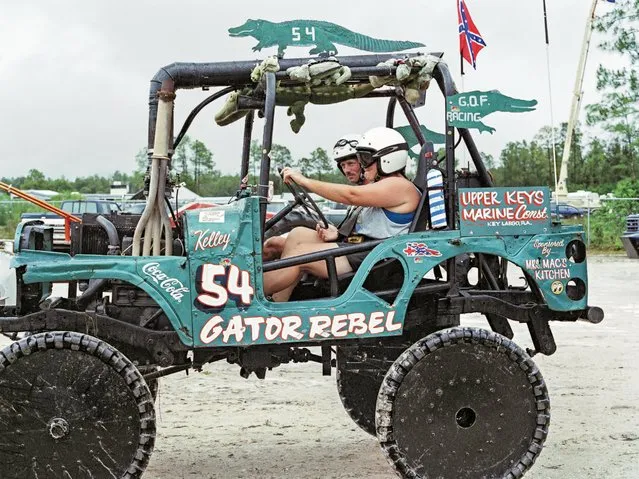
Kelley McMann, Gator Rebel, 2002. (Photo by Malcolm Lightner)

The Mile O' Mud is a 7/8-mile oval track with a 1/8-mile diagonal lane slashed through the center. The racing lanes are approximately 60 feet wide. On average, the muddy water is four to six feet deep, with three strategically placed holes. The largest hole, located in front of the grandstand, is the treacherous “Sippy Hole”, named for the legendary driver “Mississippi” Milton Morris, Swamp Buggy King 1955, who repeatedly got stuck in it. (Photo by Malcolm Lightner)
Details
19 May 2016 11:20:00
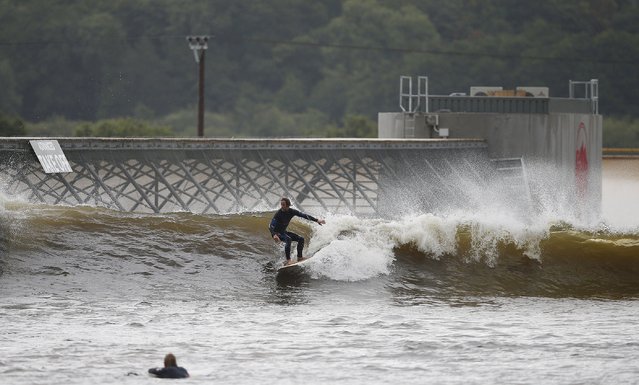
Surfers surf at Surf Snowdonia in Conwy, North Wales, September 3, 2015. (Photo by Andrew Yates/Reuters)

Surfers surf at Surf Snowdonia in Conwy, North Wales, September 3, 2015. The surf park, which cost $22.8 million, opened on August 1 and is the world's first commercial artificial surfing lake, according to the company.The pool is 300 metres (980 ft) long and 110 metres (360 ft) wide, containing a total of six million gallons of water. A bi-directional snowplough-shaped wave-generation mechanism, towed on a cable between the two central towers, moves up and down the pool on a three-rail track, generating the waves. (Photo by Andrew Yates/Reuters)
Details
04 Sep 2015 12:26:00
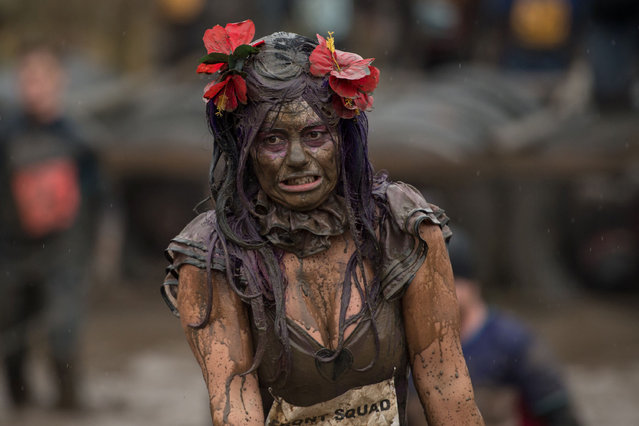
A competitor reacts as she takes part in the “Tough Guy” adventure race near Wolverhampton, central England, on January 29, 2017. (Photo by Oli Scarff/AFP Photo)

A competitor reacts as she takes part in the “Tough Guy” adventure race near Wolverhampton, central England, on January 29, 2017. The Tough Guy event, which is being held for the final time in its 30th year, challenges thousands of competitors to run a gruelling course whilst negotiating over 200 obstacles including: water, fire, and tunnels. (Photo by Oli Scarff/AFP Photo)
Details
01 Feb 2017 06:30:00
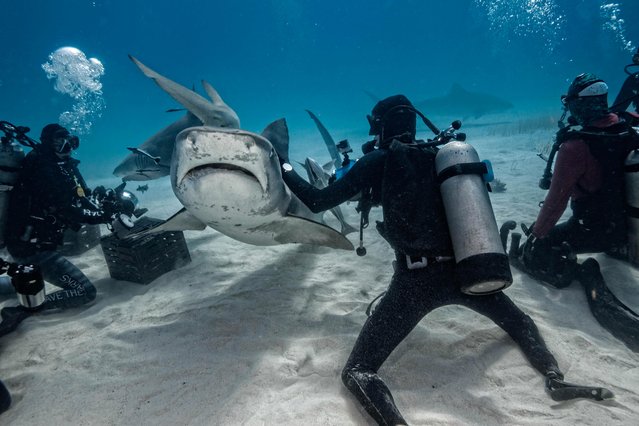
The spectacular sequence shows the divers reaching out and even petting the 500kg predators. (Photo by Steve Hinczynski/Mediadrumworld)

The spectacular sequence shows the divers reaching out and even petting the 1,000-pound predators as the inquisitive beasts happily pose for the camera. Other pictures show the sharks appearing to swim with the divers as they move towards the water’s surface. The photographs were taken at Tiger Beach, Grand Bahama by photographer, Steve Hinczynski (49) from Venice, Florida, USA. To take his images Steve used a Canon 7D Mark II camera equipped with Ikelite underwater housing. (Photo by Steve Hinczynski/Mediadrumworld)
Details
09 Mar 2017 00:01:00
Boats of fishermen are seen on the dried Poopo lakebed in the Oruro Department, south of La Paz, Bolivia, December 17, 2015. (Photo by David Mercado/Reuters)

Boats of fishermen are seen on the dried Poopo lakebed in the Oruro Department, south of La Paz, Bolivia, December 17, 2015. Lake Poopo in Bolivia, the Andean nation's formerly second largest after the famed Titicaca, has dried up entirely. With the water now gone, animals have died off in the millions, according to studies. And the local families, having lost much of their sustenance, have been forced to migrate. (Photo by David Mercado/Reuters)
Details
20 Dec 2015 08:04:00
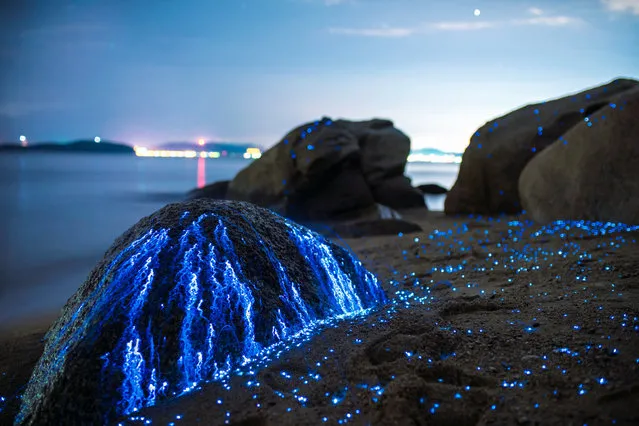
Bioluminescent sea fireflies glittering like diamonds on the rocks and sand. Okayama, Japan. July 2016. (Photo by Trevor Williams/Jonathan Galione/Getty Images)

Those lights are actually bioluminescent shrimp, better known as sea fireflies, or, in Japan, as “umibotaru”. Visible every year from May until the end of October, they live in the sand around very shallow sea water and are often seen floating between the extremes of high and low tides. Here: Bioluminescent sea fireflies glittering like diamonds on the rocks and sand. Okayama, Japan. July 2016. (Photo by Trevor Williams/Jonathan Galione/Getty Images)
Details
23 Aug 2016 10:13:00