Loading...
Done
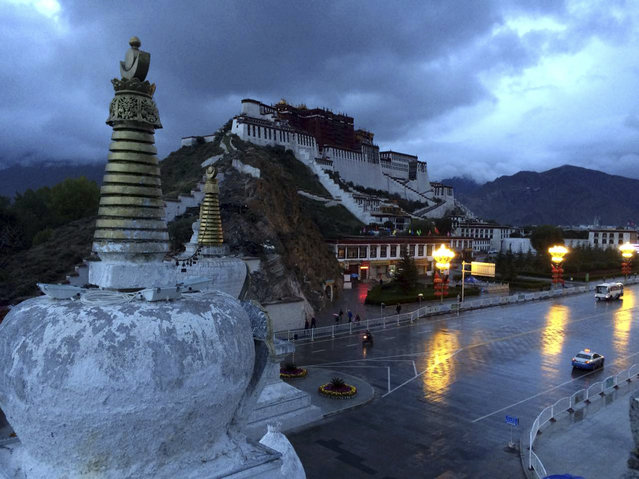
Pedestrians and vehicles make their way past the Potala Palace early on a rainy morning in Lhasa, capital of the Tibet Autonomous Region in China, Saturday, September 19, 2015. (Photo by Aritz Parra/AP Photo)

Pedestrians and vehicles make their way past the Potala Palace early on a rainy morning in Lhasa, capital of the Tibet Autonomous Region in China, Saturday, September 19, 2015. Chinese officials have taken foreign journalists on a visit to the region, normally off-limits to them, weeks after Communist Party officials commemorated the 50th anniversary of the establishment of the Tibet Autonomous Region. (Photo by Aritz Parra/AP Photo)
Details
19 Sep 2015 12:22:00
Serbian police officers of the Special Anti-Terrorist Unit pose for a picture in their base outside Belgrade October 8, 2014. (Photo by Marko Djurica/Reuters)

Serbian police officers of the Special Anti-Terrorist Unit pose for a picture in their base outside Belgrade October 8, 2014. When the killing of an unarmed black teenager by a white policeman in Ferguson, Missouri, in August sparked sometimes violent protests, the response of police in camouflage gear and armoured vehicles wielding stun grenades and assault rifles seemed more like a combat operation than a public order measure. Some U.S. police departments have recently acquired U.S. military-surplus hardware from wars abroad, but there are many law enforcers around the world whose rules of engagement also allow the use of lethal force with relatively few restrictions. But for every regulation that gives police wide scope to use firearms, there is another code that sharply limits their use. In Serbia, police may use measures ranging from batons to special vehicles, water cannon and tear gas on groups of people who have gathered illegally and are behaving in a way that is violent or could cause violence, but they may use firearms only when life is endangered. (Photo by Marko Djurica/Reuters)

Details
27 Nov 2014 14:53:00
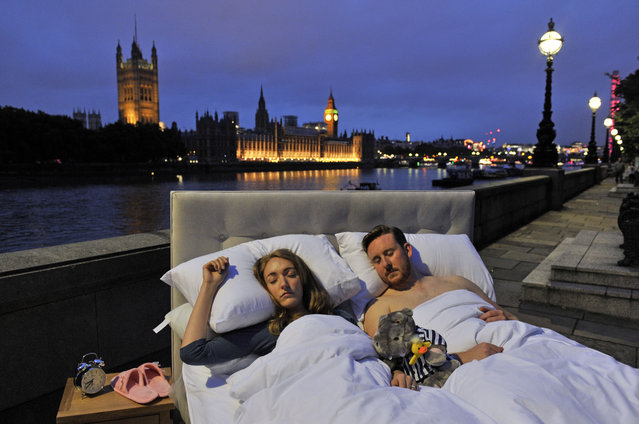
Londoners enjoy a “Silent Night” as Big Ben falls silent, London, UK on August 21, 2017. Londoners snuggle up to enjoy the city's first silent night as Big Ben chimed its last for four years. As the sun set over London last night the city bid a temporary farewell to the chimes of its beloved Big Ben. Londoners were testing out the new quiet of the Southbank in an unusual fashion. A luxurious bed, courtesy of bed firm, Silentnight, complete with fluffy white duvet, plump pillows, a hot water bottle and a cuddly toy, emerged in the heart of the city, just in time for bed. It didn't take local residents and workers long to make the most of the peace and quiet with the city's tired workers climbing in for a nap. Rose Allerston from Clapham, London said “After a stressful day in the office, I couldn't think of anything better than going home and climbing into bed - but when I saw this bed opposite Big Ben I just couldn't resist getting in for a snuggle”. (Photo by Imagewise Ltd/Rex Features/Shutterstock)

Londoners enjoy a “Silent Night” as Big Ben falls silent, London, UK on August 21, 2017. ose Allerston from Clapham, London said “After a stressful day in the office, I couldn't think of anything better than going home and climbing into bed – but when I saw this bed opposite Big Ben I just couldn't resist getting in for a snuggle”. (Photo by Imagewise Ltd/Rex Features/Shutterstock)
Details
23 Aug 2017 08:44:00
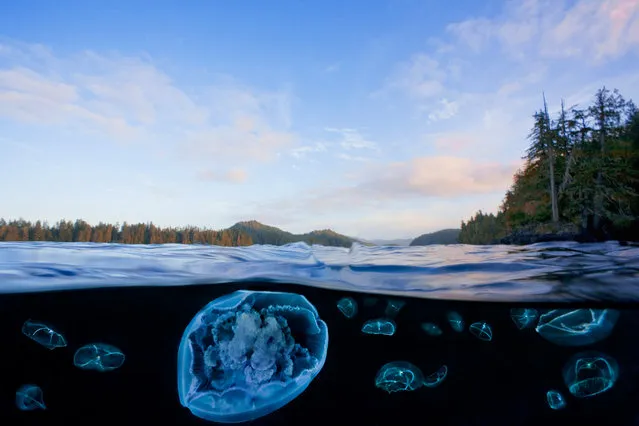
Moon jellyfish and cross jellies. (Photo by David Hall)

David Hall’s photographs of scenery and creatures off the coast of Canada in the Pacific Northwest portray serenity under the water, which belie the extreme challenges he faces to get his images. For each shoot, Hall wears a dry suit, a neoprene body suit that covers all of his body but his head and traps air inside to keep him warm. Water temperature in Canada’s British Columbia typically ranges between 45 and 50 degrees Fahrenheit. Photo: Moon jellyfish and cross jellies. (Photo by David Hall)
Details
16 Sep 2014 12:57:00
The Japanese Use A Real Rabbits As Case For Smartphone

If you see a weird trend or a mind boggling commercial, you know that it’s from Japan. Take the latest one for example. You might be misled be the title into thinking that those bloody bastards are killing poor rabbits and making iPhone cases out of them. However, the reality is much more adorable. The new trend is placing iPhones on rabbit’s tummies and taking pictures of it. Rabbits make the perfect iPhone holders! Not only are they fluffy as hell, they can also nibble on your fingers while you try to type a message, or try voiding your iPhone’s warranty by shaking your iPhone off while trying to escape this humiliation.
Details
27 Oct 2014 11:53:00
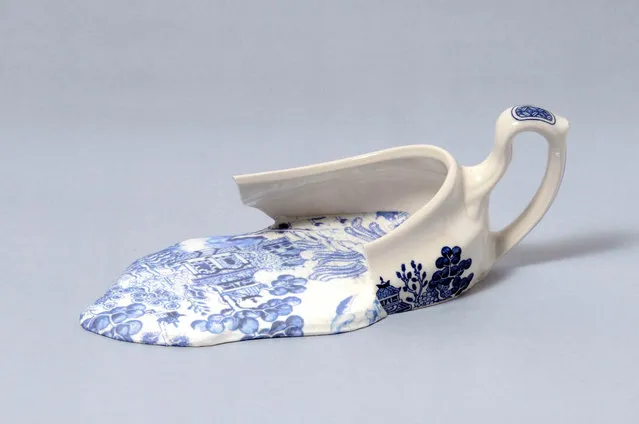
Melting Sculptures By Livia Marin

People are often fascinated by things that baffle them. For example, Livia Marin creates porcelain pottery that looks as if it has partially melted. This pottery might serve little purpose, yet it is definitely a curious thing to have in your house. This set of pictures shows off her “Nomad Patterns” series of deformed vases, pitchers, and teacups. The most appealing thing about these pieces of art is that the patterns on the “melted” parts are as beautiful as on the rest of the pottery. (Photo by Livia Marin)
Details
05 Nov 2014 12:14:00
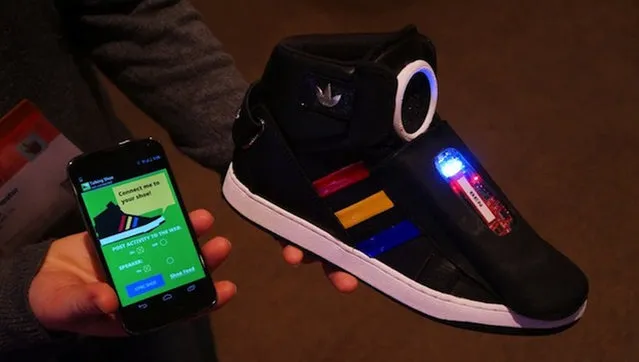
Google & Adidas – Talking Shoe

The shoe works similarly to a fitness tracking device, using an accelerometer, gyroscope, Bluetooth and other off-the-shelf technologies to analyze the wearer’s movements and offer motivating and timely commentary. It might tell you to get going if you’ve been idle for too long or cheer you on if it senses you being very active. Its comments can be posted to Google+ by the user, sent to real-time ad units, or broadcast via onboard speakers.
Details
13 Mar 2013 11:49:00


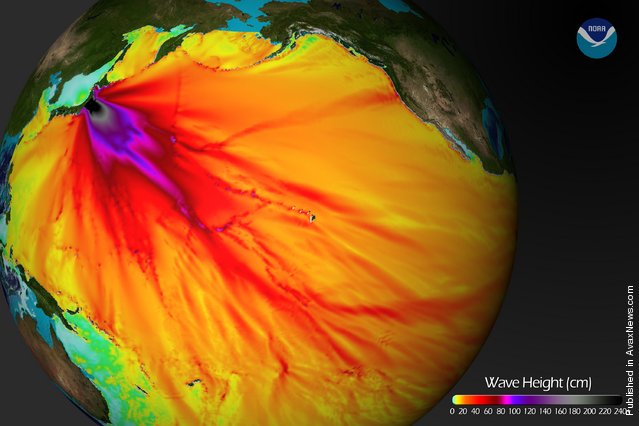
In this handout image provided by the National Oceanic and Atmospheric Administration (NOAA), model runs from the Center for Tsunami Research at the NOAA Pacific Marine Environmental Laboratory show the expected wave heights of the tsunami as it travels across the Pacific basin March 11, 2011. The largest wave heights are expected near the earthquake epicenter, off Japan. The wave will decrease in height as it travels across the deep Pacific but grow taller as it nears coastal areas. In general, as the energy of the wave decreases with distance, the near shore heights will also decrease (e.g., coastal Hawaii will not expect heights of that encountered in coastal Japan). (Photo by NOAA via Getty Images)
Details
13 Mar 2011 14:29:00