Loading...
Done
Chinese women wear protective masks as they are dressed in traditional clothing from the Qing Dynasty era outside a park on March 29, 2020 in Beijing, China. A limited section of the iconic tourist site was re-opened to the public this week allowing a smaller number of visitors to reserve tickets online in advance and to enter after passing health screening. With the pandemic hitting hard across the world, China recorded its first day with no new domestic cases of the coronavirus last week, since the government imposed sweeping measures to keep the disease from spreading. For two months, millions of people across China have been restricted in how they move from their homes, while other cities have been locked down in ways that appeared severe at the time but are now being replicated in other countries trying to contain the virus. Officials believe the worst appears to be over in China, though there are concerns of another wave of infections as the government attempts to reboot the worlds second largest economy. In Beijing, it is mandatory to wear masks outdoors, retail stores operate on reduced hours, restaurants employ social distancing among patrons, and tourist attractions at risk of drawing large crowds remain closed. Monitoring and enforcement of virus-related measures and the quarantine of anyone arriving to Beijing is carried out by neighborhood committees and a network of Communist Party volunteers who wear red arm bands. A primary concern for Chinese authorities remains the arrival of flights from Europe and elsewhere, given the exposure of passengers in regions now regarded as hotbeds for transmission. Since January, China has recorded more than 81,000 cases of COVID-19 and at least 3200 deaths, mostly in and around the city of Wuhan, in central Hubei province, where the outbreak first started. (Photo by Kevin Frayer/Getty Images)

Chinese women wear protective masks as they are dressed in traditional clothing from the Qing Dynasty era outside a park on March 29, 2020 in Beijing, China. A limited section of the iconic tourist site was re-opened to the public this week allowing a smaller number of visitors to reserve tickets online in advance and to enter after passing health screening. (Photo by Kevin Frayer/Getty Images)
Details
01 Apr 2020 00:05:00


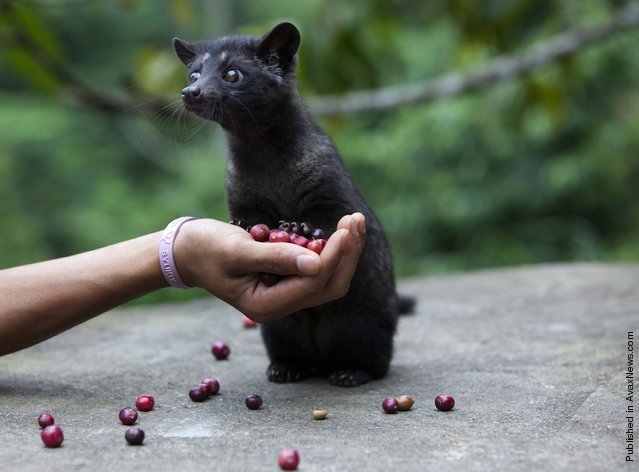
“Kopi luwak (Malay pronunciation), or civet coffee, is one of the world's most expensive and low-production coffee. It is made from the beans of coffee berries which have been eaten by the Asian Palm Civet (Paradoxurus hermaphroditus) and other related civets, then passed through its digestive tract. ...
Details
19 Mar 2011 18:41:00
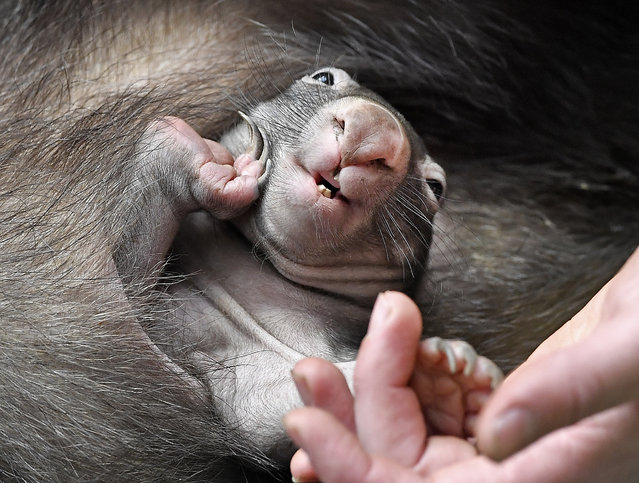
The little new born wombat baby APARI sitting in its mothers pouch at the zoo in Duisburg, Germany, Thursday, March 29, 2018. Wombat mother TINSEL once was found in the pouch of its dead mother on a street in Australia and was raised by zookeepers before she came to Germany. The zoo tried for 40 years in vain to breed a wombat, until APARI was born as the first one last week. (Photo by Martin Meissner/AP Photo)

The little new born wombat baby APARI sitting in its mothers pouch at the zoo in Duisburg, Germany, Thursday, March 29, 2018. Wombat mother TINSEL once was found in the pouch of its dead mother on a street in Australia and was raised by zookeepers before she came to Germany. The zoo tried for 40 years in vain to breed a wombat, until APARI was born as the first one last week. (Photo by Martin Meissner/AP Photo)
Details
01 Apr 2018 00:03:00
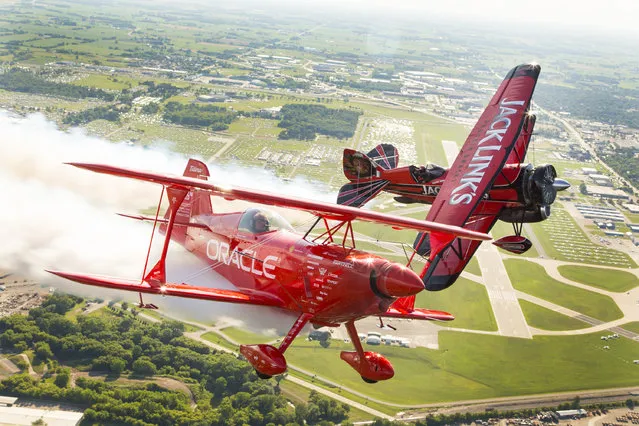
Renowned aerobatic pilots Sean D. Tucker, flying the Oracle Challenger III, and Jeff Boerboon, flying the Jack Link's Screamin' Sasquatch, take to the skies over EAA's 2015 AirVenture Oshkosh, on Monday, July 20, 2015 in Oshkosh, Wis. (Photo by Matt Ludtke/AP Images for Jack Link's)

Renowned aerobatic pilots Sean D. Tucker, flying the Oracle Challenger III, and Jeff Boerboon, flying the Jack Link's Screamin' Sasquatch, take to the skies over EAA's 2015 AirVenture Oshkosh, on Monday, July 20, 2015 in Oshkosh, Wis. (Photo by Matt Ludtke/AP Images for Jack Link's)
Details
31 Aug 2015 12:04:00
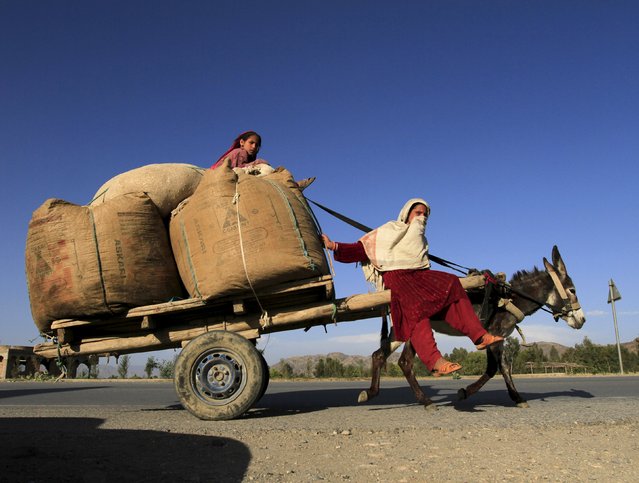
Girls ride on a donkey cart with grass for animals on the outside of Nangarhar province, Afghanistan May 19, 2015. (Photo by Reuters/Parwiz)

Girls ride on a donkey cart with grass for animals on the outside of Nangarhar province, Afghanistan May 19, 2015. (Photo by Reuters/Parwiz)
Details
28 Jul 2015 12:07:00
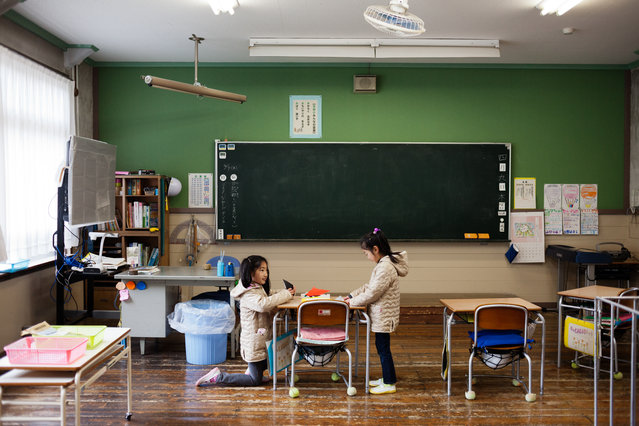
Students in Aone’s elementary school during break in between the class on April 9, 2015. The school has only six students, two of whom are from the same family. Similarly small schools can be found throughout Japan. (Photo by Ko Sasaki/The Washington Post)

Students in Aone’s elementary school during break in between the class on April 9, 2015. The school has only six students, two of whom are from the same family. Similarly small schools can be found throughout Japan. (Photo by Ko Sasaki/The Washington Post)
Details
21 Apr 2015 11:28:00
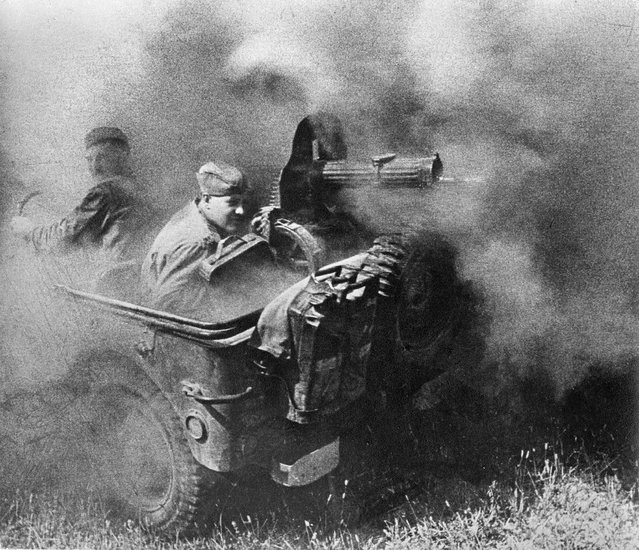
The Enemy, 1944. With the outbreak of world war two, photojournalism was enlisted in defence of Mother Russia. In this photo by Anatoli Egorov, who was wounded in action, corporal Stepan Vasiljevich Ovcharenko shoots at enemy troops with a machine gun. (Photo by Anatoli Egorov/Lumiere Brothers Center for Photography)

The Enemy, 1944. With the outbreak of world war two, photojournalism was enlisted in defence of Mother Russia. In this photo by Anatoli Egorov, who was wounded in action, corporal Stepan Vasiljevich Ovcharenko shoots at enemy troops with a machine gun. (Photo by Anatoli Egorov/Lumiere Brothers Center for Photography)
Details
18 Nov 2015 08:02:00
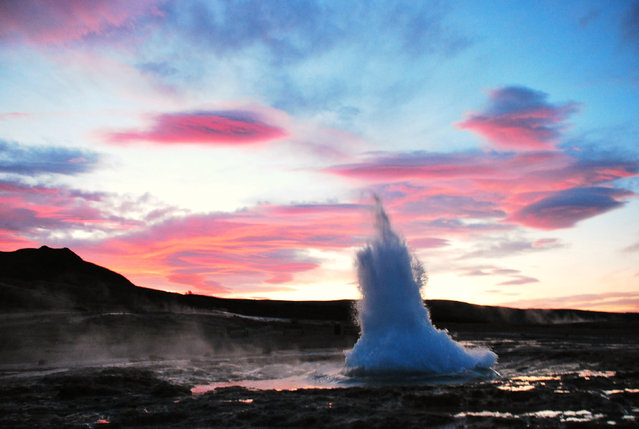
Strokkur geyser against cloudy sky at sunset. Strokkur is a fountain geyser located in a geothermal area beside the Hvítá River in Iceland in the southwest part of the country, east of Reykjavík. It is one of Iceland's most famous geysers, erupting once every 6–10 minutes. Its usual height is 15–20 m, although it can sometimes erupt up to 40 m high. (Photo by Teatsche Dijkhuis/Getty Images/EyeEm)

Strokkur geyser against cloudy sky at sunset. Strokkur is a fountain geyser located in a geothermal area beside the Hvítá River in Iceland in the southwest part of the country, east of Reykjavík. It is one of Iceland's most famous geysers, erupting once every 6–10 minutes. Its usual height is 15–20 m, although it can sometimes erupt up to 40 m high. (Photo by Teatsche Dijkhuis/Getty Images/EyeEm)
Details
18 Oct 2016 12:43:00