Loading...
Done
A Kazakh hunter walks with his tamed golden eagle during an annual hunting competition in Chengelsy Gorge, some 150 km (93 miles) east of Almaty February 22, 2013. (Photo by Shamil Zhumatov/Reuters)

A Kazakh hunter walks with his tamed golden eagle during an annual hunting competition in Chengelsy Gorge, some 150 km (93 miles) east of Almaty February 22, 2013. (Photo by Shamil Zhumatov/Reuters)
Details
05 Mar 2013 13:20:00
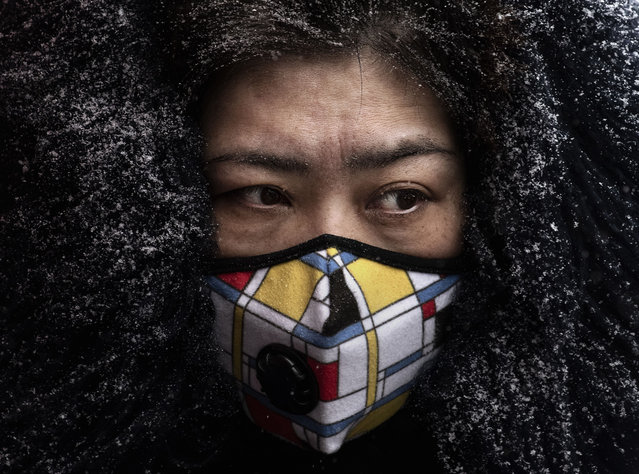
A Chinese woman wears a protective mask as she shops in a market on February 6, 2020 in Beijing, China. The number of cases of a deadly new coronavirus rose to more than 28000 in mainland China Thursday, days after the World Health Organization (WHO) declared the outbreak a global public health emergency. China continued to lock down the city of Wuhan in an effort to contain the spread of the pneumonia-like disease which medicals experts have confirmed can be passed from human to human. In an unprecedented move, Chinese authorities have put travel restrictions on the city which is the epicenter of the virus and municipalities in other parts of the country affecting tens of millions of people. The number of those who have died from the virus in China climbed to over 564 on Thursday, mostly in Hubei province, and cases have been reported in other countries including the United States, Canada, Australia, Japan, South Korea, India, the United Kingdom, Germany, France and several others. The World Health Organization has warned all governments to be on alert and screening has been stepped up at airports around the world. Some countries, including the United States, have put restrictions on Chinese travelers entering and advised their citizens against travel to China. (Photo by Kevin Frayer/Getty Images)

A Chinese woman wears a protective mask as she shops in a market on February 6, 2020 in Beijing, China. The number of cases of a deadly new coronavirus rose to more than 28000 in mainland China Thursday, days after the World Health Organization (WHO) declared the outbreak a global public health emergency. (Photo by Kevin Frayer/Getty Images)
Details
09 Feb 2020 00:07:00
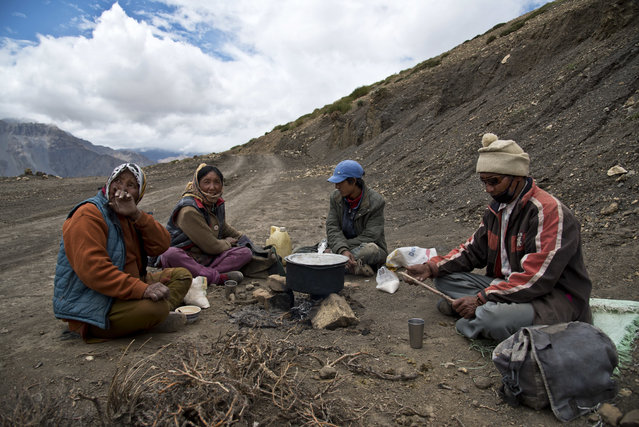
In this August 17, 2016, photo, from left to right, Chhering Chodom, 60, Tashi Yangzom, 50, Lobsang Chhering, 27, and Dorje Tandup, 58, drink milk tea on the side of the road. For centuries, the sleepy valley nestled in the Indian Himalayas remained a hidden Buddhist enclave forbidden to outsiders. Enduring the harsh year-round conditions of the high mountain desert, the people of Spiti Valley lived by a simple communal code – share the Earth's bounty, be hospitable to neighbors, and eschew greed and temptation at all turns. That's all starting to change, for better or worse. Since India began allowing its own citizens as well as outsiders to visit the valley in the early 1990s, tourism and trade have boomed. And the marks of modernization, such as solar panels, asphalt roads and concrete buildings, have begun to appear around some of the villages that dot the remote landscape at altitudes above 4,000 meters (13,000 feet). (Photo by Thomas Cytrynowicz/AP Photo)

In this August 17, 2016, photo, from left to right, Chhering Chodom, 60, Tashi Yangzom, 50, Lobsang Chhering, 27, and Dorje Tandup, 58, drink milk tea on the side of the road. For centuries, the sleepy valley nestled in the Indian Himalayas remained a hidden Buddhist enclave forbidden to outsiders. Enduring the harsh year-round conditions of the high mountain desert, the people of Spiti Valley lived by a simple communal code – share the Earth's bounty, be hospitable to neighbors, and eschew greed and temptation at all turns. That's all starting to change, for better or worse. (Photo by Thomas Cytrynowicz/AP Photo)

Details
15 Sep 2016 09:22:00
An infrared portrait from NASA's Spitzer Space Telescope which shows generations of stars is seen in this undated NASA handout image released February 14, 2013. In this wispy star-forming region, called W5, the oldest stars can be seen as blue dots in the centers of the two hollow cavities (other blue dots are background and foreground stars not associated with the region). Red shows heated dust that pervades the region's cavities, while green highlights dense clouds. (Photo by NASA/Reuters/JPL-Caltech/Harvard-Smithsonian/Handout)

An infrared portrait from NASA's Spitzer Space Telescope which shows generations of stars is seen in this undated NASA handout image released February 14, 2013. In this wispy star-forming region, called W5, the oldest stars can be seen as blue dots in the centers of the two hollow cavities (other blue dots are background and foreground stars not associated with the region). Red shows heated dust that pervades the region's cavities, while green highlights dense clouds. (Photo by NASA/Reuters/JPL-Caltech/Harvard-Smithsonian/Handout)
Details
03 Mar 2013 08:44:00
Atlas Moth @ Carleton. (Photo by Terri Oda)

“The Atlas moth (Attacus atlas) is a large saturniid moth found in the tropical and subtropical forests of Southeast Asia, and common across the Malay archipelago. Atlas moths are considered the largest moths in the world in terms of total wing surface area [upwards of c. 400 cm2 (62 sq in)]. Their wingspans are also amongst the largest, reaching over 25 cm (10 in). Females are appreciably larger and heavier”. – Wikipedia. Photo: Atlas Moth. (Photo by Terri Oda)


Details
10 Feb 2013 16:49:00
Ocean voyage

Do you think that history is a science? Well, not exactly. First, and foremost, history is the state's “legend of wars”, it’s official regalia. Of course, public historians are not interested in scientific truth – quite the opposite. In this respect, any attempt to present a state’s history as altruistic and benevolent as possible is welcomed and encouraged – as opposed to any revisionism attempts that may be more accurate. In this matter, Chinese have surpassed us all – they revised in highly creative manner (but rather shamelessly) the technology already invented by Europeans, a process that resulted in oldest state on the planet. Here is an interesting paradox: ask any sinologist about the Middle Kingdom during second century B.C., and he will describe it to you in such a vivid manner as if he has been living there all his life – but as soon as you will ask him to describe Chinese history in the 19-20th centuries… let's say, his eagerness will be greatly diminished. However, we will discuss China in a different article, and in the meantime we will try to understand how exactly historic “legend of wars” is formed and functions – based on a specific and well-known example. A great example is Ferdinand Magellan's first voyage around the world.
Details
14 Nov 2011 09:11:00
This photo taken on December 2, 2015 shows a lenticular cloud forming as white streaks from airplanes mark the blue sky, in a rare atmospheric phenomena above the town of Gevgelija on December 2, 2015. Lenticular clouds have been regularly confused for UFOs throughout history due to the their smooth, round or oval lens-shaped structure. (Photo by Armend Nimani/AFP Photo)

This photo taken on December 2, 2015 shows a lenticular cloud forming as white streaks from airplanes mark the blue sky, in a rare atmospheric phenomena above the town of Gevgelija on December 2, 2015. Lenticular clouds have been regularly confused for UFOs throughout history due to the their smooth, round or oval lens-shaped structure. (Photo by Armend Nimani/AFP Photo)
Details
31 Dec 2019 00:03:00
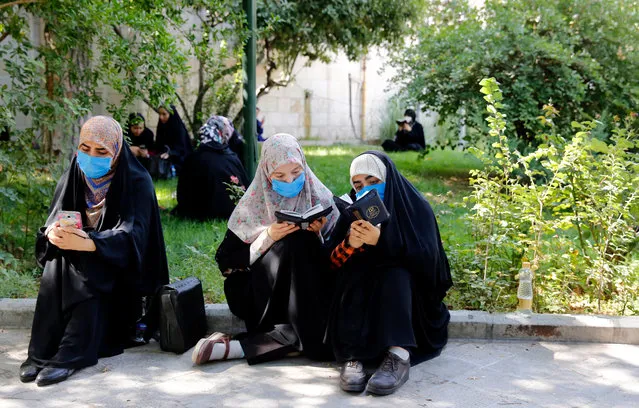
Faithful wearing face mask pray during the Arafah prayer ceremony ahead of Eid al-Adha, at the Tehran university’s mosque in Tehran, Iran, 30 July 2020. Iran will not hold the Eid al-Adha prayers and ceremonies over the coronavirus (COVID-19) crisis in the country. (Photo by Abedin Taherkenareh/EPA/EFE)

Faithful wearing face mask pray during the Arafah prayer ceremony ahead of Eid al-Adha, at the Tehran university’s mosque in Tehran, Iran, 30 July 2020. Iran will not hold the Eid al-Adha prayers and ceremonies over the coronavirus (COVID-19) crisis in the country. (Photo by Abedin Taherkenareh/EPA/EFE)
Details
16 Sep 2020 00:05:00