Loading...
Done
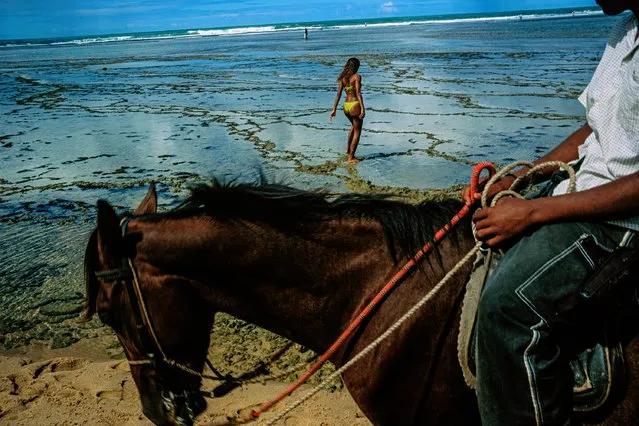
Praia du Forte, Bahia. “This was the lead picture for a National Geographic story on Bahia, because it was both mysterious as well as a “geography” picture showing where the slaves arrived from Nigeria. Beach pictures seem like they should be easy to take, but for me they are actually quite difficult. Too easy to fall into cliche. When I saw the kid coming on the horse, I quickly ran to see if I could make something with a woman in a bikini that was not a bikini shot”. (Photo by David Alan Harvey/The Guardian)

Praia du Forte, Bahia. “This was the lead picture for a National Geographic story on Bahia, because it was both mysterious as well as a “geography” picture showing where the slaves arrived from Nigeria. Beach pictures seem like they should be easy to take, but for me they are actually quite difficult. Too easy to fall into cliche. When I saw the kid coming on the horse, I quickly ran to see if I could make something with a woman in a bikini that was not a bikini shot”. (Photo by David Alan Harvey/The Guardian)
Details
20 Aug 2016 11:35:00
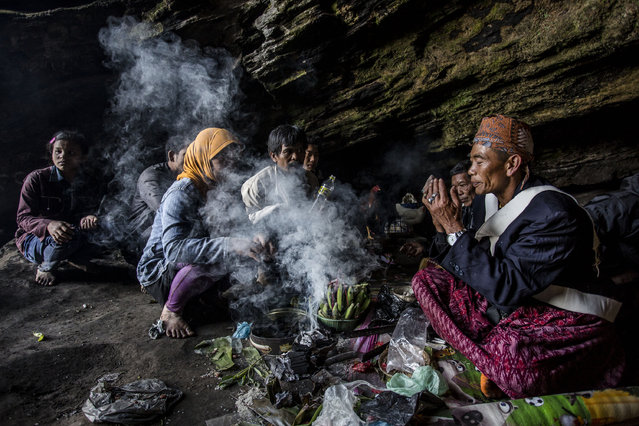
A Tenggerese shaman praying for worshippers at Widodaren cave during the Tenggerese Hindu Yadnya Kasada festival on July 31, 2015 in Probolinggo, East Java, Indonesia. The festival is the main festival of the Tenggerese people and lasts about a month. On the fourteenth day, the Tenggerese make the journey to Mount Bromo to make offerings of rice, fruits, vegetables, flowers and livestock to the mountain gods by throwing them into the volcano's caldera. (Photo by Ulet Ifansasti/Getty Images)

A Tenggerese shaman praying for worshippers at Widodaren cave during the Tenggerese Hindu Yadnya Kasada festival on July 31, 2015 in Probolinggo, East Java, Indonesia. The festival is the main festival of the Tenggerese people and lasts about a month. On the fourteenth day, the Tenggerese make the journey to Mount Bromo to make offerings of rice, fruits, vegetables, flowers and livestock to the mountain gods by throwing them into the volcano's caldera. The origin of the festival lies in the 15th century when a princess named Roro Anteng started the principality of Tengger with her husband Joko Seger, and the childless couple asked the mountain Gods for help in bearing children. The legend says the Gods granted them 24 children but on the provision that the 25th must be tossed into the volcano in sacrifice. The 25th child, Kesuma, was finally sacrificed in this way after initial refusal, and the tradition of throwing sacrifices into the caldera to appease the mountain Gods continues today. (Photo by Ulet Ifansasti/Getty Images)
Details
01 Aug 2015 12:07:00
Models take part in the promotion of the Miss Bumbum (buttocks) beauty pageant, along Paulista Avenue in Sao Paulo, Brazil, on August 7, 2017. The annual Bumbum pageant to select the nation' s sexiest female buttocks will be held on November, 6 in Sao Paulo. (Photo by Nelson Almeida/AFP Photo)

Models take part in the promotion of the Miss Bumbum (buttocks) beauty pageant, along Paulista Avenue in Sao Paulo, Brazil, on August 7, 2017. The annual Bumbum pageant to select the nation' s sexiest female buttocks will be held on November, 6 in Sao Paulo. (Photo by Nelson Almeida/AFP Photo)
Details
08 Aug 2017 07:16:00
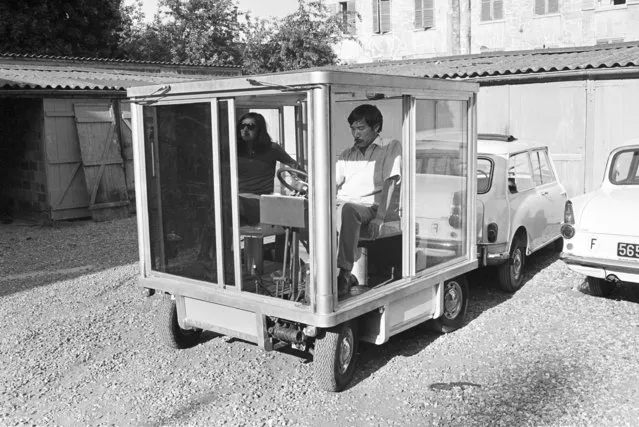
South Vietnamese-born designer Quasar drives the six-foot long square-shaped plastic car he built and which is scheduled to be a hit with the young driving set, in Paris, June 23, 1967. The car can be driven at speeds of up to 60 mph  (Photo by Michel Laurent/AP Photo)

South Vietnamese-born designer Quasar drives the six-foot long square-shaped plastic car he built and which is scheduled to be a hit with the young driving set, in Paris, June 23, 1967. The car can be driven at speeds of up to 60 mph (Photo by Michel Laurent/AP Photo)
Details
07 Oct 2017 07:37:00
School teachers and staff members take part during an active shooter training at James I. O'Neill High School in Highland Falls, New York, U.S., December 12, 2017. (Photo by Eduardo Munoz/Reuters)

School teachers and staff members take part during an active shooter training at James I. O'Neill High School in Highland Falls, New York, U.S., December 12, 2017. (Photo by Eduardo Munoz/Reuters)
Details
13 Dec 2017 10:02:00
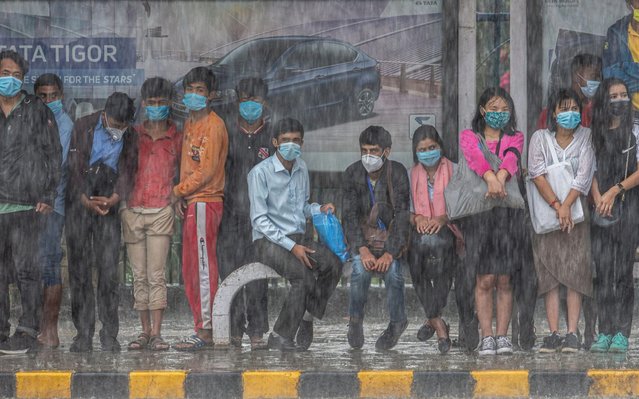
People wait at a bus stop during heavy rain in Kathmandu, Nepal on September 21, 2020. The government eased the coronavirus lockdown for economic activities despite the number of COVID-19 cases is on the rise in Nepal. (Photo by Narendra Shrestha/EPA/EFE/Rex Features/Shutterstock)

People wait at a bus stop during heavy rain in Kathmandu, Nepal on September 21, 2020. The government eased the coronavirus lockdown for economic activities despite the number of COVID-19 cases is on the rise in Nepal. (Photo by Narendra Shrestha/EPA/EFE/Rex Features/Shutterstock)
Details
09 Oct 2020 00:01:00
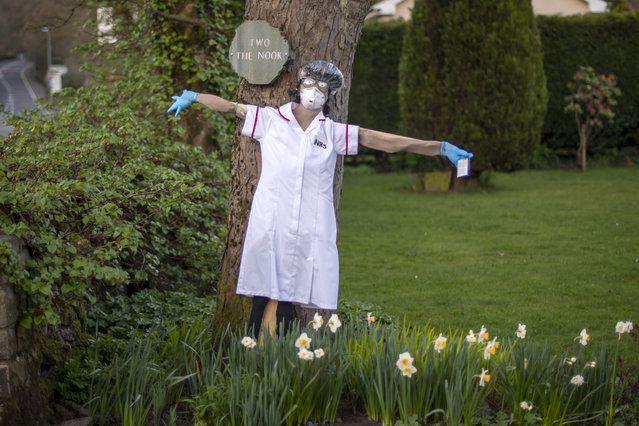
Residents display scarecrows with an NHS theme outside their homes in Greenfield for the annual scarecrow parade on April 09, 2020 in Manchester, United Kingdom. There have been around 60,000 reported cases of the COVID-19 coronavirus in the United Kingdom and 7,000 deaths. The country is in its third week of lockdown measures aimed at slowing the spread of the virus. (Photo by Anthony Devlin/Getty Images)

Residents display scarecrows with an NHS theme outside their homes in Greenfield for the annual scarecrow parade on April 09, 2020 in Manchester, United Kingdom. There have been around 60,000 reported cases of the COVID-19 coronavirus in the United Kingdom and 7,000 deaths. The country is in its third week of lockdown measures aimed at slowing the spread of the virus. (Photo by Anthony Devlin/Getty Images)
Details
07 Jan 2021 00:01:00
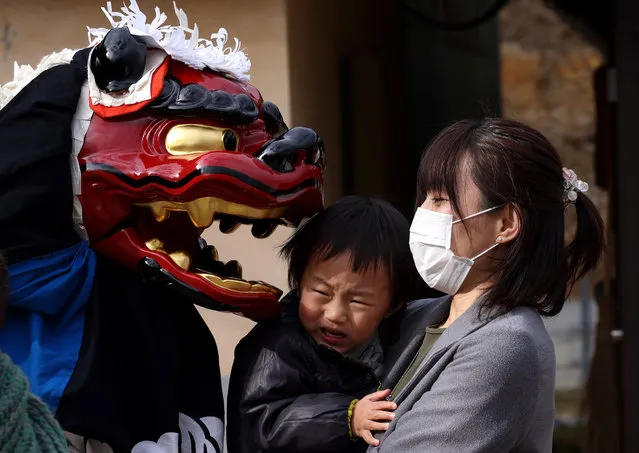
A performer wearing a lion mask performs the Ise Daikagura lion dance at the remote village of Yamanawa on February 08, 2021 in Ryuo, Japan. Ise Daikagura is a group of traditional Lion Dance performers who pray in front of farmers houses and businesses for good grain harvests and disease-free lives. Performers play sacred music using drums and flutes with two lion mask dancers. A lion mask is considered a symbol of God, who enters the house and performs in front of the Shinto God, a statue placed inside the house, mostly in the kitchen. These prayers are called “Kamodo Barai”. After the prayers, they are gifted with money, rice, sake and Japanese sweets from the householders. A group can travel for more than one hundred days to thousands of households and businesses throughout rural-villages in western Japan, and pray to those who are unable to visit the country’s most sacred shrine, the Grand Ise Shrine in Mie Prefecture. The group started its performance in the Edo era between 1603 to 1868 according to Japanese history. The Japanese government designated it as an important folk cultural national property in 1981. (Photo by Buddhika Weerasinghe/Getty Images)

A performer wearing a lion mask performs the Ise Daikagura lion dance at the remote village of Yamanawa on February 08, 2021 in Ryuo, Japan. Ise Daikagura is a group of traditional Lion Dance performers who pray in front of farmers houses and businesses for good grain harvests and disease-free lives. (Photo by Buddhika Weerasinghe/Getty Images)
Details
18 Feb 2021 09:27:00