Loading...
Done
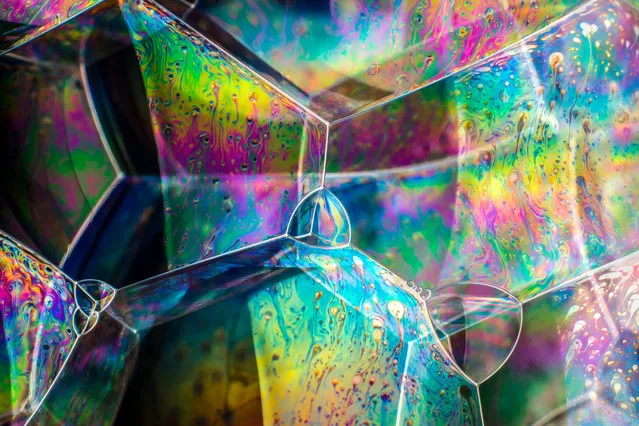
Soap Bubble Structures by Kym Cox. Bubbles optimise space and minimise their surface area for a given volume of air. This phenomenon makes them a useful tool in many areas of research, in particular, materials science and ‘packing’ – how things fit together. Bubble walls drain under gravity, thin at the top, thick at the bottom, which interferes with travelling lightwaves to create bands of colour. Black spots show the wall is too thin for interference colours, indicating the bubble is about to burst. (Photo by Kym Cox/2019 Science Photographer of the Year/RPS)

Soap Bubble Structures by Kym Cox. Bubbles optimise space and minimise their surface area for a given volume of air. This phenomenon makes them a useful tool in many areas of research, in particular, materials science and “packing” – how things fit together. Bubble walls drain under gravity, thin at the top, thick at the bottom, which interferes with travelling lightwaves to create bands of colour. Black spots show the wall is too thin for interference colours, indicating the bubble is about to burst. (Photo by Kym Cox/2019 Science Photographer of the Year/RPS)
Details
15 Aug 2019 00:03:00
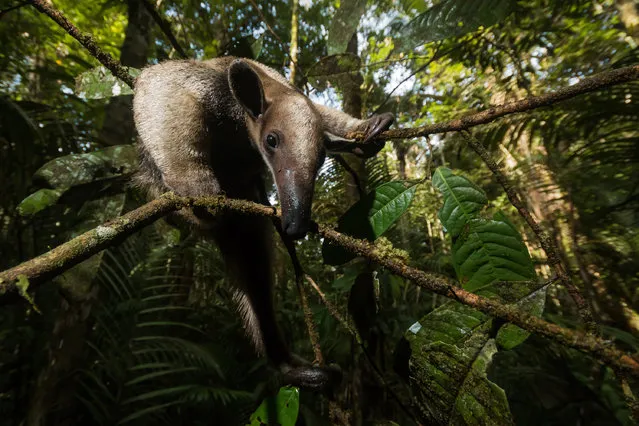
Individuals and populations student winner. Limbing in the Tropics, photographed in Manaus, Brazil. While walking in the Amazon rainforest looking for bat roosts to set up mist nets to capture bats for scientific research, a faint and almost imperceptible noise suddenly caught this photographer’s attention. An anteater was climbing with exceptional ability in a tangled mess of branches and lianas. With an unbelievable calmness, the animal watched the photographer at work and seemed to enjoy being the subject of an impromptu photography session in the most biodiverse ecosystem on Earth. (Photo by Adrià López Baucells/University of Lisbon/British Ecological Society)

Individuals and populations student winner. Limbing in the Tropics, photographed in Manaus, Brazil. While walking in the Amazon rainforest looking for bat roosts to set up mist nets to capture bats for scientific research, a faint and almost imperceptible noise suddenly caught this photographer’s attention. An anteater was climbing with exceptional ability in a tangled mess of branches and lianas. (Photo by Adrià López Baucells/University of Lisbon/British Ecological Society)
Details
05 Dec 2018 00:03:00
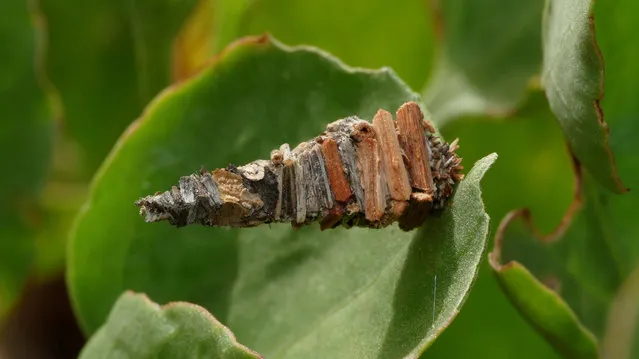
An undated handout photo made available by the Zerynthia Association shows the pupa of an amicta moneiba, a recently discovered species of moth endemic to La Gomera and El Hierro islands in the Canary Islands, Spain (issued 01 July 2020), as those two islands pulled apart from the rest of the Canary Islands 2.5 million years ago. The Institute of Evolutionary Biology of the Spanish National Research Council (CSIC) and the Zerynthia Association have recently discovered two new moth species in El Hierro and La Gomera. (Photo by Yeray Monasterio/Zerynthia/EPA/EFE)

An undated handout photo made available by the Zerynthia Association shows the pupa of an amicta moneiba, a recently discovered species of moth endemic to La Gomera and El Hierro islands in the Canary Islands, Spain (issued 01 July 2020), as those two islands pulled apart from the rest of the Canary Islands 2.5 million years ago. The Institute of Evolutionary Biology of the Spanish National Research Council (CSIC) and the Zerynthia Association have recently discovered two new moth species in El Hierro and La Gomera. (Photo by Yeray Monasterio/Zerynthia/EPA/EFE)
Details
11 Oct 2020 00:01:00
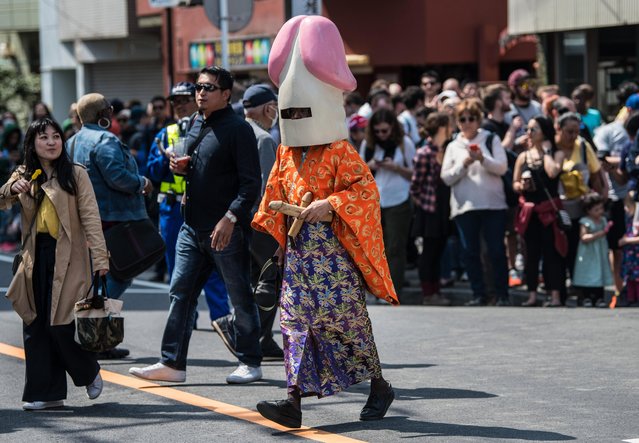
A man wear a phallic-shaped hat during Kanamara Matsuri (Festival of the Steel Phallus) on April 1, 2018 in Kawasaki, Japan. The Kanamara Festival is held annually on the first Sunday of April. The pen*s is the central theme of the festival, focused at the local pen*s-venerating shrine which was once frequented by prostitutes who came to pray for business prosperity and protection against sexually transmitted diseases. Today the festival has become a popular tourist attraction and is used to raise money for HIV awareness and research. (Photo by Carl Court/Getty Images)

A man wear a phallic-shaped hat during Kanamara Matsuri (Festival of the Steel Phallus) on April 1, 2018 in Kawasaki, Japan. The Kanamara Festival is held annually on the first Sunday of April. The pen*s is the central theme of the festival, focused at the local pen*s-venerating shrine which was once frequented by prostitutes who came to pray for business prosperity and protection against sexually transmitted diseases. Today the festival has become a popular tourist attraction and is used to raise money for HIV awareness and research. (Photo by Carl Court/Getty Images)
Details
04 Apr 2018 09:41:00
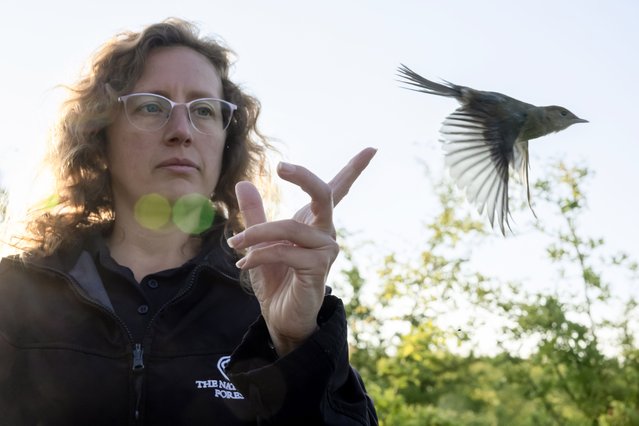
A juvenile blackcap is recorded in the soft light of morning at Minorca, UK, a former open-cast mine near Moira in the National Forest on June 18, 2025. Dr Heather Gilbert, research and evidence manager, checks mist nets among wildflowers and young trees as part of long-term monitoring that shows bird numbers have increased by 48 per cent over 30 years. (Photo by Rod Kirkpatrick/RKP Photography)

A juvenile blackcap is recorded in the soft light of morning at Minorca, UK, a former open-cast mine near Moira in the National Forest on June 18, 2025. Dr Heather Gilbert, research and evidence manager, checks mist nets among wildflowers and young trees as part of long-term monitoring that shows bird numbers have increased by 48 per cent over 30 years. (Photo by Rod Kirkpatrick/RKP Photography)
Details
29 Jun 2025 03:58:00
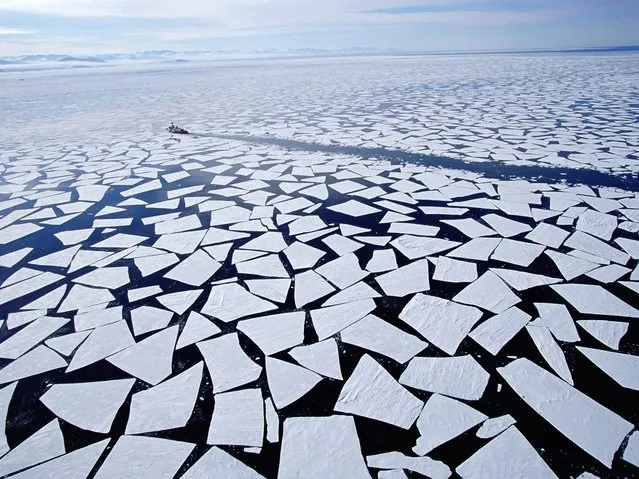
McMurdo Station Antarctic

McMurdo Station is a U.S. Antarctic research centre located on the southern tip of Ross Island, which is in the New Zealand-claimed Ross Dependency on the shore of McMurdo Sound in Antarctica. It is operated by the United States through the United States Antarctic Program, a branch of the National Science Foundation. The station is the largest community in Antarctica, capable of supporting up to 1,258 residents, and serves as the United States Antarctic science facility. All personnel and cargo going to or coming from Amundsen–Scott South Pole Station first pass through McMurdo.
Details
05 Sep 2013 10:18:00


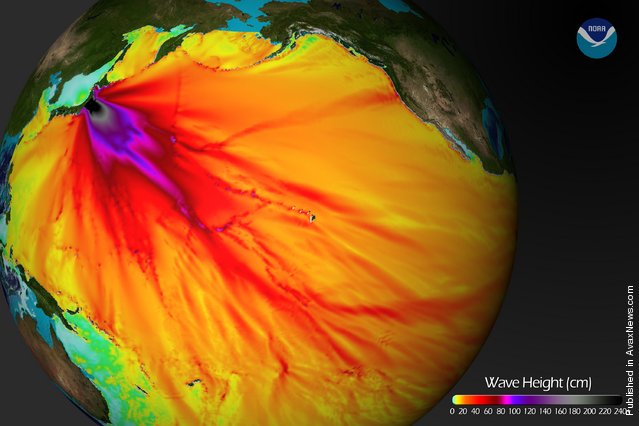
In this handout image provided by the National Oceanic and Atmospheric Administration (NOAA), model runs from the Center for Tsunami Research at the NOAA Pacific Marine Environmental Laboratory show the expected wave heights of the tsunami as it travels across the Pacific basin March 11, 2011. The largest wave heights are expected near the earthquake epicenter, off Japan. The wave will decrease in height as it travels across the deep Pacific but grow taller as it nears coastal areas. In general, as the energy of the wave decreases with distance, the near shore heights will also decrease (e.g., coastal Hawaii will not expect heights of that encountered in coastal Japan). (Photo by NOAA via Getty Images)
Details
13 Mar 2011 14:29:00
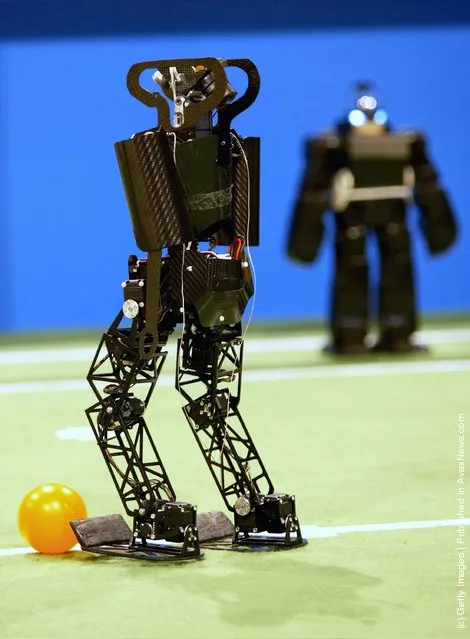
Humanoid robots of the children size league compete during the RoboCup 2006 football world championships

“RoboCup is an international robotics competition founded in 1997. The aim is to develop autonomous soccer robots with the intention of promoting research and education in the field of artificial intelligence. The name RoboCup is a contraction of the competition's full name, «Robot Soccer World Cup», but there are many other stages of the competition such as «Search and Rescue» and «Robot Dancing»”. – Wikipedia

Photo: Humanoid robots of the children size league compete during the RoboCup 2006 football world championships final at the Congress Centre on June 18, 2006 in Bremen, Germany. (Photo by Malte Christians/Bongarts/Getty Images)
Details
25 Oct 2011 13:22:00