Loading...
Done
Sharafkhaneh port and lake Urmia. Masoud Ghadiri (Iran). The summer Milky Way is very prominent in this photo. On the galaxy zone, Saturn is located besides the Lagoon nebula. On the right of the horizon, you can see the extreme light pollution of Urmia, which is caused by ever-increasing city development. (Photo by Masoud Ghadiri/National Maritime Museum)

Sharafkhaneh port and lake Urmia. Masoud Ghadiri (Iran). The summer Milky Way is very prominent in this photo. On the galaxy zone, Saturn is located besides the Lagoon nebula. On the right of the horizon, you can see the extreme light pollution of Urmia, which is caused by ever-increasing city development. (Photo by Masoud Ghadiri/National Maritime Museum)
Details
20 Jun 2019 00:01:00
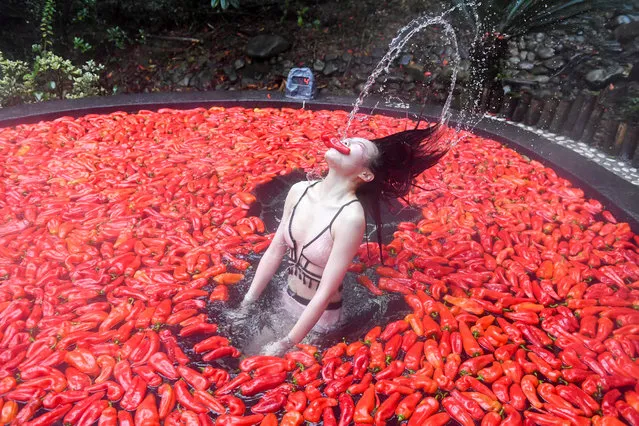
A participant, surrounded by red chilli peppers, takes part in a chilli-eating competition at a hot spring in Yichun, Jiangxi province, China on December 9, 2018. (Photo by Chen Fei/China News Service via Reuters)

A participant, surrounded by red chilli peppers, takes part in a chilli-eating competition at a hot spring in Yichun, Jiangxi province, China on December 9, 2018. (Photo by Chen Fei/China News Service via Reuters)
Details
11 Dec 2018 00:05:00
A zoo keeper holds a month old striped Hyena cub called Hachi at the Bali zoo in Giayar, Bali Indonesia on Saturday, February 6, 2021. (Photo by Firdia Lisnawati/AP Photo)

A zoo keeper holds a month old striped Hyena cub called Hachi at the Bali zoo in Giayar, Bali Indonesia on Saturday, February 6, 2021. (Photo by Firdia Lisnawati/AP Photo)
Details
28 Feb 2021 09:59:00
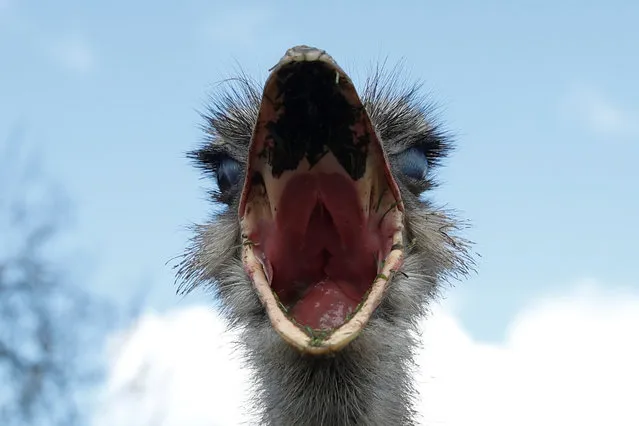
An ostrich is seen at Woburn Safari park before its opening as coronavirus disease (COVID-19) restrictions begin to ease, in Woburn, Britain on April 11, 2021. (Photo by Andrew Boyers/Reuters)

An ostrich is seen at Woburn Safari park before its opening as coronavirus disease (COVID-19) restrictions begin to ease, in Woburn, Britain on April 11, 2021. (Photo by Andrew Boyers/Reuters)
Details
25 Apr 2021 08:10:00
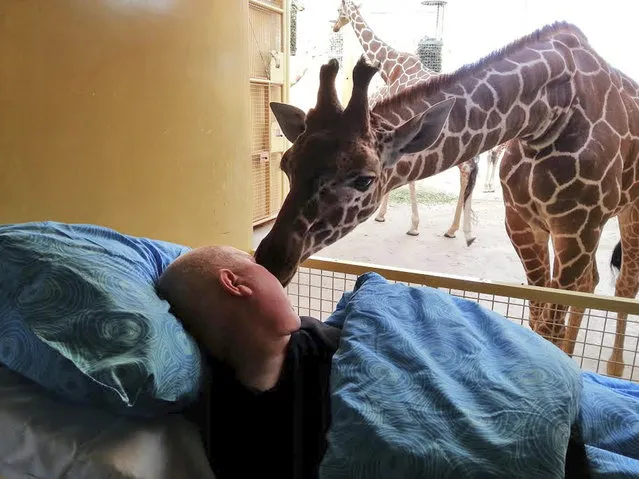
This photo released Saturday March 22, 2014 by Stichting Ambulance Wens or Ambulance Wish Foundation shows a giraffe at Blijdorp Zoo in Rotterdam giving a lick to terminally ill Mario Eijs on Wednesday March 19, 2014. The Stichting Ambulancewens “Ambulance Wish Foundation” offers transport for terminally ill patients who cannot walk to help fulfill a last wish, in Eijs' case to be taken to the Blijdorp Zoo in Rotterdam where he worked doing odd jobs for 25 years. (Photo by AP Photo/Stichting Ambulance Wens)

This photo released Saturday March 22, 2014 by Stichting Ambulance Wens or Ambulance Wish Foundation shows a giraffe at Blijdorp Zoo in Rotterdam giving a lick to terminally ill Mario Eijs on Wednesday March 19, 2014. The Stichting Ambulancewens “Ambulance Wish Foundation” offers transport for terminally ill patients who cannot walk to help fulfill a last wish, in Eijs' case to be taken to the Blijdorp Zoo in Rotterdam where he worked doing odd jobs for 25 years. Eijs, who has a mental handicap, is dying of a brain tumor and has difficulty walking or speaking. (Photo by AP Photo/Stichting Ambulance Wens)
Details
29 Mar 2014 14:20:00
With its huge eyes, comical name and diminutive size, Mark R. Smith’s image of a baby Hawaiian bobtail squid can’t help but raise a smile. A curiously endearing creature, the cephalopod is just 1.5cm across, its mantle cavity bearing more than a passing resemblance to a rather natty shower cap. But it is also a beautiful example of symbiosis – nature’s version of “I’ll scratch your back if you scratch mine” – for on the underside of the squid is a light organ which houses bioluminescent bacteria. The squid offers the bacteria protection and food, while the bacteria emit a glow – a handy trait that the squid uses to offset its silhouette, helping it to evade predators in the depths below. Mark R. Smith’s entry combines several images of a Hawaiian bobtail squid with different focus lengths to create a final picture with greater depth of field than normal. (Photo by Mark R. Smith/Wellcome Images/Macroscopic Solutions)

With its huge eyes, comical name and diminutive size, Mark R. Smith’s image of a baby Hawaiian bobtail squid can’t help but raise a smile. A curiously endearing creature, the cephalopod is just 1.5cm across, its mantle cavity bearing more than a passing resemblance to a rather natty shower cap. But it is also a beautiful example of symbiosis – nature’s version of “I’ll scratch your back if you scratch mine” – for on the underside of the squid is a light organ which houses bioluminescent bacteria. The squid offers the bacteria protection and food, while the bacteria emit a glow – a handy trait that the squid uses to offset its silhouette, helping it to evade predators in the depths below. Mark R. Smith’s entry combines several images of a Hawaiian bobtail squid with different focus lengths to create a final picture with greater depth of field than normal. (Photo by Mark R. Smith/Wellcome Images/Macroscopic Solutions)
Details
08 Mar 2017 00:05:00
People walk during a polluted day in Shenyang, Liaoning province, March 31, 2016. (Photo by Reuters/Stringer)

People walk during a polluted day in Shenyang, Liaoning province, March 31, 2016. (Photo by Reuters/Stringer)
Details
18 Apr 2016 10:12:00
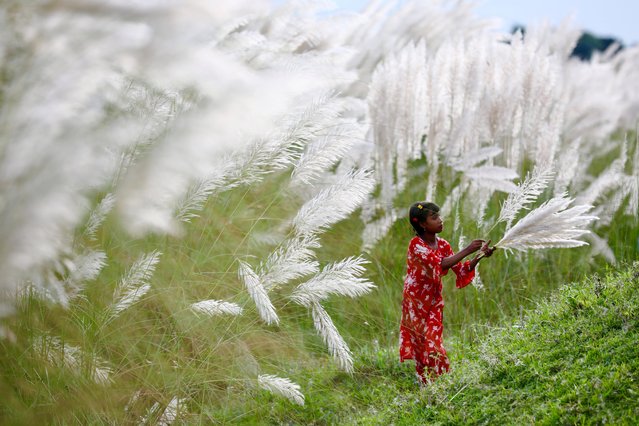
A girl picks catkins at a field amid the COVID-19 pandemic in Sarighat, on the outskirts of Dhaka, Bangladesh, October 2, 2020. (Photo by Mohammad Ponir Hossain/Reuters)

A girl picks catkins at a field amid the COVID-19 pandemic in Sarighat, on the outskirts of Dhaka, Bangladesh, October 2, 2020. (Photo by Mohammad Ponir Hossain/Reuters)
Details
16 Oct 2020 00:05:00