Loading...
Done
“Shanghai Tian Wai №26, 2014”. This series was an attempt to document an ever-changing city and the things it loses, as working-class neighbourhoods give way to ever-more modern urban development. (Photo by Liu Tao/The Guardian)

This 2014 series Shanghai Tian Wa saw Chinese photographer Liu Tao train his lens on two distinct districts in Shanghai. Here: “Shanghai Tian Wai №26, 2014”. (Photo by Liu Tao/The Guardian)
Details
25 May 2018 00:01:00


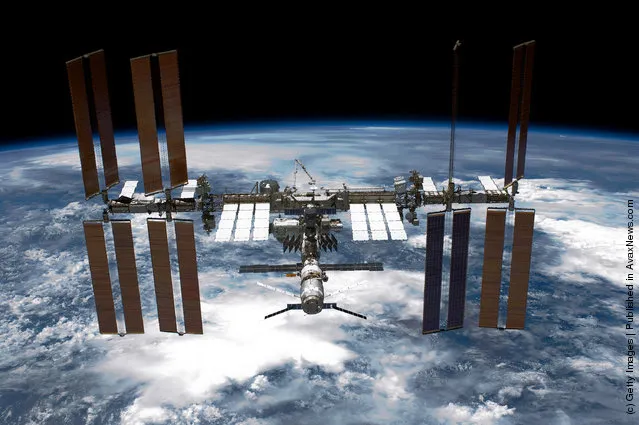
Back dropped by planet Earth the International Space Station (ISS) is seen from NASA space shuttle Endeavour after the station and shuttle began their post-undocking relative separation May 29, 2011 in space. After 20 years, 25 missions and more than 115 million miles in space, NASA space shuttle Endeavour is on the last leg of its final flight to the International Space Station before being retired and donated to the California Science Center in Los Angeles. Capt. Mark E. Kelly, U.S. Rep. Gabrielle Giffords' (D-AZ) husband, has lead mission STS-134 as it delivered the Express Logistics Carrier-3 (ELC-3) and the Alpha Magnetic Spectrometer (AMS-2) to the International Space Station. (Photo by NASA via Getty Images)
Details
01 Jun 2011 06:47:00
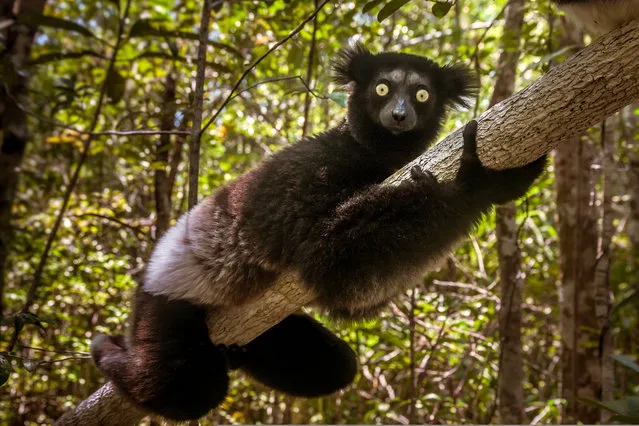
The secretive indri (Indri indri) of Madagascar, the largest living lemur. It is also critically endangered and highly evolutionarily distinct with no close relatives, which makes its branch one of most precarious on the mammal evolutionary tree. In the likely event that the indri goes extinct, we will lose 19m years of unique evolutionary history from the mammal tree of life. (Photo by Pierre-Yves Babelon/Aarhus University)

The secretive indri (Indri indri) of Madagascar, the largest living lemur. It is also critically endangered and highly evolutionarily distinct with no close relatives, which makes its branch one of most precarious on the mammal evolutionary tree. In the likely event that the indri goes extinct, we will lose 19m years of unique evolutionary history from the mammal tree of life. (Photo by Pierre-Yves Babelon/Aarhus University)
Details
18 Nov 2018 00:02:00
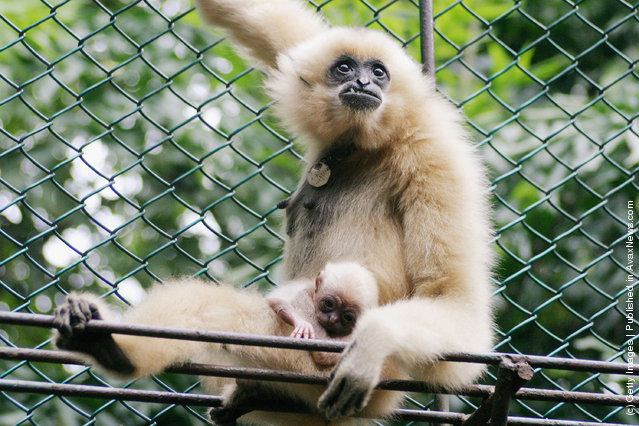
Newborn White-Cheeked Gibbon Nomascus

“Nomascus is the second most speciose genus of gibbons (family Hylobatidae). Originally this genus was a subgenus of Hylobates, and all individuals were considered one species, Hylobates concolor. Species within Nomascus are characterized by 52 chromosomes. Some species are all black, some light with a distinct black tuft of crown fur, and some by distinct, light-colored cheek patches. Nomascus is found from southern China (Yunnan) to southern Vietnam, and also on Hainan Island. One of the genus' species, Nomascus nasutus, has been deemed “the most critically endangered ape species in the world”. All of the species in this genus are endangered or critically endangered”. – Wikipedia

Photo: A newborn White-Cheeked Gibbon clings to its mother in the Nanning Zoo on April 12, 2004 in Nanning, Guangxi province, China. The White-Cheeked Gibbon's natural habitat is Southern China as well as Vietnam and Laos. They are classified as highly endangered and are on the brink of extinction due to poaching and reduction of natural rainforests. (Photo by Getty Images)
Details
12 Aug 2011 11:51:00
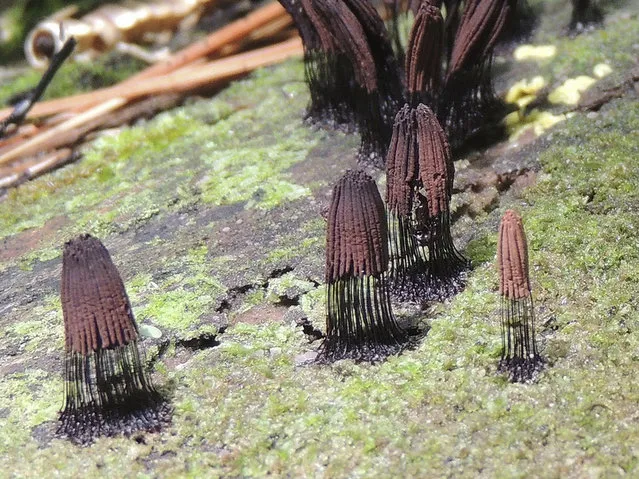
Stemonitis  Axifera

Stemonitis axifera is a species of slime mold. It fruits in clusters on dead wood, and has distinctive tall reddish-brown sporangia, supported on slender stalks. The species was first described as Trichia axifera by Jean Baptiste François Pierre Bulliard in 1791. Thomas Huston MacBride transferred it to the genus Stemonitis in 1889. Stemonitis fasciculata and Stemonitis smithii are synonyms.
Details
08 Feb 2014 10:30:00
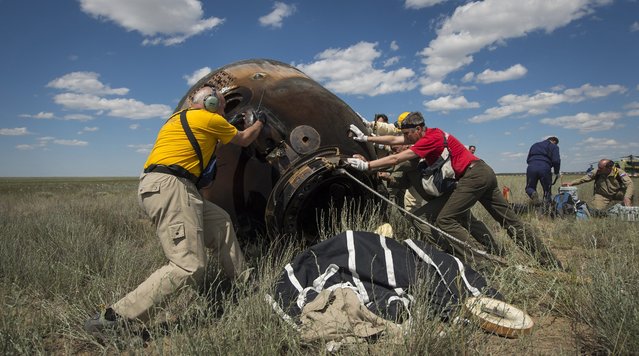
A handout phptopgraph made avaiable by NASA showing Russian support personnel roll the Soyuz TMA-19M spacecraft after it landed with with with Expedition 47 crew members Tim Kopra of NASA, Tim Peake of the European Space Agency, and Yuri Malenchenko of Roscosmos near the town of Zhezkazgan, Kazakhstan 18 June 2016. Kopra, Peake, and Malenchenko are returning after six months in space where they served as members of the Expedition 46 and 47 crews onboard the International Space Station. (Photo by Bill Ingalls/EPA/NASA)

A handout phptopgraph made avaiable by NASA showing Russian support personnel roll the Soyuz TMA-19M spacecraft after it landed with with with Expedition 47 crew members Tim Kopra of NASA, Tim Peake of the European Space Agency, and Yuri Malenchenko of Roscosmos near the town of Zhezkazgan, Kazakhstan 18 June 2016. Kopra, Peake, and Malenchenko are returning after six months in space where they served as members of the Expedition 46 and 47 crews onboard the International Space Station. (Photo by Bill Ingalls/EPA/NASA)
Details
19 Jun 2016 10:20:00
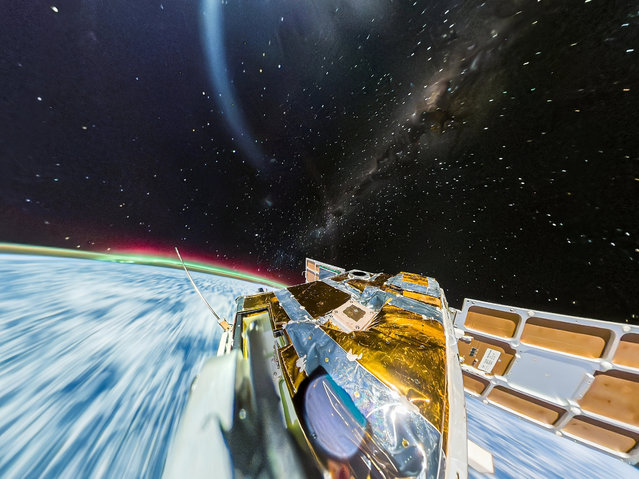
View from the Insta360 360 degree camera in the last decade of November 2023 attached to a satellite launched 500km into outer space. Chinese firm Insta360 say they have achieved “the first fully exposed camera in space” a feat which required a lot of preparation to get X2 ready for the harsh environment. (Photo by South West News Service)

View from the Insta360 360 degree camera in the last decade of November 2023 attached to a satellite launched 500km into outer space. Chinese firm Insta360 say they have achieved “the first fully exposed camera in space” a feat which required a lot of preparation to get X2 ready for the harsh environment. (Photo by South West News Service)
Details
13 May 2024 05:02:00


“Chameleons (family Chamaeleonidae) are a distinctive and highly specialized clade of lizards. They are distinguished by their parrot-like zygodactylous feet, their separately mobile and stereoscopic eyes, their very long, highly modified, and rapidly extrudable tongues, their swaying gait, the possession by many of a prehensile tail, crests or horns on their distinctively shaped heads, and the ability of some to change color. Uniquely adapted for climbing and visual hunting, the approximately 160 species of chameleon range from Africa, Madagascar, Spain and Portugal, across south Asia, to Sri Lanka, have been introduced to Hawaii, California and Florida, and are found in warm habitats that vary from rain forest to desert conditions”. – Wikipedia

Photo: A woman with the latest fashion accessory, a chameleon. (Photo by Fox Photos/Getty Images). Circa 1926

Details
20 Mar 2011 15:45:00