Loading...
Done
Photographers gather to take pictures of pilot Andre Borschberg (C) ahead of the take off of Solar Impulse 2-a solar powered plane- in Nanjing, China, May 31, 2015. The world's largest solar-powered airplane, Solar Impulse 2, took off from eastern China's Nanjing on Sunday to continue its round-the-world voyage. The Swiss-made plane left Nanjing's Lukou International Airport at 2:39 in the early morning, with former fighter pilot Borschberg at the controls alone for the entire 8,200-kilometer flight from Nanjing to Hawaii, the toughest leg of its marathon adventure.   REUTERS/Solar Impulse/Handout via Reuters

Photographers gather to take pictures of pilot Andre Borschberg (C) ahead of the take off of Solar Impulse 2-a solar powered plane- in Nanjing, China, May 31, 2015. The world's largest solar-powered airplane, Solar Impulse 2, took off from eastern China's Nanjing on Sunday to continue its round-the-world voyage. The Swiss-made plane left Nanjing's Lukou International Airport at 2:39 in the early morning, with former fighter pilot Borschberg at the controls alone for the entire 8,200-kilometer flight from Nanjing to Hawaii, the toughest leg of its marathon adventure. (Photo by Reuters/Solar Impulse)
Details
06 Jun 2015 12:09:00


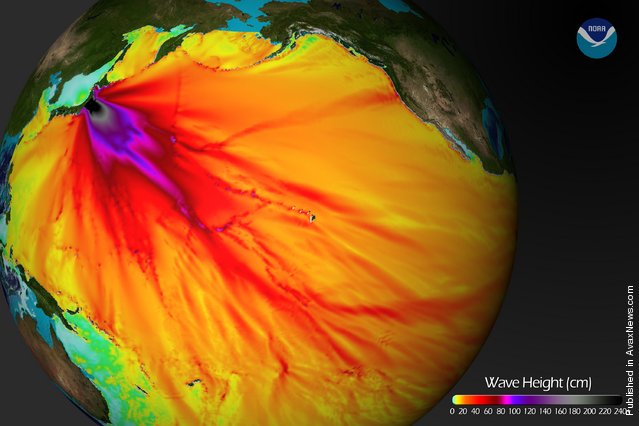
In this handout image provided by the National Oceanic and Atmospheric Administration (NOAA), model runs from the Center for Tsunami Research at the NOAA Pacific Marine Environmental Laboratory show the expected wave heights of the tsunami as it travels across the Pacific basin March 11, 2011. The largest wave heights are expected near the earthquake epicenter, off Japan. The wave will decrease in height as it travels across the deep Pacific but grow taller as it nears coastal areas. In general, as the energy of the wave decreases with distance, the near shore heights will also decrease (e.g., coastal Hawaii will not expect heights of that encountered in coastal Japan). (Photo by NOAA via Getty Images)
Details
13 Mar 2011 14:29:00
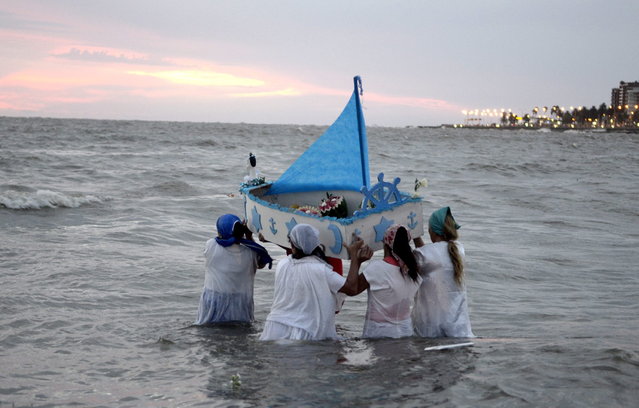
Faithful carry a boat out to sea, filled with offerings to Yemanja, the African sea goddess, during a ceremony honoring the deity in Montevideo, Uruguay, Saturday, February 2, 2013. Thousands of worshippers come to the beach in Montevideo on her feast day, February 2, bearing candles, flowers, perfumes and fruit to show their gratitude for her blessings bestowed upon them. The belief in the goddess sprouts from Umbanda, a blend of religions that include African, Catholicism and Spiritism. (Photo by Matilde Campodonico/AP Photo)

Faithful carry a boat out to sea, filled with offerings to Yemanja, the African sea goddess, during a ceremony honoring the deity in Montevideo, Uruguay, Saturday, February 2, 2013. Thousands of worshippers come to the beach in Montevideo on her feast day, February 2, bearing candles, flowers, perfumes and fruit to show their gratitude for her blessings bestowed upon them. The belief in the goddess sprouts from Umbanda, a blend of religions that include African, Catholicism and Spiritism. (Photo by Matilde Campodonico/AP Photo)
Details
03 Feb 2013 13:14:00
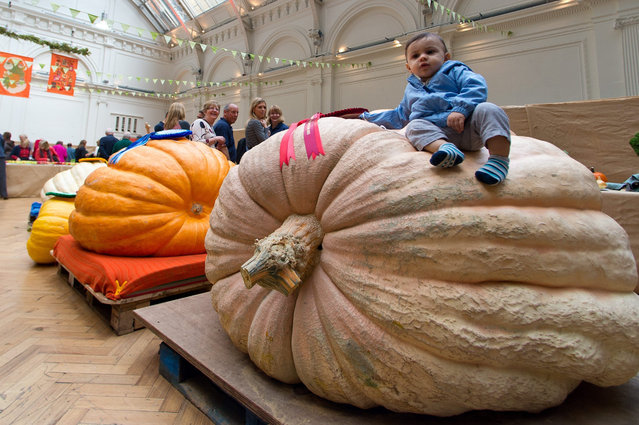
A toddler sits on the winner of the giant pumpkin category during the RHS (Royal Horticultural Society) London Harvest Festival Show at RHS Lindley Halls on October 6, 2015 in London, England. The traditional harvest themed show runs October 6-7 and showcases a wide range of late summer grown fruit and vegetables. (Photo by Ben Pruchnie/Getty Images)

A toddler sits on the winner of the giant pumpkin category during the RHS (Royal Horticultural Society) London Harvest Festival Show at RHS Lindley Halls on October 6, 2015 in London, England. The traditional harvest themed show runs October 6-7 and showcases a wide range of late summer grown fruit and vegetables. (Photo by Ben Pruchnie/Getty Images)
Details
09 Oct 2015 08:07:00
Masks that come with T'antawawas bread are displayed in a popular market of La Paz, October 27, 2015. Residents of La Paz city have started to prepare offerings for their dead relatives next Sunday as part of the All Saints' Day celebrations. The offerings include things the deceased liked during their life, such as fruits, food, breads and drinks, according to local media. (Photo by David Mercado/Reuters)

Masks that come with T'antawawas bread are displayed in a popular market of La Paz, October 27, 2015. Residents of La Paz city have started to prepare offerings for their dead relatives next Sunday as part of the All Saints' Day celebrations. The offerings include things the deceased liked during their life, such as fruits, food, breads and drinks, according to local media. (Photo by David Mercado/Reuters)
Details
01 Nov 2015 08:06:00
A devotee of the Afro-Brazilian goddess of the sea Lemanja pays tribute on Lemanja's Day at Ramirez beach in Montevideo February 2, 2015. On this day every year, worshippers light candles at a shrine and throw sweets, alcoholic drinks, fruits and cheap jewellery into the sea as offerings to ask for good health and luck in love and work. (Photo by Andres Stapff/Reuters)

A devotee of the Afro-Brazilian goddess of the sea Lemanja pays tribute on Lemanja's Day at Ramirez beach in Montevideo February 2, 2015. On this day every year, worshippers light candles at a shrine and throw sweets, alcoholic drinks, fruits and cheap jewellery into the sea as offerings to ask for good health and luck in love and work. (Photo by Andres Stapff/Reuters)
Details
04 Feb 2015 12:14:00
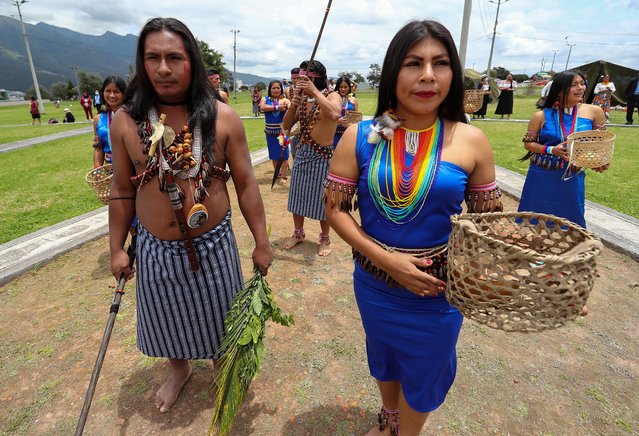
Ecuadorian indigenous people celebrate the festival of the moon or Kulla Raymi, in Quito, Ecuador, 21 September 2021. A circle on the ground made up of fruits and inside the Andean symbol of the chacana, multinational geometric flags and a cross that symbolizes the four cardinal points, were the setting in which the festival of the moon, the Kulla, was commemorated this Tuesday. Raymi, on a hill in Quito. It is one of the four most significant festivities of the Andean agroecological calendar, which commemorates the beginning of life and exalts women as the maximum representation of fertility. (Photo by Jose Jacome/EPA/EFE)

Ecuadorian indigenous people celebrate the festival of the moon or Kulla Raymi, in Quito, Ecuador, 21 September 2021. A circle on the ground made up of fruits and inside the Andean symbol of the chacana, multinational geometric flags and a cross that symbolizes the four cardinal points, were the setting in which the festival of the moon, the Kulla, was commemorated this Tuesday. Raymi, on a hill in Quito. It is one of the four most significant festivities of the Andean agroecological calendar, which commemorates the beginning of life and exalts women as the maximum representation of fertility. (Photo by Jose Jacome/EPA/EFE)
Details
22 Sep 2021 09:01:00
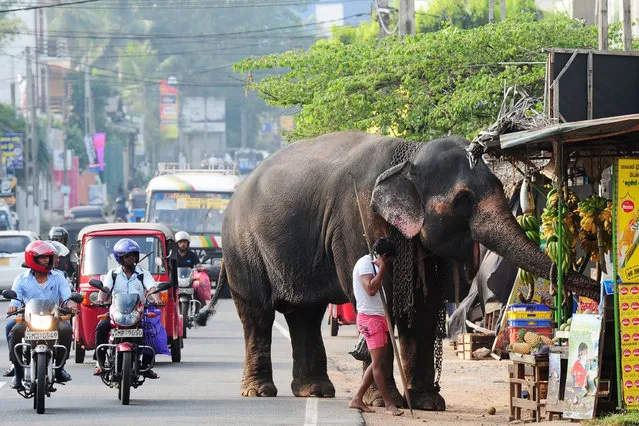
A Sri Lankan elephant, accompanied by his mahout, browse through a roadside fruit stall in Colombo on January 19, 2015. The Sri Lankan elephant is listed as endangered by the International Union for Conservation of Nature (IUCN) as the population has declined by at least 50 percent over the last three generations, with the species threatened by habitat loss, degradation and fragmentation. (Photo by Lakruwan Wanniarachchi/AFP Photo)

A Sri Lankan elephant, accompanied by his mahout, browse through a roadside fruit stall in Colombo on January 19, 2015. The Sri Lankan elephant is listed as endangered by the International Union for Conservation of Nature (IUCN) as the population has declined by at least 50 percent over the last three generations, with the species threatened by habitat loss, degradation and fragmentation. (Photo by Lakruwan Wanniarachchi/AFP Photo)
Details
23 Jan 2015 13:21:00