Loading...
Done
A man wears a busho mask and a costume made of sheep pelt while climbing up a ladder outside a barn in Mohacs, Hungary, 20 February 2020, on the first day of carnival. The traditional Busho carnival, which marks the end of winter, dates back to the 16th century. According to local legend, members of an ethnic South Slavic group living in Mohacs at the time dressed up in similar costumes and wore wooden masks to scare away Ottoman invaders, who mistook them for demons. (Photo by Tamas Soki/EPA/EFE)

A man wears a busho mask and a costume made of sheep pelt while climbing up a ladder outside a barn in Mohacs, Hungary, 20 February 2020, on the first day of carnival. The traditional Busho carnival, which marks the end of winter, dates back to the 16th century. According to local legend, members of an ethnic South Slavic group living in Mohacs at the time dressed up in similar costumes and wore wooden masks to scare away Ottoman invaders, who mistook them for demons. (Photo by Tamas Soki/EPA/EFE)
Details
23 Feb 2020 00:07:00
A woman hangs strips of salted meat she collected from different places during the Muslim's Eid al-Adha or Festival of Sacrifice, in Lahore, Pakistan, Sunday, August 2, 2020. Pakistanis are celebrating the Eid al-Adha, or the Feast of the Sacrifice, to mark the willingness of the Prophet Ibrahim – Abraham to Christians and Jews – to sacrifice his son. During the holiday Muslims slaughter sheep and cattle, distribute part of the meat to the poor. (Photo by K.M. Chaudary/AP Photo)

A woman hangs strips of salted meat she collected from different places during the Muslim's Eid al-Adha or Festival of Sacrifice, in Lahore, Pakistan, Sunday, August 2, 2020. Pakistanis are celebrating the Eid al-Adha, or the Feast of the Sacrifice, to mark the willingness of the Prophet Ibrahim – Abraham to Christians and Jews – to sacrifice his son. During the holiday Muslims slaughter sheep and cattle, distribute part of the meat to the poor. (Photo by K.M. Chaudary/AP Photo)
Details
28 Aug 2020 00:05:00
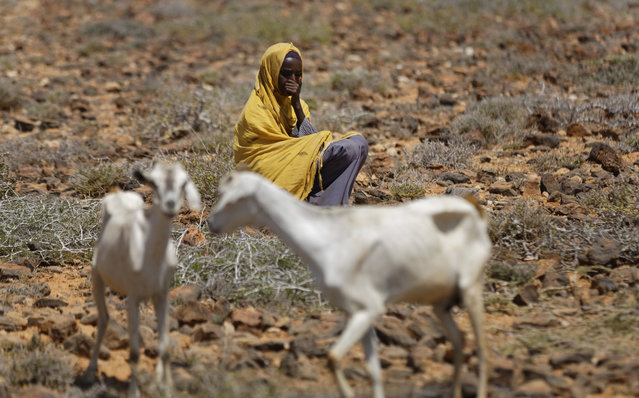
In this photo taken Wednesday, March 8, 2017, a woman herder sits with her goats in a remote desert area near Bandar Beyla in Somalia's semiautonomous northeastern state of Puntland. Somalia has declared the drought a national disaster, part of what the United Nations calls the largest humanitarian crisis since the world body was founded in 1945, and with animals being central to many the drought threatens their main sources of nutrition and survival. (Photo by Ben Curtis/AP Photo)

In this photo taken Wednesday, March 8, 2017, a woman herder sits with her goats in a remote desert area near Bandar Beyla in Somalia's semiautonomous northeastern state of Puntland. Somalia has declared the drought a national disaster, part of what the United Nations calls the largest humanitarian crisis since the world body was founded in 1945, and with animals being central to many the drought threatens their main sources of nutrition and survival. (Photo by Ben Curtis/AP Photo)
Details
15 Mar 2017 00:03:00
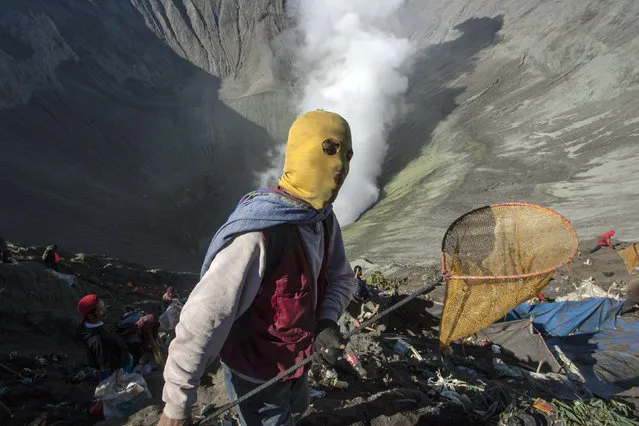
Non-Hindus carry nets as they wait on the edge of the crater to catch offerings cast down by Hindus during the Kasodo ceremony at Mount Bromo, Probolinggo, Indonesia, August 12, 2014. The Kasodo ceremony is a way of Tengger Hindus to express their gratitude to God for good harvest and fortune. The offerings range from vegetables to chickens, from fruits to goats, from money to other valuables. (Photo by Fully Handoko/EPA)

Non-Hindus carry nets as they wait on the edge of the crater to catch offerings cast down by Hindus during the Kasodo ceremony at Mount Bromo, Probolinggo, Indonesia, August 12, 2014. The Kasodo ceremony is a way of Tengger Hindus to express their gratitude to God for good harvest and fortune. The offerings range from vegetables to chickens, from fruits to goats, from money to other valuables. (Photo by Fully Handoko/EPA)
Details
14 Aug 2014 11:06:00
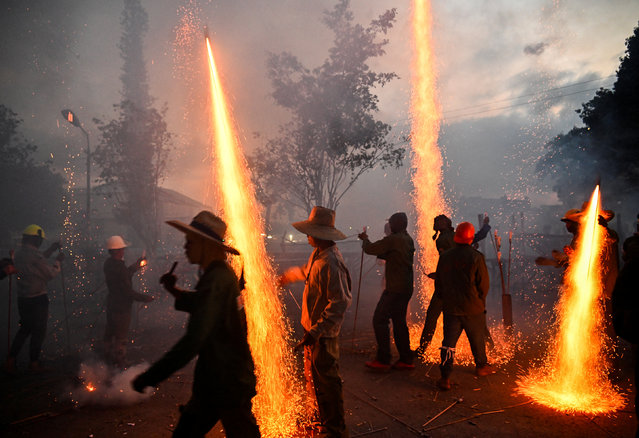
People paly with fireworks during Parrandas de Camajuani, Cuba on March 22, 2025. Two neighborhoods of the city, San Jose, represented by a toad, and Santa Teresa, represented by a goat, fight with carnival shows that involve the whole town in a party with bands, huge floats and fireworks. The Parrandas de Camajuani with more than 130 years, are recognized as Intangible Cultural Heritage of Humanity since 2018. (Photo by Yamil Lage/AFP Photo)

People paly with fireworks during Parrandas de Camajuani, Cuba on March 22, 2025. Two neighborhoods of the city, San Jose, represented by a toad, and Santa Teresa, represented by a goat, fight with carnival shows that involve the whole town in a party with bands, huge floats and fireworks. The Parrandas de Camajuani with more than 130 years, are recognized as Intangible Cultural Heritage of Humanity since 2018. (Photo by Yamil Lage/AFP Photo)
Details
24 Oct 2025 04:44:00
The legs of camel and sheep for the “Living Nativity” scene, and Rockettes, of the “Radio City Christmas Special”, are juxtaposed as they pose for photos outside New York's Radio City Music Hall, Tuesday, October 28, 2014. The show is scheduled to open Friday, November 7, 2014 and continue through Wednesday, December 31, 2014. The “Living Nativity” has been part of the Christmas Spectacular since its inception in 1933. (Photo by Richard Drew/AP Photo)

The legs of camel and sheep for the “Living Nativity” scene, and Rockettes, of the “Radio City Christmas Special”, are juxtaposed as they pose for photos outside New York's Radio City Music Hall, Tuesday, October 28, 2014. The show is scheduled to open Friday, November 7, 2014 and continue through Wednesday, December 31, 2014. The “Living Nativity” has been part of the Christmas Spectacular since its inception in 1933. (Photo by Richard Drew/AP Photo)
Details
01 Nov 2014 14:53:00
A Fulani Pastoralist carries two baby sheep on her donkey cart as her family move on northwards in Barkedji, Senegal on July 21, 2020. Thousands of Pastoralist families will start the movement north in the next weeks. With the first rains comes fresh grass and water for the Fulani herders' livestock, it also marks the point where most of the Pastoralist will move northwards until the dry season. (Photo by John Wessels/AFP Photo)

A Fulani Pastoralist carries two baby sheep on her donkey cart as her family move on northwards in Barkedji, Senegal on July 21, 2020. Thousands of Pastoralist families will start the movement north in the next weeks. With the first rains comes fresh grass and water for the Fulani herders' livestock, it also marks the point where most of the Pastoralist will move northwards until the dry season. (Photo by John Wessels/AFP Photo)
Details
04 Aug 2020 00:05:00
A leather worker with his frightening types of clothes prepares after painted themselves using chimney soot as they participate in a programme within the September 6 celebrations, in Balikesir, Turkey on September 06, 2019. According to the story, “Tulutabaklar” were painting themselves with ash and wearing goatskin or sheep skin to frighten the Greek soldiers occupying Balikesir during the National Struggle period. Every year on September 6, Tulutabaklar perform this ritual as part of the celebration of liberation of the city for 96 years. (Photo by Ali Atmaca/Anadolu Agency via Getty Images)

A leather worker with his frightening types of clothes prepares after painted themselves using chimney soot as they participate in a programme within the September 6 celebrations, in Balikesir, Turkey on September 06, 2019. According to the story, “Tulutabaklar” were painting themselves with ash and wearing goatskin or sheep skin to frighten the Greek soldiers occupying Balikesir during the National Struggle period. Every year on September 6, Tulutabaklar perform this ritual as part of the celebration of liberation of the city for 96 years. (Photo by Ali Atmaca/Anadolu Agency via Getty Images)
Details
09 Sep 2019 00:05:00