Loading...
Done
Titanoboa: Monster Snake

Titanoboa, meaning "titanic boa," is an extinct genus of snake that lived approximately 60–58 million years ago, during the Paleocene epoch, a 10-million-year period immediately following the dinosaur extinction event. The only known species is Titanoboa cerrejonensis, the largest, longest, and heaviest snake ever discovered, which supplanted the previous record holder, Gigantophis.

A full-scale model of the snake was unveiled at New York City's Grand Central station before the exhibit opens at the Smithsonian in Washington DC.
Details
06 Feb 2014 12:38:00
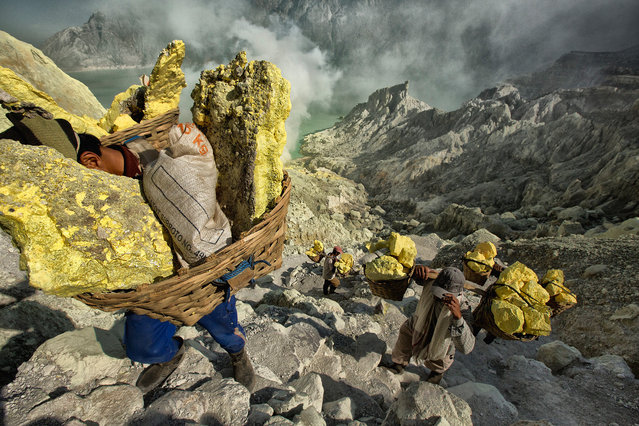
Sulphur miners haul sulphur up an arduous path out of Indonesia’s Ijen volcano. The average carry out of the volcano is 70 kilograms per load per miner.  The all-time record carry was 120 kilograms in one load.  Extraordinary numbers given most of the miners only weigh around 55 kilograms.  Ijen volcano, Indonesia, 2012. (Photo by Hugh Brown/South West News Service)

Sulphur miners haul sulphur up an arduous path out of Indonesia’s Ijen volcano. The average carry out of the volcano is 70 kilograms per load per miner. The all-time record carry was 120 kilograms in one load. Extraordinary numbers given most of the miners only weigh around 55 kilograms. Ijen volcano, Indonesia, 2012. (Photo by Hugh Brown/South West News Service)
Details
30 Jul 2018 00:05:00
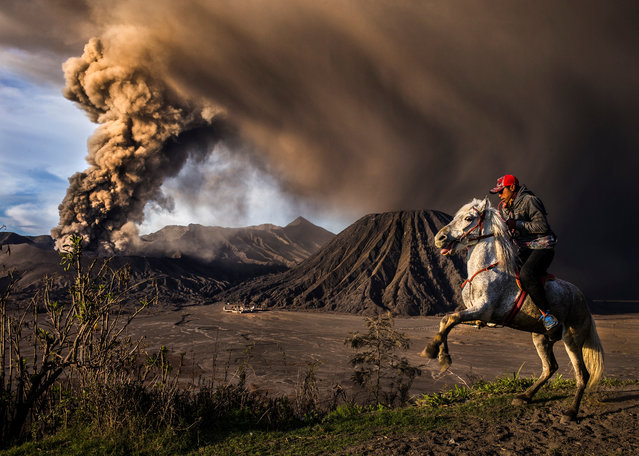
The Mount Bromo volcano erupts in the Bryce Canyon, Utah. (Photo by Reynold Dewantara/2016 National Geographic Travel Photographer of the Year Contest)

The Mount Bromo volcano erupts in the Bryce Canyon, Utah. (Photo by Reynold Dewantara/2016 National Geographic Travel Photographer of the Year Contest)
Details
05 May 2016 13:46:00
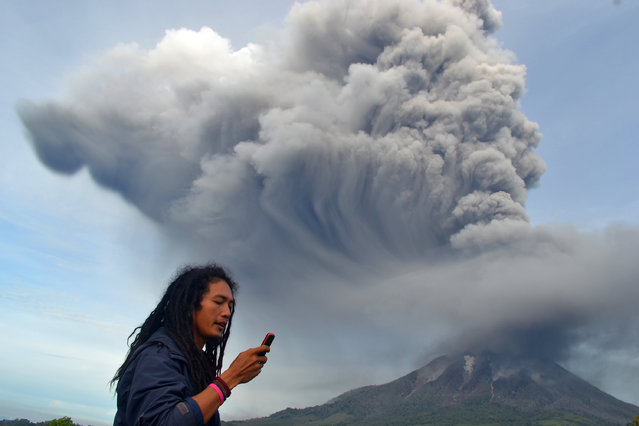
A man uses his mobile phone as Mount Sinabung continues to erupt, with hot smoke spewing from the volcano, in the Karo district on the north of Indonesia's Sumatra island on November 18, 2013. Officials said a week ago at more than 5,000 people had fled their homes since the volcano erupted early this month. (Photo by Sutanta Aditya/AFP Photo)

Starting in September, Indonesia's Mount Sinabung began erupting yet again. In the days that followed, ash and smoke were shot into the air multiple times. As a result, nearby towns turned gray from repeated blows by the volcano. Photo: A man uses his mobile phone as Mount Sinabung continues to erupt, with hot smoke spewing from the volcano, in the Karo district on the north of Indonesia's Sumatra island on November 18, 2013. Officials said a week ago at more than 5,000 people had fled their homes since the volcano erupted early this month. (Photo by Sutanta Aditya/AFP Photo)
Details
22 Nov 2013 08:08:00
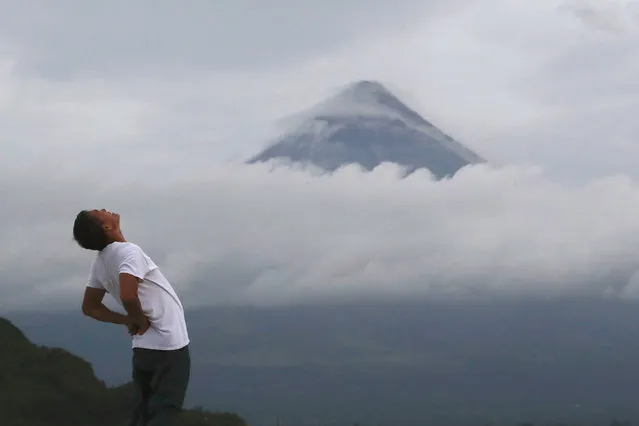
A villager stretches as the Mayon volcano spews ashes and lava in Legaspi city, Albay province, Philippines, 12 June 2023. The restive Mayon volcano has begun spewing lava and small eruptions, putting the lives of thousands of people at risk from possible violent explosion. (Photo by Francis R. Malasig/EPA/EFE)

A villager stretches as the Mayon volcano spews ashes and lava in Legaspi city, Albay province, Philippines, 12 June 2023. The restive Mayon volcano has begun spewing lava and small eruptions, putting the lives of thousands of people at risk from possible violent explosion. (Photo by Francis R. Malasig/EPA/EFE)
Details
24 Jun 2023 03:25:00
A villager watches as Mount Sinabung volcano erupts, in Kuta Tengah village, Karo Regency in Indonesia's North Sumatra April 1, 2015. The Indonesian volcano was dormant for 400 years before erupting in 2010. (Photo by Y. T. Haryono/Reuters)

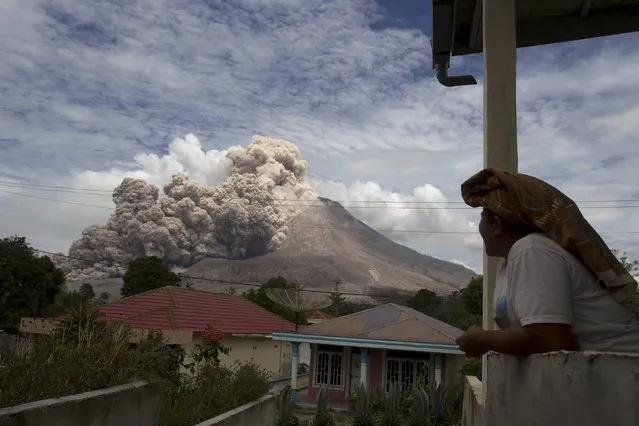
A villager watches as Mount Sinabung volcano erupts, in Kuta Tengah village, Karo Regency in Indonesia's North Sumatra April 1, 2015. The Indonesian volcano was dormant for 400 years before erupting in 2010. (Photo by Y. T. Haryono/Reuters)
Details
02 Apr 2015 13:00:00
This image obtained January 31, 2017 from the US Geological Survey's Hawaiian Volcano Observatory showing a  lava stream, pouring out of the lava tube on the sea cliff at the Kamokuna ocean entry from the Kilauea Volcano on January 29. (Photo by AFP Photo/USGS)

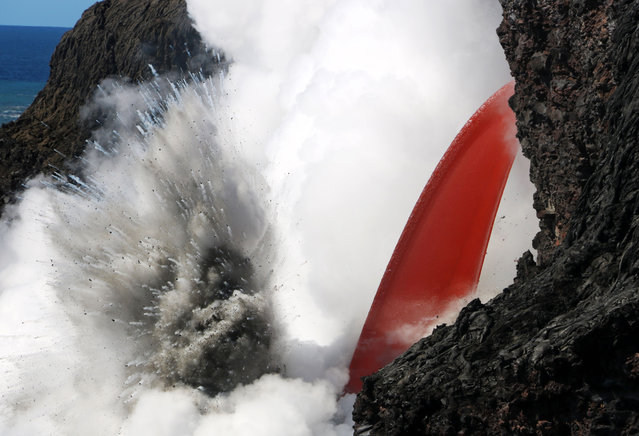
This image obtained January 31, 2017 from the US Geological Survey's Hawaiian Volcano Observatory showing a lava stream, pouring out of the lava tube on the sea cliff at the Kamokuna ocean entry from the Kilauea Volcano on January 29. (Photo by AFP Photo/USGS)
Details
01 Feb 2017 10:21:00
An infrared portrait from NASA's Spitzer Space Telescope which shows generations of stars is seen in this undated NASA handout image released February 14, 2013. In this wispy star-forming region, called W5, the oldest stars can be seen as blue dots in the centers of the two hollow cavities (other blue dots are background and foreground stars not associated with the region). Red shows heated dust that pervades the region's cavities, while green highlights dense clouds. (Photo by NASA/Reuters/JPL-Caltech/Harvard-Smithsonian/Handout)

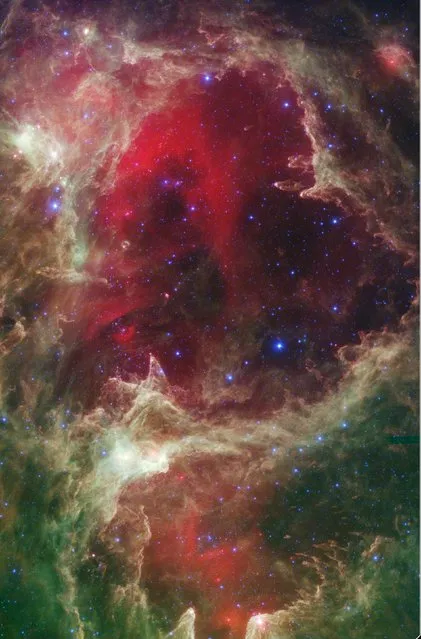
An infrared portrait from NASA's Spitzer Space Telescope which shows generations of stars is seen in this undated NASA handout image released February 14, 2013. In this wispy star-forming region, called W5, the oldest stars can be seen as blue dots in the centers of the two hollow cavities (other blue dots are background and foreground stars not associated with the region). Red shows heated dust that pervades the region's cavities, while green highlights dense clouds. (Photo by NASA/Reuters/JPL-Caltech/Harvard-Smithsonian/Handout)
Details
03 Mar 2013 08:44:00