Loading...
Done
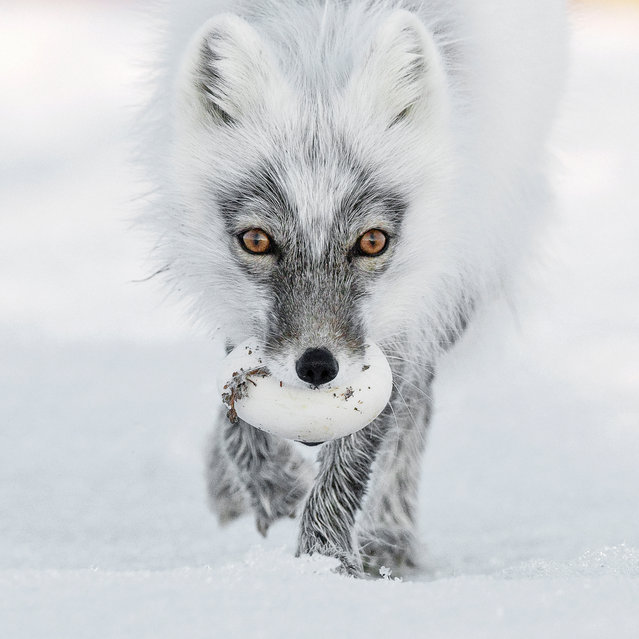
Arctic treasure by Sergey Gorshkov (Russia). An arctic fox carries its egg trophy from a raid on a snow goose nest and heads for a suitable burial spot. Finalist 2017, Animal Portraits. (Photo by  Sergey Gorshkov/2017 Wildlife Photographer of the Year)

Arctic treasure by Sergey Gorshkov (Russia). An arctic fox carries its egg trophy from a raid on a snow goose nest and heads for a suitable burial spot. Finalist 2017, Animal Portraits. (Photo by Sergey Gorshkov/2017 Wildlife Photographer of the Year)
Details
12 Sep 2017 09:33:00
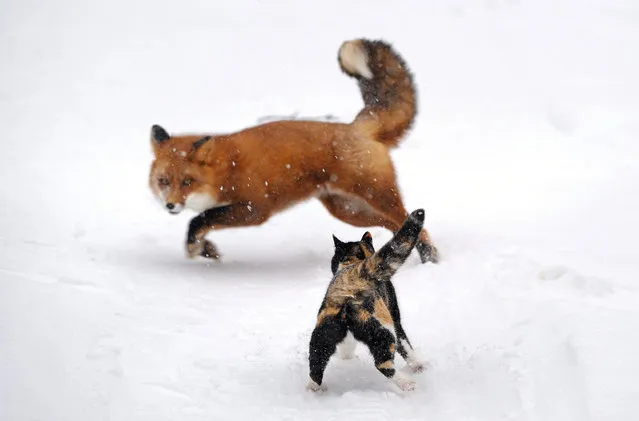
Respect, Kronotsky nature reserve, Russia. The photographer’s cat, Ryska – her name means little lynx in Russian – stands outside their cabin and with aggressive posturing warns off a fox. In winter, foxes would regularly visit the cabin searching for food. If one peered in at the window, possible when the snow was deep, Ryska would sit on the other side, fur raised, and growl. When outside, she would hold her ground. The foxes were not always frightened and so encounters could be a sort of dance. (Photo by Igor Shpilenok/Unforgettable Behaviour/NHM)

Respect, Kronotsky nature reserve, Russia. The photographer’s cat, Ryska – her name means little lynx in Russian – stands outside their cabin and with aggressive posturing warns off a fox. In winter, foxes would regularly visit the cabin searching for food. If one peered in at the window, possible when the snow was deep, Ryska would sit on the other side, fur raised, and growl. When outside, she would hold her ground. The foxes were not always frightened and so encounters could be a sort of dance. (Photo by Igor Shpilenok/Unforgettable Behaviour/NHM)
Details
08 Apr 2017 09:14:00
A woman in a wedding dress walks on the dried-up riverbed of the Jialing river, a tributary of the Yangtze, that is approaching record-low water levels in Chongqing, China on August 18, 2022. (Photo by Thomas Peter/Reuters)

A woman in a wedding dress walks on the dried-up riverbed of the Jialing river, a tributary of the Yangtze, that is approaching record-low water levels in Chongqing, China on August 18, 2022. (Photo by Thomas Peter/Reuters)
Details
29 Aug 2022 05:44:00
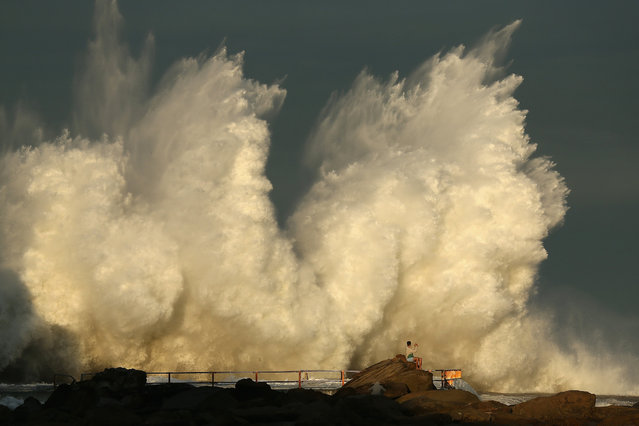
A man watches a wave hit a rock pool at Curl Curl beach as large swell hits the East Coast of Australia on June 6, 2016 in Sydney, Australia. Torrential rain over the weekend saw streets and homes flooded while wind gusts up to 120km per hour brought down trees and powerlines. A king tide has also seen beachside homes evacuated on Sydney's northern beaches as large waves erode the coast. (Photo by Cameron Spencer/Getty Images)

A man watches a wave hit a rock pool at Curl Curl beach as large swell hits the East Coast of Australia on June 6, 2016 in Sydney, Australia. Torrential rain over the weekend saw streets and homes flooded while wind gusts up to 120km per hour brought down trees and powerlines. A king tide has also seen beachside homes evacuated on Sydney's northern beaches as large waves erode the coast. (Photo by Cameron Spencer/Getty Images)
Details
25 Jul 2016 11:30:00
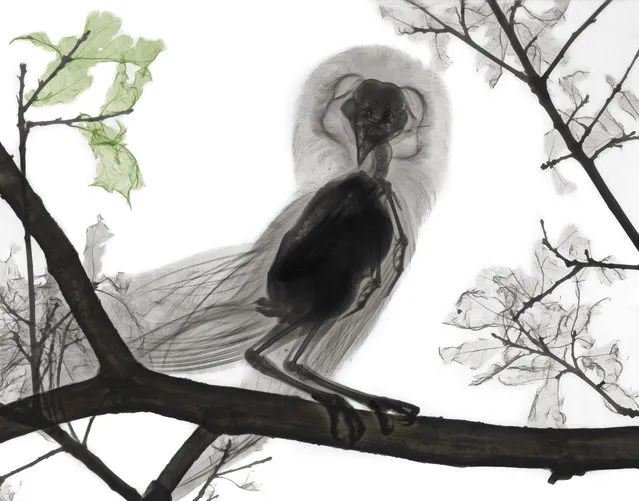
Coloured X-ray of a barn owl. A physicist has used X-ray to create an extraordinary collection of artwork. Arie van't Riets pictures reveal birds, fish, monkeys and flowers in an incredible new light. The 66-year-old, from Bathmen in the Netherlands, began X-raying flowers as a means to teach radiographers and physicians how the machine worked. But after adding a bit of colour to the pictures, the retired medical physicist realised the potential for an exciting new collection of art. (Photo by Arie van't Riet/Barcroft Media)

Coloured X-ray of a barn owl. A physicist has used X-ray to create an extraordinary collection of artwork. Arie van't Riets pictures reveal birds, fish, monkeys and flowers in an incredible new light. The 66-year-old, from Bathmen in the Netherlands, began X-raying flowers as a means to teach radiographers and physicians how the machine worked. But after adding a bit of colour to the pictures, the retired medical physicist realised the potential for an exciting new collection of art. (Photo by Arie van't Riet/Barcroft Media)
Details
08 Jul 2014 13:25:00
In this November 3, 2015 file photo, Afghan Taliban fighters listen to Mullah Mohammed Rasool, the newly-elected leader of a breakaway faction of the Taliban, in Farah province, Afghanistan. Despite US President Donald Trump’s pronouncement that there would be no talks with the Taliban following a series of deadly attacks in Kabul, officials say talks continue, but neither side trusts the other and neither believes the other negotiates independently. (Photo by AP Photo/Stringer)

In this November 3, 2015 file photo, Afghan Taliban fighters listen to Mullah Mohammed Rasool, the newly-elected leader of a breakaway faction of the Taliban, in Farah province, Afghanistan. Despite US President Donald Trump’s pronouncement that there would be no talks with the Taliban following a series of deadly attacks in Kabul, officials say talks continue, but neither side trusts the other and neither believes the other negotiates independently. (Photo by AP Photo/Stringer)
Details
24 Feb 2018 00:02:00
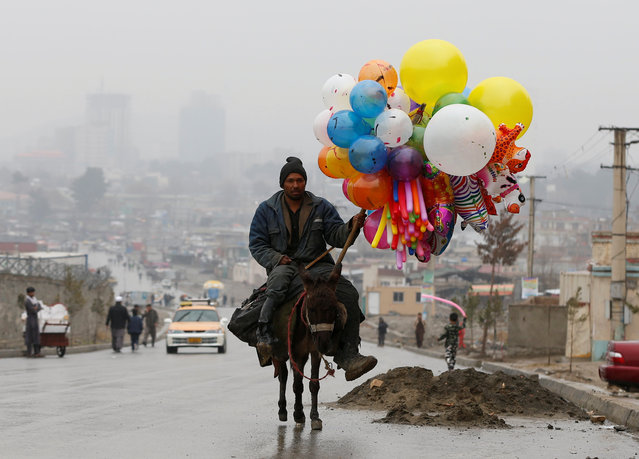
An Afghan man rides on his donkey, holding balloons for sale during Newroz Day celebrations, a festival marking their spring and new year, in Kabul, Afghanistan March 21, 2017. (Photo by Omar Sobhani/Reuters)

An Afghan man rides on his donkey, holding balloons for sale during Newroz Day celebrations, a festival marking their spring and new year, in Kabul, Afghanistan March 21, 2017. (Photo by Omar Sobhani/Reuters)
Details
29 May 2017 06:32:00
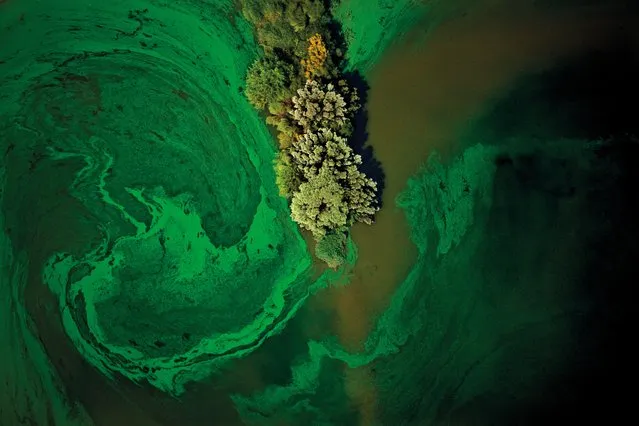
Luling, Louisiana US. New evidence contradicts previous claims of the relative safety of glyphosate, the world’s most widely used herbicide, which is manufactured here. It is often used in conjunction with seeds that have been genetically modified to tolerate its application, meaning that anyone consuming these crops is eating a genetically modified plant, and whatever residue of the pesticide that remains. (Photo by J. Henry Fair/Industrial Scars/Papadakis Publisher)

Luling, Louisiana, US. New evidence contradicts previous claims of the relative safety of glyphosate, the world’s most widely used herbicide, which is manufactured here. It is often used in conjunction with seeds that have been genetically modified to tolerate its application, meaning that anyone consuming these crops is eating a genetically modified plant, and whatever residue of the pesticide that remains. (Photo by J. Henry Fair/Industrial Scars/Papadakis Publisher)
Details
25 Oct 2016 10:40:00