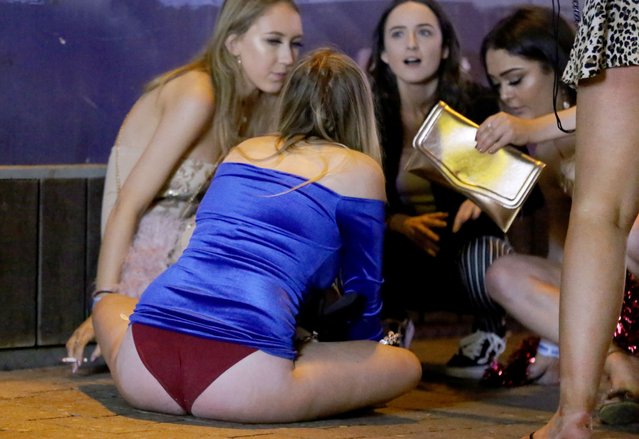
Revelers celebrate during fireworks marking the start of the New Year on Copacabana beach on January 1, 2017 in Rio de Janeiro, Brazil. (Photo by Mario Tama/Getty Images)
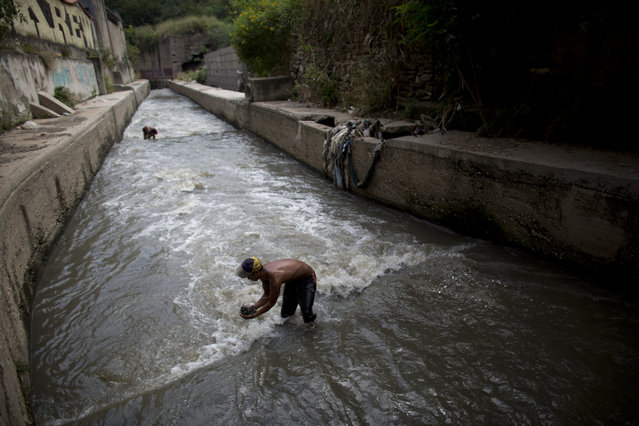
In this November 30, 2017 photo, Douglas scoops up mud from the bottom of the polluted Guaire River, in search of gold and anything valuable he can sell, in Caracas, Venezuela. Some stretches of the river smell of sewer while others emit a toxic odor of fuel, a stench that stays in ones nose for hours after leaving the water. (Photo by Ariana Cubillos/AP Photo)
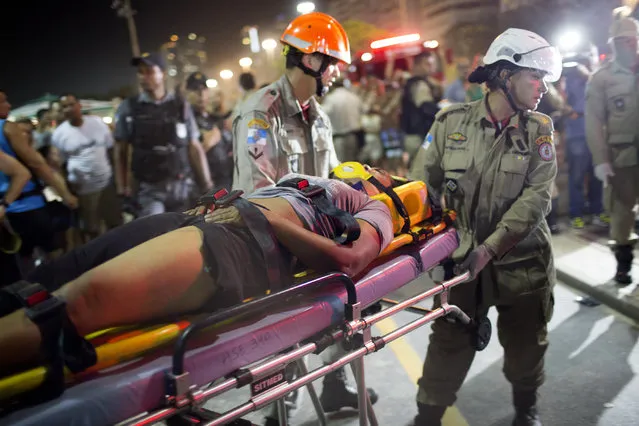
Firefighters carry a woman on a stretcher after a car drove into the crowded seaside boardwalk along Copacabana beach in Rio de Janeiro, Brazil, Thursday, January 18, 2018. Military police said on Twitter that at least 11 people were injured and that the driver has been taken into custody. (Photo by Silvia Izquierdo/AP Photo)
A pedestrian carries an umbrella as they stroll past an advertisment as a rainstorm moves through Sacramento, Calif., Wednesday, February 13, 2019. Rain is falling widely in Northern California and is expected to spread south. (Photo by Rich Pedroncelli/AP Photo)
Sun Rongchun, 57, exercises with an improvised cervical traction device attached to a high bar at a sports complex in Shenyang, Liaoning province, China on April 9, 2019. (Photo by Sheng Li/Reuters)
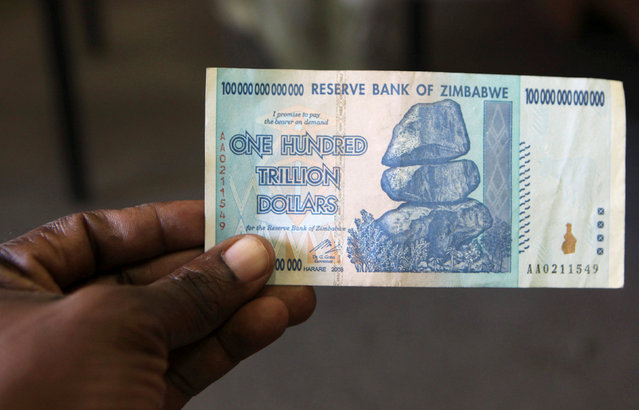
A man holds up for a picture a one hundred trillion Zimbabwean dollars note inside a shop in Harare, Zimbawe, June 12, 2015. Hyperinflation in Zimbabwe was a period of currency instability that began in the late 1990s shortly after the confiscation of private farms from landowners, towards the end of Zimbabwean involvement in the Second Congo War. During the height of inflation from 2008 to 2009, it was difficult to measure Zimbabwe's hyperinflation because the government of Zimbabwe stopped filing official inflation statistics. However, Zimbabwe's peak month of inflation is estimated at 79.6 billion percent in mid-November 2008. (Photo by Philimon Bulawayo/Reuters)