Loading...
Done


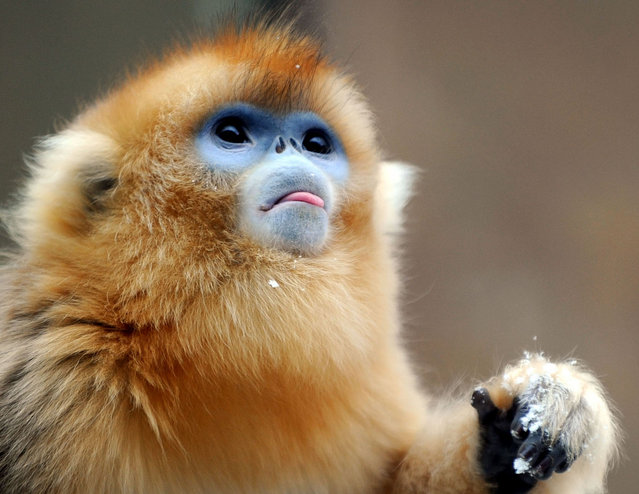
The golden monkey (Cercopithecus kandti) is a species of Old World monkey found in the Virunga volcanic mountains of Central Africa, including four national parks: Mgahinga, in south-west Uganda; Volcanoes, in north-west Rwanda; and Virunga and Kahuzi-Biéga, in the eastern Democratic Republic of Congo. It is restricted to highland forest, especially near bamboo.
Details
07 May 2012 04:39:00


“Snowflake (c. 1964 – November 24, 2003) was an albino gorilla. He was the only known albino gorilla so far, and the most popular resident of the Barcelona Zoo in Catalonia, Spain. Originally named Nfumu Ngui in Fang language ("white gorilla") by his captor, he was then nicknamed Floquet de Neu (Catalan for little snowflake) by his keeper Jordi Sabater Pi. On his arrival to Barcelona where he was given an official reception by the then Mayor of Barcelona, Josep Maria de Porcioles, in November 1966, he was called Blancanieves (“Snow White”) in the newspaper Tele/Exprés. But he became famous with the name given to him by Sabater when National Geographic Magazine featured him on the main page in March 1967, with the English name Snowflake. This name spread among the press (Stern, Life, Paris-Match) and was later translated to Spanish as Copito de Nieve. Sabater himself called the gorilla Floquet or Copi, and in the later years Nfumu. The asteroid 95962 Copito, discovered by Catalan astronomer J. Manteca, is named in his honour”.

Details
07 Mar 2011 15:50:00


Alexandre Vinokourov of Kazakhstan from the T-Mobile Team is chased by eccentric german inventor Didi Senft dressed as the red devil during the stage 16 of the 92nd Tour de France between Mourenx and Pau on July 19, 2005, France. (Photo by Friedemann Vogel/Bongarts/Getty Images)
Details
25 Mar 2011 14:16:00


An F/A-18 Hornet assigned to Strike Fighter Squadron One Five One (VFA-151) emerges from a cloud created when it broke the sound barrier in the skies over the Pacific Ocean, July 7, 1999. (Photo by John Gay/US Navy)
Details
25 May 2011 10:33:00
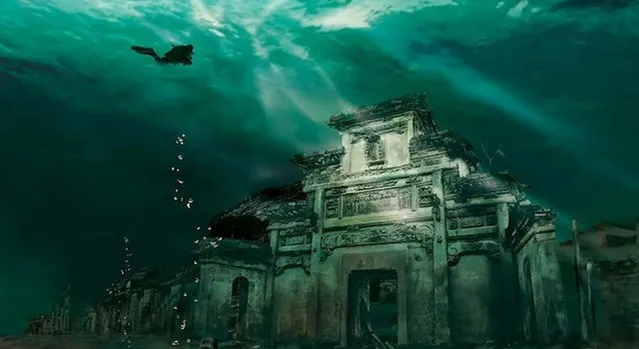
Lost City Shicheng found Underwater in China

Qiandao Lake (Chinese: 千島湖, lit. Thousand Island Lake), a man-made lake located in Chun'an County, Zhejiang, China, formed after the completion of the Xin'an River hydroelectric station in 1959. 1,078 large islands dot the lake and a few thousand smaller ones are scattered across it. The lake covers an area of 573 km² and has a storage capacity of 17.8 km³. The islands in the lake cover about 86 km²
Details
07 Feb 2014 13:25:00


A view of the spectacular colour of clouds at sunset on January 17, 2005 in Beijing, China. (Photo by China Photos/Getty Images)
Details
31 May 2011 09:31:00
A large molded bust of Edward Snowden is pictured in Fort Greene Park at the Brooklyn borough of New York in this April 6, 2015 picture provided by ANIMALNewYork. A group of anonymous artists erected the 4-foot-tall bronze statue of Snowden, the former U.S. spy agency contractor famous for leaking classified information, in a New York City park overnight, officials said on Monday. (Photo by Aymann Ismail/Reuters/ANIMALNewYork)

A large molded bust of Edward Snowden is pictured in Fort Greene Park at the Brooklyn borough of New York in this April 6, 2015 picture provided by ANIMALNewYork. A group of anonymous artists erected the 4-foot-tall bronze statue of Snowden, the former U.S. spy agency contractor famous for leaking classified information, in a New York City park overnight, officials said on Monday. (Photo by Aymann Ismail/Reuters/ANIMALNewYork)
Details
07 Apr 2015 11:23:00
This Thursday, January 22, 2015 photo made with a long exposure shows the glow from a Noctiluca scintillans algal bloom along the seashore in Hong Kong. The luminescence, also called Sea Sparkle, is triggered by farm pollution that can be devastating to marine life and local fisheries, according to University of Georgia oceanographer Samantha Joye. (Photo by Kin Cheung/AP Photo)

This Thursday, January 22, 2015 photo made with a long exposure shows the glow from a Noctiluca scintillans algal bloom along the seashore in Hong Kong. The luminescence, also called Sea Sparkle, is triggered by farm pollution that can be devastating to marine life and local fisheries, according to University of Georgia oceanographer Samantha Joye. Noctiluca itself does not produce neurotoxins like other similar organisms do. But its role as both prey and predator tends can eventually magnify the accumulation of toxins in the food chain, according to R. Eugene Turner at Louisiana State University. (Photo by Kin Cheung/AP Photo)
Details
23 Jan 2015 13:12:00