Loading...
Done
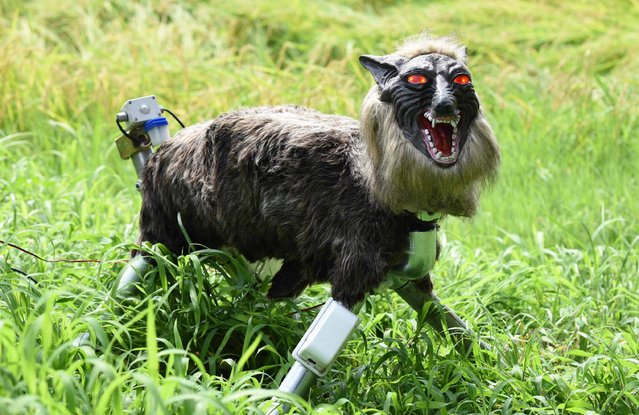
A wolf-like robot “Super Monster Wolf” stands beside a rice field to drive away wild animals that cause damages to crops in Kisarazu, Chiba prefecture, on August 25, 2017. The agricultural coopetative association JA Kisarazu-shi introduced the 65cm-long and 50cm-high robot recently on a trial basis which can detect wild animals such as boars and deers with an infrared ray sensor when they approach and intimidates them, flashing the red LED eyes and blaring 48 types of sounds including a wolf growl and human voice. (Photo by Toru Yamanaka/AFP Photo)

A wolf-like robot “Super Monster Wolf” stands beside a rice field to drive away wild animals that cause damages to crops in Kisarazu, Chiba prefecture, on August 25, 2017. The agricultural coopetative association JA Kisarazu-shi introduced the 65cm-long and 50cm-high robot recently on a trial basis which can detect wild animals such as boars and deers with an infrared ray sensor when they approach and intimidates them, flashing the red LED eyes and blaring 48 types of sounds including a wolf growl and human voice. (Photo by Toru Yamanaka/AFP Photo)
Details
27 Aug 2017 07:17:00
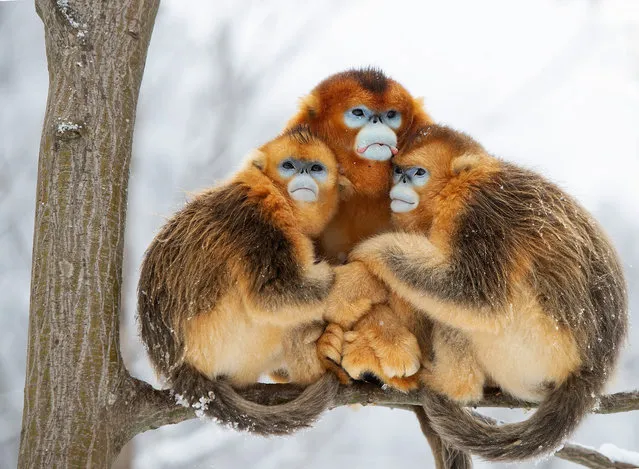
A golden huddle by Minqiang Lu, China. Two females and a male golden snub-nosed monkey huddle together to keep warm in the extreme cold. Threatened by forest loss and fragmentation, this endangered species is confined to central China. Restricted to living high up in the temperate forests, these monkeys – here in the Qinling mountains in Shaanxi province – feed mostly in the trees, on leaves, bark, buds and lichen. In heavy wind and snow, Minqiang walked up the mountain carrying his equipment. He stayed for half an hour in temperatures of –10C opposite the tree where the group was huddled before achieving this eye-level composition. (Photo by Minqiang Lu/Wildlife Photographer of the Year)

A golden huddle by Minqiang Lu, China. Two females and a male golden snub-nosed monkey huddle together to keep warm in the extreme cold. Threatened by forest loss and fragmentation, this endangered species is confined to central China. Restricted to living high up in the temperate forests, these monkeys – here in the Qinling mountains in Shaanxi province – feed mostly in the trees, on leaves, bark, buds and lichen. In heavy wind and snow, Minqiang walked up the mountain carrying his equipment. He stayed for half an hour in temperatures of –10C opposite the tree where the group was huddled before achieving this eye-level composition. (Photo by Minqiang Lu/Wildlife Photographer of the Year)
Details
12 Jan 2023 01:19:00
A member of the South African National Defense Force (SANDF) stands on a military vehicle during a joint South African Police Services (SAPS) and SANDF patrol on day 31 of the national lockdown as a result of the ongoing coronavirus COVID-19 pandemic in Johannesburg, South Africa, 26 April 2020. The patrol was in the high density areas of Hillbrow and Yoeville where civilians are still breaking the strict lockdown rules. Those that where breaking the rules where arrested. South Africa's Stage 5 lockdown is due to end 30 April 2020 when stage 4 will be implemented. (Photo by Kim Ludbrook/EPA/EFE)

A member of the South African National Defense Force (SANDF) stands on a military vehicle during a joint South African Police Services (SAPS) and SANDF patrol on day 31 of the national lockdown as a result of the ongoing coronavirus COVID-19 pandemic in Johannesburg, South Africa, 26 April 2020. The patrol was in the high density areas of Hillbrow and Yoeville where civilians are still breaking the strict lockdown rules. Those that where breaking the rules where arrested. South Africa's Stage 5 lockdown is due to end 30 April 2020 when stage 4 will be implemented. (Photo by Kim Ludbrook/EPA/EFE)
Details
06 May 2020 00:01:00
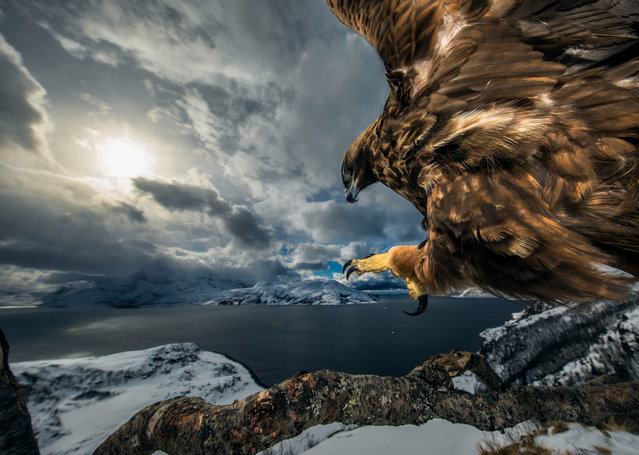
Birds behaviour winner: Land of the Eagle by Audun Rikardsen, Norway. High on a ledge, on the coast near his home in northern Norway, Rikardsen carefully positioned an old tree branch that he hoped would make a perfect golden eagle lookout. To this, he bolted a tripod head with a camera, flashes and motion sensor attached, and built himself a hide a short distance away. From time to time, he left road‑kill carrion nearby. Very gradually – over the next three years – a golden eagle got used to the camera and started to use the branch regularly to survey the coast below. (Photo by Audun Rikardsen/2019 Wildlife Photographer of the Year)

Birds behaviour winner: Land of the Eagle by Audun Rikardsen, Norway. High on a ledge, on the coast near his home in northern Norway, Rikardsen carefully positioned an old tree branch that he hoped would make a perfect golden eagle lookout. To this, he bolted a tripod head with a camera, flashes and motion sensor attached, and built himself a hide a short distance away. From time to time, he left road‑kill carrion nearby. Very gradually – over the next three years – a golden eagle got used to the camera and started to use the branch regularly to survey the coast below. (Photo by Audun Rikardsen/2019 Wildlife Photographer of the Year)
Details
17 Oct 2019 00:03:00
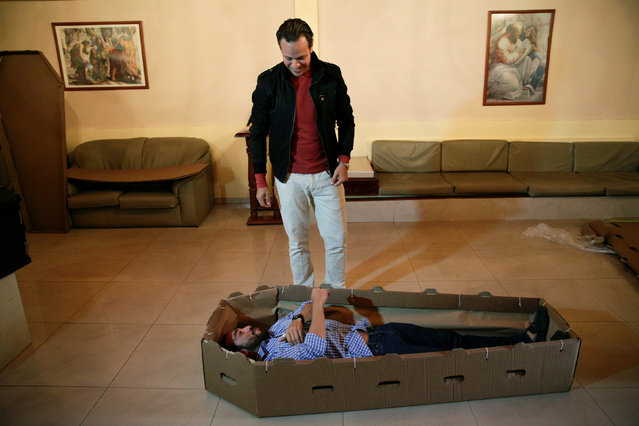
Elio Angulo (bottom C) lies inside a cardboard coffin next to Alejandro Blanchard as they introduce their product to potential customers at a mortuary in Valencia, in the state of Carabobo, Venezuela August 25, 2016. (Photo by Marco Bello/Reuters)

Elio Angulo (bottom C) lies inside a cardboard coffin next to Alejandro Blanchard as they introduce their product to potential customers at a mortuary in Valencia, in the state of Carabobo, Venezuela August 25, 2016. When Venezuelan entrepreneurs Alejandro Blanchard and Elio Angulo decided to create cardboard coffins, they were looking for an ecological selling point to compete against classic wood and brass caskets. Three years on, with the oil-rich country mired in deep economic crisis, their “bio-coffins” are becoming a viable option because of high prices for wooden coffins and shortages of brass ones. (Photo by Marco Bello/Reuters)
Details
27 Aug 2016 11:18:00


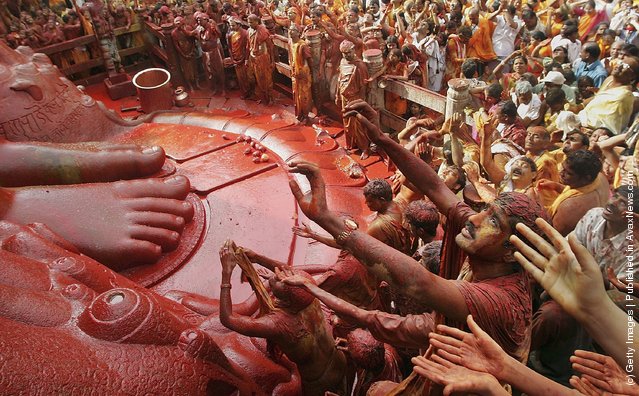
“The Mahamasthakabhisheka (or Mahamasthak Abhishek) is an important Jain festival held once every twelve years in the town of Shravanabelagola in Karnataka state, India. The festival is held in veneration of an immense 18 meter high statue of the Bhagwan (or Saint) Gomateshwara Bahubali. The anointing last took place in February 2006, and the next ceremony will occur in 2018”. – Wikipedia

Photo: A Jain Sadhu (2nd L) and devotees gather and pray at the feet of the monolithic statue of Jain sage Gomateswara during preparations for the Mahamastak Abhisheka ceremony February 7, 2006 in Shravanabelagola, India. The Mahamastak Abhisheka ceremony is held just once every twelve years where the statue will be bathed with milk, yogurt, saffron, gold coins and other religious items. The statue is said to be the world's largest monolith. The ceremony officially runs February 8-19. (Photo by Mario Tama/Getty Images)
Details
21 Jun 2011 12:27:00


“NASA's Pathfinder, Pathfinder Plus, Centurion and Helios Prototype were an evolutionary series of solar- and fuel-cell-system-powered unmanned aerial vehicles. AeroVironment, Inc. developed the vehicles under NASA's Environmental Research Aircraft and Sensor Technology (ERAST) program. They were built to develop the technologies that would allow long-term, high-altitude aircraft to serve as “atmospheric satellites”, to perform atmospheric research tasks as well as serve as communications platforms”. – Wikipedia

Photo: The solar-electric Helios Prototype flying wing is flies over the Hawaiian islands of Niihau and Lehua during the first solar-powered test flight July 14, 2001 from the U.S. Navy's Pacific Missile Range Facility on Kauai, HI. The 18-hour flight was a functional checkout of the aircraft's systems and performance in preparation for an attempt to reach sustained flight at 100,000 feet altitude later in the summer. (Photo Courtesy of NASA/Getty Images)
Details
14 Jul 2011 09:24:00


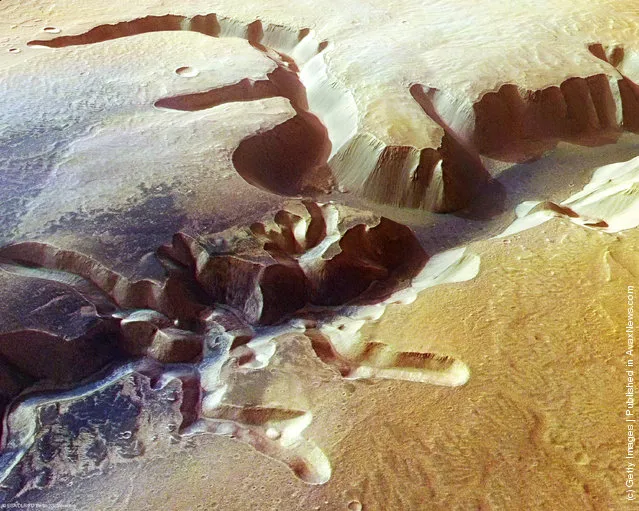
“Echus Chasma is a chasma in the Lunae Planum high plateau north of the Valles Marineris canyon system of Mars. Clay has been found in Echus Chasma that means that water once sat there for a time. Echus Chasma is approximately 100 km long and 10 km wide, with valleys ranging in depth from around 1 km to 4 km”. – Wikipedia

Photo: In this handout image supplied by the European Space Agency (ESA) on July 16, 2008, The Echus Chasma, one of the largest water source regions on Mars, is pictured from ESA's Mars Express. The data was acquired on September 25, 2005. The dark material shows a network of light-coloured, incised valleys that look similar to drainage networks known on Earth. It is still debated whether the valleys originate from precipitation, groundwater springs or liquid or magma flows on the surface. (Photo by ESA via Getty Images)
Details
18 Jul 2011 11:47:00