Loading...
Done
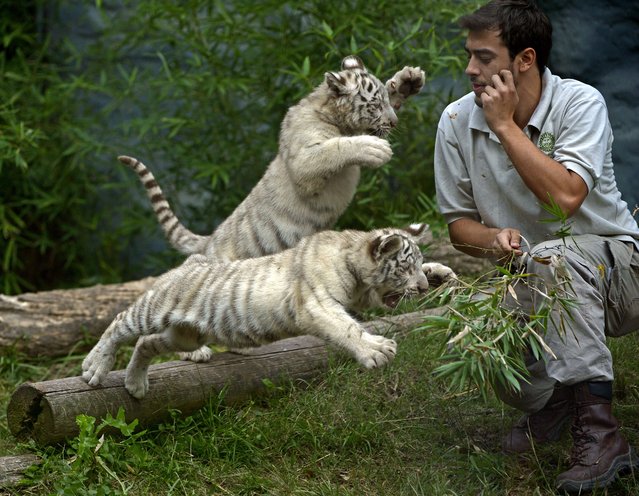
Two three-month-old female white Bengal tiger cubs play with a zoo keeper in their enclosure at the Buenos Aires' Zoo, in Argentina, on April 17, 2014. Captive white Bengal tiger Cloe, gave birth to three cubs – two females and one male – on January 14, 2014. (Photo by Juan Mabromata/AFP Photo)

Two three-month-old female white Bengal tiger cubs play with a zoo keeper in their enclosure at the Buenos Aires' Zoo, in Argentina, on April 17, 2014. Captive white Bengal tiger Cloe, gave birth to three cubs – two females and one male – on January 14, 2014. (Photo by Juan Mabromata/AFP Photo)
Details
19 Apr 2014 12:27:00
An aerial view shows a sinkhole 3.5 km (2 miles) to the east of Solikamsk-2 mine in Perm region, November 20, 2014. Shares in Russia's Uralkali, the world's top potash producer, fell sharply for a second day on Wednesday after a mine accident that could reduce global supplies and push up prices of the crop nutrient worldwide. (Photo by Reuters/Press service of Uralkali company)

An aerial view shows a sinkhole 3.5 km (2 miles) to the east of Solikamsk-2 mine in Perm region, November 20, 2014. Shares in Russia's Uralkali, the world's top potash producer, fell sharply for a second day on Wednesday after a mine accident that could reduce global supplies and push up prices of the crop nutrient worldwide. Uralkali shares have fallen 28 percent since Tuesday when it suspended work at its Solikamsk-2 mine, which accounts for a fifth of the company's output and 3.5 percent of global capacity, following an inflow of water. A sinkhole, stretching 30 by 40 metres (yards), found at an abandoned mine 3.5 km (2 miles) to the east, increased concern about the future of the mine because an inflow of water and the resulting sinkhole in 2006 forced another Uralkali operation to shut permanently. (Photo by Reuters/Press service of Uralkali company)

Details
22 Nov 2014 13:51:00
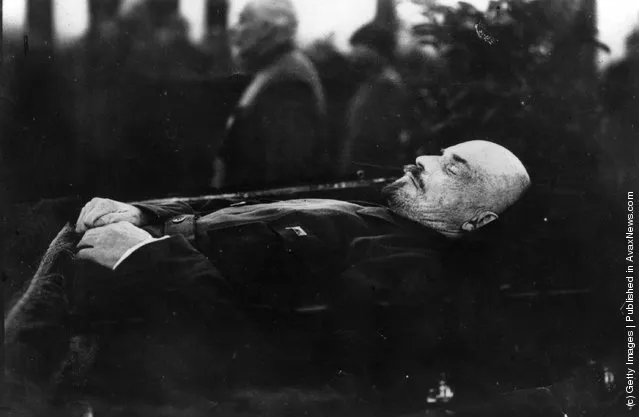
1924:  Vladimir Ilyich Lenin lying in state in the Kremlin

Photo: Vladimir Ilyich Lenin (1870 – 1924) lying in state in the Kremlin. (Photo by Hulton Archive/Getty Images). 1924

Important! For the same article in Russian language click here.

Something quite intriguing is happening within Russian-speaking internet during the last few – should you type a fully academic inquiry (at least, according to Russian academic requirements) in national search engines for "Lenin's mausoleum" – the first thing you get (even in top 10 searches) is website pages talking about black magic and occult. Website authors view this construction differently, but unconditionally agree on one thing: the mausoleum of the "leader of the world proletariat” – the essence of a magical artifact, a sort of “energy vampire”. It was built with a certain purpose: to drain the energy out of miserable Soviet citizens on one hand; and to poison the anthroposphere of one-sixth part of the earth with its vibes (the exact territory that was occupied by the former Soviet Union), depriving the Russian people of will to resist on the other hand. Complete nonsense? No doubt. Nevertheless, an intriguing one. Well, probably because some oddities do exist in mausoleum's history. These oddities are the thing we are going to discuss this time. First, let me refresh you memory on the subject.
Details
16 Oct 2011 11:27:00
Indian dancers paint their body like tigers as they perform a Tiger dance during the International day of the Tiger in Calcutta, India, July 29, 2015. Students of Calcutta are taking part in an awareness campaign aiming to draw attention to the threats that tigers face due to habitat loss and poaching. (Photo by Piyal Adhikary/EPA)

Indian dancers paint their body like tigers as they perform a Tiger dance during the International day of the Tiger in Calcutta, India, July 29, 2015. Students of Calcutta are taking part in an awareness campaign aiming to draw attention to the threats that tigers face due to habitat loss and poaching. (Photo by Piyal Adhikary/EPA)
Details
30 Jul 2015 12:47:00
Two Chinese farmers got more than they bargained for when they pulled up the root of a fleece flower – and came face-to-face with the doppelganger of Homer Simpson, on May 17, 2013. The large root appears to have two bulging eyes and a prominent nose – giving it an uncanny resemblance to the famous cartoon character. With two offshoot roots shaped like arms, it even looks like it is pondering or confused – just what you would expect from the real Homer. (Photo by ImagineChina)

Two Chinese farmers got more than they bargained for when they pulled up the root of a fleece flower – and came face-to-face with the doppelganger of Homer Simpson, on May 17, 2013. The large root appears to have two bulging eyes and a prominent nose – giving it an uncanny resemblance to the famous cartoon character. With two offshoot roots shaped like arms, it even looks like it is pondering or confused – just what you would expect from the real Homer. (Photo by ImagineChina)
Details
18 May 2013 11:52:00
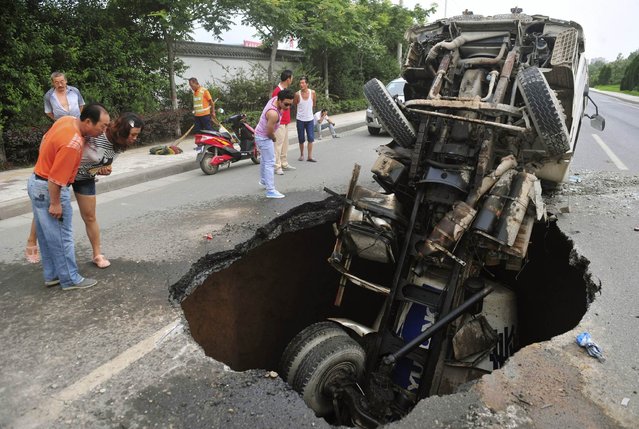
People look at a tanker after it fell into a caved-in area on a road in Xi'an, Shaanxi province, July 27, 2013. No casualty was reported in the accident, according to local media. (Photo by Reuters/Stringer)

People look at a tanker after it fell into a caved-in area on a road in Xi'an, Shaanxi province, July 27, 2013. No casualty was reported in the accident, according to local media. (Photo by Reuters/Stringer)
Details
03 Aug 2013 11:22:00
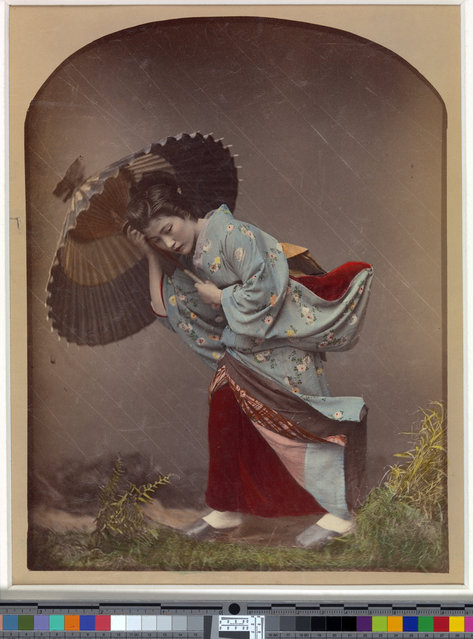
“Woman with Umbrella in Rain” by Raimund von Stillfried. Artist: Kusakabe Kimbei (Japanese, 1841–1934), 1870s. (Photo courtesy of The Metropolitan Museum of Art)

“Woman with Umbrella in Rain” by Raimund von Stillfried. Artist: Kusakabe Kimbei (Japanese, 1841–1934), 1870s. Commercial photography studios in Meiji-era Japan were renowned for the subtlety and refinement of their coloring techniques. This hand-tinted image of a young woman caught in a heavy rainstorm achieved its naturalistic effect by knitting together multiple strands of artifice: the greenery in the foreground was a studio prop; the flaps of the kimono were suspended by thin wires to create the impression of a strong wind; and long, diagonal marks were made on the negative to suggest streaks of rain. (Photo courtesy of The Metropolitan Museum of Art)
Details
12 May 2013 10:13:00
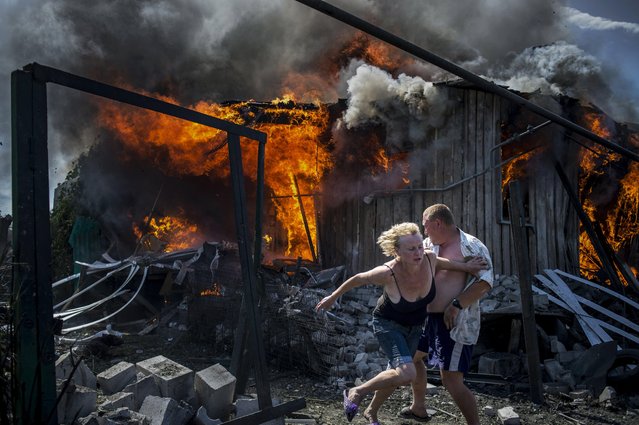
A handout photo made available by the World Press Photo (WPP) organization on 13 February 2017 shows a picture by Rossiya Segodnya photographer Valery Melnikov that won the Long-Term Projects – First Prize award of the 60th annual World Press Photo Contest, it was announced by the WPP Foundation in Amsterdam, The Netherlands on 13 February 2017. Caption: Civilians escape from a fire at a house destroyed by an air attack in the Luhanskaya village. Story: Ordinary people became victims of the conflict between self-proclaimed republics and the official Ukrainian authorities from 2014 onwards in the region of Donbass. Disaster came into their lives unexpectedly. These people were involved in the military confrontation against their will. They experienced the most terrible things: the death of their friends and relatives, destroyed homes and the ruined lives of thousands of people. (Photo by Valery Melnikov/EPA/Rossiya Segodnya/World Press Photo)

A handout photo made available by the World Press Photo (WPP) organization on 13 February 2017 shows a picture by Rossiya Segodnya photographer Valery Melnikov that won the Long-Term Projects – First Prize award of the 60th annual World Press Photo Contest, it was announced by the WPP Foundation in Amsterdam, The Netherlands on 13 February 2017. Caption: Civilians escape from a fire at a house destroyed by an air attack in the Luhanskaya village. (Photo by Valery Melnikov/EPA/Rossiya Segodnya/World Press Photo)
Details
15 Feb 2017 00:06:00