Loading...
Done
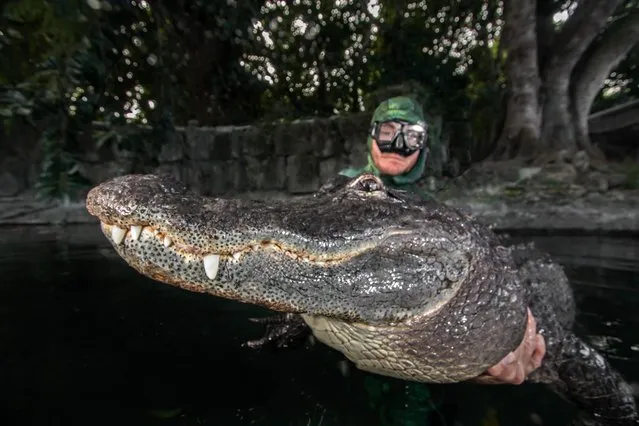
He brings the beast up close and personal to the camera. (Photo by Chris Gillette and Michael Dornellas/Mediadrumworld.com)

The incredible photographs show the three alligators crowding around the man’s head as they look directly at the camera and one even appears to sit on his lap whilst another reptile places a claw on his arm as it swims towards the surface. Photographs taken from above the surface show animal handler, Chris Gillette (29) from Fort Lauderdale, Florida, USA holding an alligator out of the water. The images of Chris were taken by Michael Dornellas at the Everglades Outpost Wildlife Rescue, Florida USA. Here: Mich­ael Dornellas brings the beast up close and personal to the camera. (Photo by Chris Gillette and Michael Dornellas/Mediadrumworld.com)
Details
20 Jan 2017 08:03:00


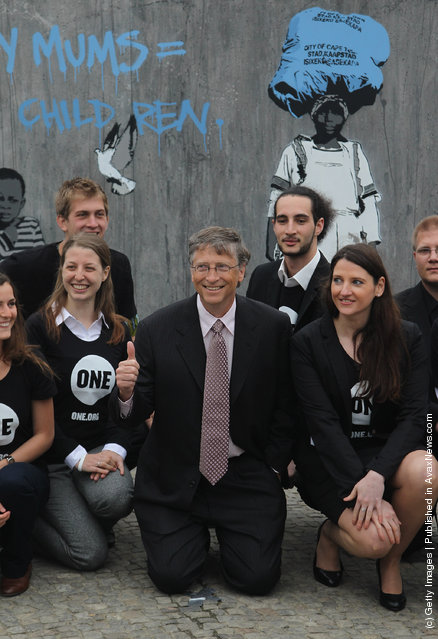
“The ONE Campaign is a international, nonpartisan, non-profit organization which aims to increase government funding for and effectiveness of international aid programs. ONE was originally founded by a coalition of 11 non-profit humanitarian and advocacy organizations — including DATA, World Vision, Oxfam America, and Bread for the World — with funding from the Bill & Melinda Gates Foundation. In 2007, ONE announced that it would be merging with DATA. Currently, ONE is campaigning for resources to help developing countries adapt to climate change. During the 2008 U.S. presidential election the organization launched a campaign, called ONE Vote '08, which was co-chaired by former U.S. Senate majority leaders Tom Daschle (D-SD) and Bill Frist (R-TN). The campaign is named after the U2 song “One” which was a top ten hit single on the critically acclaimed 1991 Achtung Baby album”. – Wikipedia

Photo: Bill Gates, founder of Microsoft and now philanthropist, poses with One.org charity volunteers at Pariser Platz square during a brief stop at Brandenburg Gate on April 6, 2011 in Berlin, Germany. Gates is in Berlin to meet with German government officials, including Chancellor Angela Merkel and Development Minister Dirk Niebel, to discuss aid for developing countries and promote his One.org charity initiative, which is part of the Bill and Melinda Gates Foundation. (Photo by Sean Gallup/Getty Images)

Details
07 Apr 2011 08:31:00
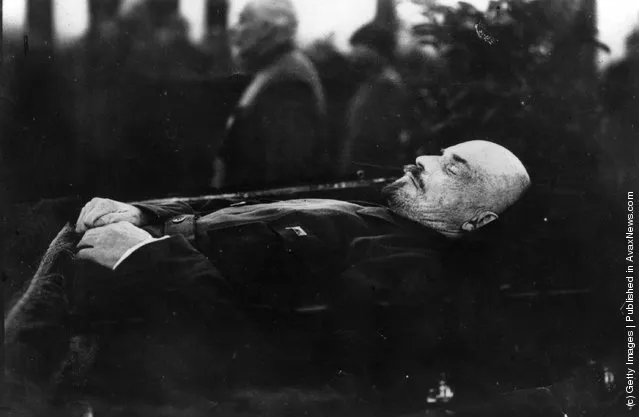
1924:  Vladimir Ilyich Lenin lying in state in the Kremlin

Photo: Vladimir Ilyich Lenin (1870 – 1924) lying in state in the Kremlin. (Photo by Hulton Archive/Getty Images). 1924

Important! For the same article in Russian language click here.

Something quite intriguing is happening within Russian-speaking internet during the last few – should you type a fully academic inquiry (at least, according to Russian academic requirements) in national search engines for "Lenin's mausoleum" – the first thing you get (even in top 10 searches) is website pages talking about black magic and occult. Website authors view this construction differently, but unconditionally agree on one thing: the mausoleum of the "leader of the world proletariat” – the essence of a magical artifact, a sort of “energy vampire”. It was built with a certain purpose: to drain the energy out of miserable Soviet citizens on one hand; and to poison the anthroposphere of one-sixth part of the earth with its vibes (the exact territory that was occupied by the former Soviet Union), depriving the Russian people of will to resist on the other hand. Complete nonsense? No doubt. Nevertheless, an intriguing one. Well, probably because some oddities do exist in mausoleum's history. These oddities are the thing we are going to discuss this time. First, let me refresh you memory on the subject.
Details
16 Oct 2011 11:27:00
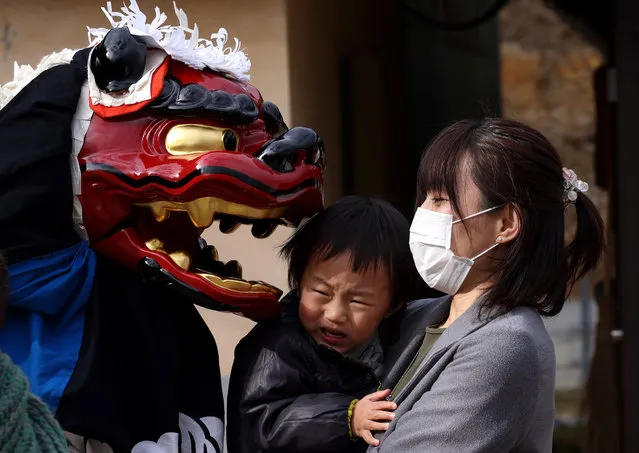
A performer wearing a lion mask performs the Ise Daikagura lion dance at the remote village of Yamanawa on February 08, 2021 in Ryuo, Japan. Ise Daikagura is a group of traditional Lion Dance performers who pray in front of farmers houses and businesses for good grain harvests and disease-free lives. Performers play sacred music using drums and flutes with two lion mask dancers. A lion mask is considered a symbol of God, who enters the house and performs in front of the Shinto God, a statue placed inside the house, mostly in the kitchen. These prayers are called “Kamodo Barai”. After the prayers, they are gifted with money, rice, sake and Japanese sweets from the householders. A group can travel for more than one hundred days to thousands of households and businesses throughout rural-villages in western Japan, and pray to those who are unable to visit the country’s most sacred shrine, the Grand Ise Shrine in Mie Prefecture. The group started its performance in the Edo era between 1603 to 1868 according to Japanese history. The Japanese government designated it as an important folk cultural national property in 1981. (Photo by Buddhika Weerasinghe/Getty Images)

A performer wearing a lion mask performs the Ise Daikagura lion dance at the remote village of Yamanawa on February 08, 2021 in Ryuo, Japan. Ise Daikagura is a group of traditional Lion Dance performers who pray in front of farmers houses and businesses for good grain harvests and disease-free lives. (Photo by Buddhika Weerasinghe/Getty Images)
Details
18 Feb 2021 09:27:00
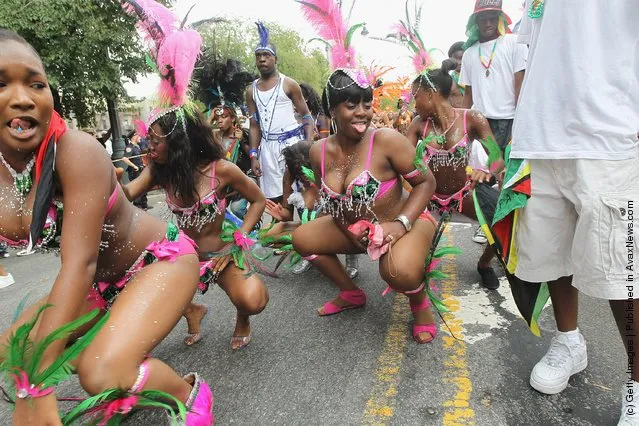
New Yorkers Celebrate At West Indian Day Parade

“The Labor Day Parade (or West Indian Carnival), is an annual celebration held on American Labor Day (the first Monday in September), in Crown Heights, Brooklyn, New York. Ms. Jessie Waddell and some of her West Indian friends started the Carnival in Harlem in the 1920s by staging costume parties in large enclosed places like the Savoy, Renaissance and Audubon Ballrooms due to the cold wintry weather of February. This is the usual time for the pre-Lenten celebrations held in most countries around the world. However, because of the very nature of Carnival, and the need to parade in costume to music, indoor confinement did not work well. The earliest known Carnival street parade was held on September 1, 1947. The Trinidad Carnival Pageant Committee was the founding force behind the parade, which was held in Harlem. The parade route was along Seventh Avenue, starting at 110th St.” – Wikipedia

Photo: A reveler looks on during the West Indian-American Day Parade September 5, 2011 in the Brooklyn borough of New York City. More than 2 million spectators were expected to attend the celebration of Caribbean culture. (Photo by Mario Tama/Getty Images)
Details
06 Sep 2011 11:18:00
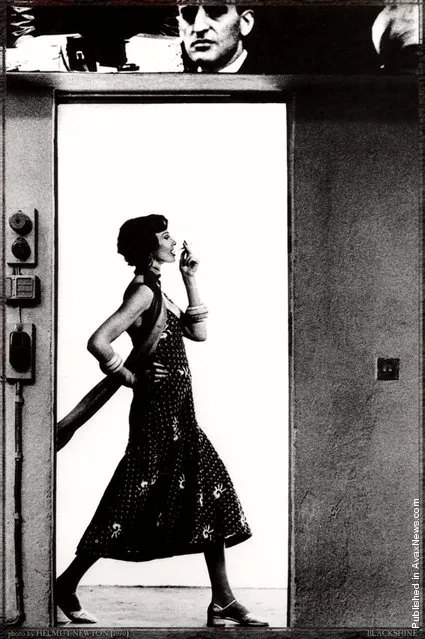
Photographers: Helmut Newton

“Newton was born in Berlin, the son of Klara “Claire” (Marquis) and Max Neustädter, a button factory owner. His family was Jewish. Newton attended the Heinrich-von-Treitschke-Realgymnasium and the American School in Berlin. Interested in photography from the age of 12 when he purchased his first camera, he worked for the German photographer Yva (Elsie Neulander Simon) from 1936. The increasingly oppressive restrictions placed on Jews by the Nuremberg laws meant that his father lost control of the factory in which he manufactured buttons and buckles; he was briefly interned in a concentration camp on “Kristallnacht”, November 9, 1938, which finally compelled the family to leave Germany. Newton's parents fled to South America. He was issued with a passport just after turning 18, and left Germany on December 5, 1938. At Trieste he boarded the “Conte Rosso” (along with about 200 others escaping the Nazis) intending to journey to China. After arriving in Singapore he found he was able to remain there, first and briefly as a photographer for the Straits Times and then as a portrait photographer”. – Wikipedia

Photo: Sigourney Weaver by Helmut Newton, 1995.
Details
08 Apr 2012 13:49:00
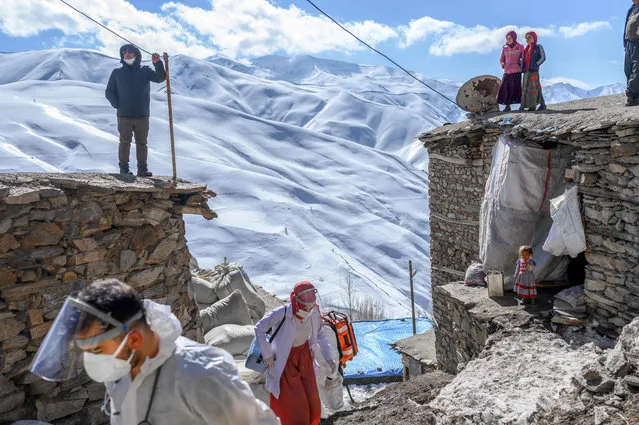
In this photograph taken on February 15, 2021, doctor Sergen Saracoglu (L) and nurse Yilzdiz Ayten (C) from the Bahcesaray public hospital vaccination team, arrive at the village of Guneyyamac in eastern Turkey, as part of an expedition to vaccinate residents of 65 years old or above with Sinovac's CoronaVac Covid-19 vaccine. Turkey's population of more than 83 million is spread out across Europe and Asia and covers some seemingly impregnable terrain. The vaccination effort with China's CoronaVac jab kicked off with a bang in mid-January when Turkey inoculated more than half a million people in the first few days. But it slowed down considerably when doctors left the big cities and tried to reach remote places such as Imamli and Ozbeyli – two ethnically Kurdish hamlets of a few hundred herders and farmers each. (Photo by Bulent Kilic/AFP Photo)

In this photograph taken on February 15, 2021, doctor Sergen Saracoglu (L) and nurse Yilzdiz Ayten (C) from the Bahcesaray public hospital vaccination team, arrive at the village of Guneyyamac in eastern Turkey, as part of an expedition to vaccinate residents of 65 years old or above with Sinovac's CoronaVac Covid-19 vaccine. (Photo by Bulent Kilic/AFP Photo)
Details
18 Mar 2021 09:32:00
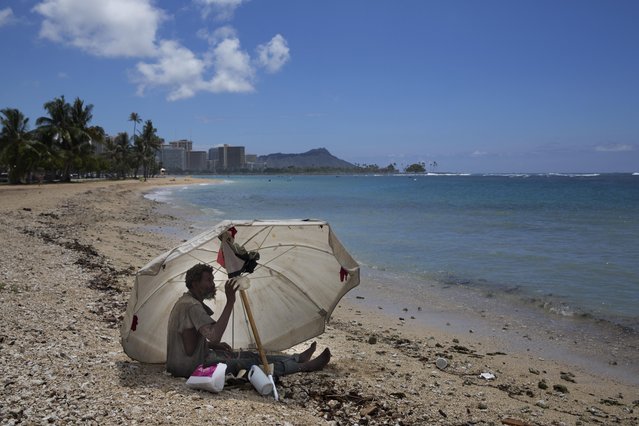
In this Thursday, August 27, 2015 photo, a homeless man drinks water while sitting on the beach at Ala Moana Beach Park located near Waikiki in Honolulu. Homelessness in Hawaii has grown steadily in recent years, leaving the state with the nation's highest rate of homeless people per capita. (Photo by Jae C. Hong/AP Photo)

Hawaii has long been known as a tropical paradise, but in recent years another image has intruded into the state's carefully crafted one of idyllic beaches and relaxing resorts: homelessness. The number of homeless people has grown in recent years, leaving the state with 487 homeless per 100,000 people, the nation's highest rate per capita, above New York and Nevada, according to federal statistics. Many of the homeless, however, defy the stereotype of the mentally ill or drug addicted. They are families, with men and women who work full-time jobs. They are struggling to get a foothold in a place with a high cost of living and low wages. Here: in this Thursday, August 27, 2015 photo, a homeless man drinks water while sitting on the beach at Ala Moana Beach Park located near Waikiki in Honolulu. (Photo by Jae C. Hong/AP Photo)
Details
11 Nov 2015 08:03:00