Loading...
Done
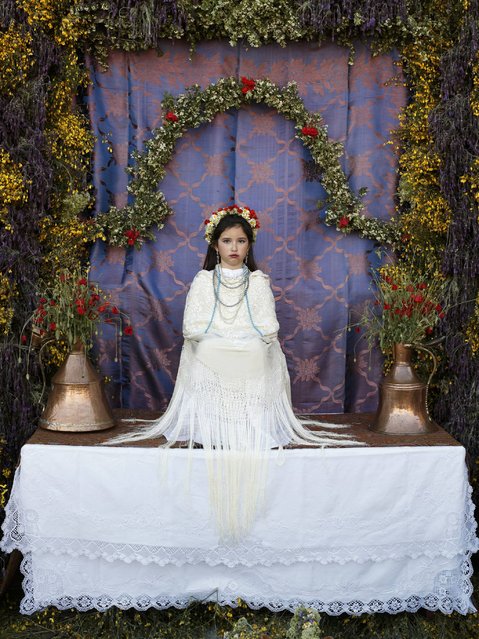
A “Maya” girl sits in an altar during the traditional celebration of “Las Mayas” on the streets in Colmenar Viejo, near Madrid, Spain, Friday, May 2, 2014. (Photo by Daniel Ochoa de Olza/AP Photo)

A “Maya” girl sits in an altar during the traditional celebration of “Las Mayas” on the streets in Colmenar Viejo, near Madrid, Spain, Friday, May 2, 2014. The festivity of the Maya comes from pagan rites and dates from the medieval age, appearing in ancient documents, it takes place every year in the beginning of May and celebrates the beginning off the spring. A girl between 7 and 11years is chosen as “Maya” and should sit still, serious, and quiet for a couple of hours in an altar on the street decorated with flowers and plants, afterwards they walk to the church with their family where they attend a ceremony. (Photo by Daniel Ochoa de Olza/AP Photo)
Details
13 May 2014 10:17:00
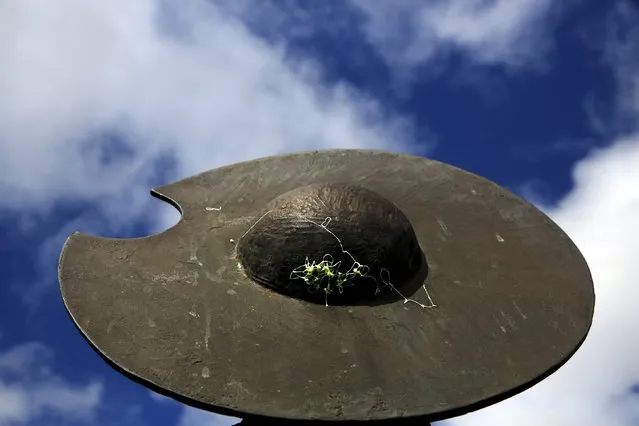
A sculpture of Don Quixote shows him wearing the basin he mistook for the enchanted helmet of the fictional Moorish king Mambrino in Alcazar de San Juan, Spain, April 5, 2016. (Photo by Susana Vera/Reuters)

A sculpture of Don Quixote shows him wearing the basin he mistook for the enchanted helmet of the fictional Moorish king Mambrino in Alcazar de San Juan, Spain, April 5, 2016. The arid central Spanish region of La Mancha is the setting for “Don Quixote”, the seventeenth-century novel by Miguel de Cervantes. Four hundred years after his death, references to the characters of Don Quixote, his loyal squire Sancho Panza and his beautiful lady Dulcinea abound in the surrounding villages from sweet treats to theatre productions involving livestock. Cervantes did not give away the name of the birthplace of Don Quixote, a middle-aged gentleman who becomes obsessed with chivalrous ideals. But many identify the village of Argamasilla de Alba as his hometown. The anniversary of Cervantes’ death is marked on the 23 April. (Photo by Susana Vera/Reuters)
Details
21 Apr 2016 12:32:00
Yedam Kim (L) and Chaewon Kim, both of South Korea, look at a smartphone backstage after performing on stage during the first day of the 51st Prix de Lausanne at the Theatre de Beaulieu, in Lausanne, Switzerland, 30 January 2023. Launched in 1973, the Prix de Lausanne is an international dance competition for young dancers aged 15 to 18. Closing the six-day event, scholarships granting free tuition in a world-renowned dance school or dance company will be award to the best dancers out of 87 participants who come from 18 different countries this year. (Photo by Laurent Gillieron/EPA)

Yedam Kim (L) and Chaewon Kim, both of South Korea, look at a smartphone backstage after performing on stage during the first day of the 51st Prix de Lausanne at the Theatre de Beaulieu, in Lausanne, Switzerland, 30 January 2023. (Photo by Laurent Gillieron/EPA)
Details
01 Feb 2023 00:08:00
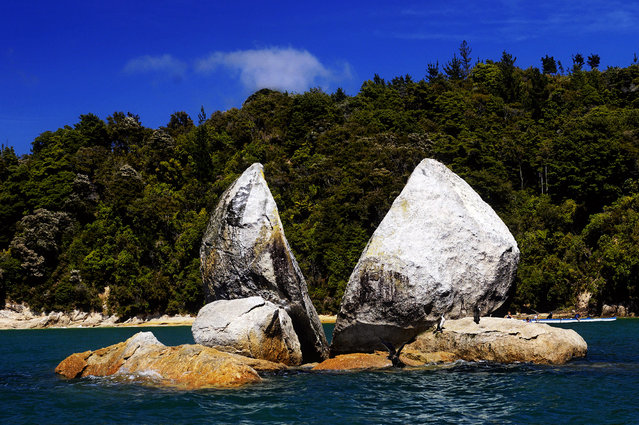
Split Apple Rock

Split Apple Rock is a geological rock formation in The Tasman Bay off the northern coast of the South Island of New Zealand. Made of granite, it is in the shape of an apple which has been cut in half. It is a popular tourist attraction in the waters of the Tasman Sea approximately 50 metres off the coast between Kaiteriteri and Marahau. The rock sits in shallow water at low tide and is accessible by wading. It is also a point of interest for the many tourist boats and pleasure craft which operate along the shores of the Abel Tasman National Park. The cleft to produce two sides of the 'apple' was a natural occurrence. It is unknown when this happened and therefore the cleaving of the rock has attracted mythological explanations.
Details
19 Oct 2013 10:58:00
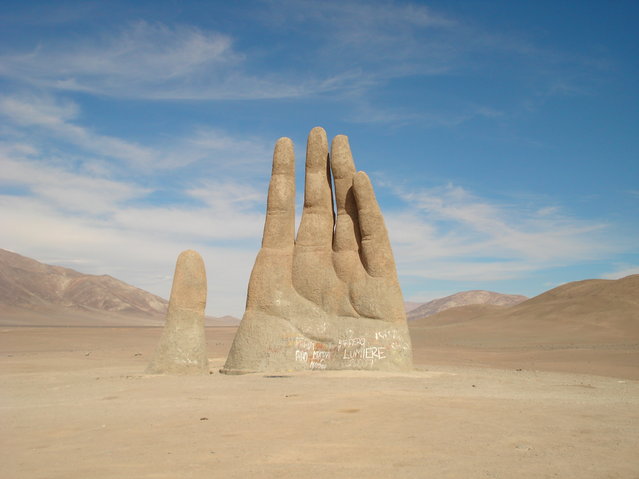
The Giant Hand of Atacama

The Mano de Desierto is a large-scale sculpture of a hand located in the Atacama Desert in Chile, 75 km to the south of the city of Antofagasta, on the Panamerican Highway. The nearest point of reference is the “Ciudad Empresarial La Negra” (La Negra Business City). The sculpture was constructed by the Chilean sculptor Mario Irarrázabal at an altitude of 1,100 meters above sea level. Irarrázabal used the human figure to express emotions like injustice, loneliness, sorrow and torture. Its exaggerated size is said to emphasize human vulnerability and helplessness. The work has a base of iron and cement, and stands 11 metres (36 ft) tall. Funded by Corporación Pro Antofagasta, a local booster organization, the sculpture was inaugurated on March 28, 1992.
Details
21 Dec 2013 10:18:00
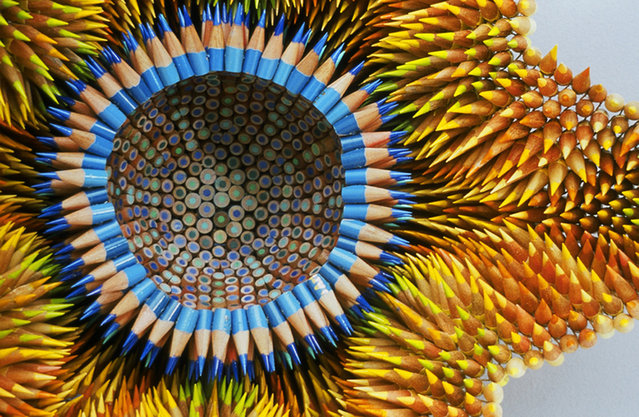
Pencil Sculptures - by Jennifer Maestre

Jennifer Maestre (born 1959 in Johannesburg, South Africa) is a Massachusetts-based artist, internationally known for her unique pencil sculptures.
She derives most of her inspiration from the form and texture of the sea urchin. To make the pencil sculptures, Jennifer makes use of a variety pencils, nails and stitching. She takes hundreds of pencils, cuts them into small 1-inch sections, drills a hole in each section, sharpens them all and sews them together.
Details
22 Aug 2012 13:16:00
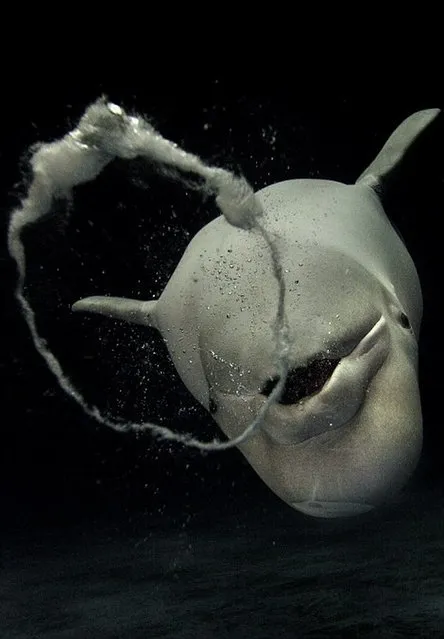
Beluga Whales Blowing Bubbles in Japan

The talent in bubbles unfurled the white Beluga whales living in Shimane Aquarium in Japan.As shown in the picture, have learned to make bubble rings, indicative of high intelligence.Whales blowing air from the mouth to create a stream and immediately after xanafysoun powerfully in the same place so that the bubbles to form a ring.Beluga whales are organized in groups and are social animals. They live in Arctic and sub​​-Arctic and known as "sea canaries" and mimic a wide range of sounds.
Details
18 Sep 2012 10:55:00
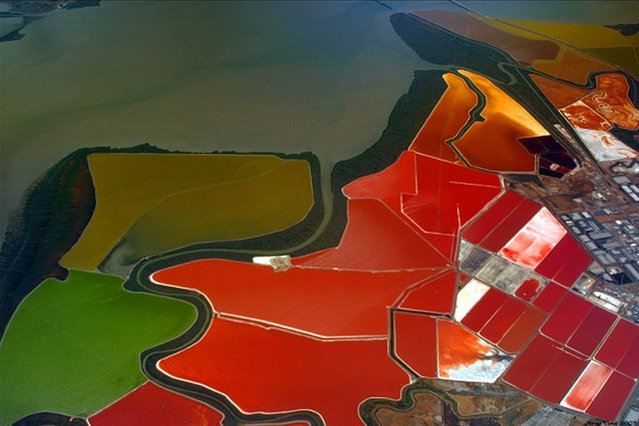
Salt ponds in San Francisco Bay

Salt evaporation ponds, also called salterns or salt pans, are shallow artificial ponds designed to produce salts from sea water or other brines. The seawater or brine is fed into large ponds and water is drawn out through natural evaporation which allows the salt to be subsequently harvested. The ponds also provide a productive resting and feeding ground for many species of waterbirds, which may include endangered species. The ponds are commonly separated by levees.
Details
11 Oct 2012 12:49:00