Loading...
Done
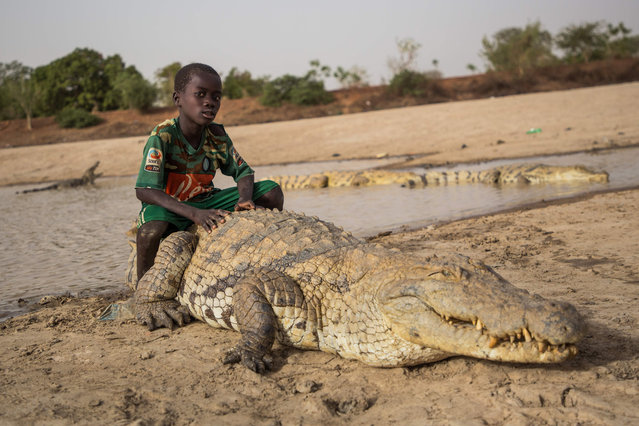
A boy sits on the back of a crocodile on May 19, 2018 at a pond in Bazoule in Burkina Faso, a village which happily shares its local pond with “sacred” crocodiles. Crocodiles may be one of the deadliest hunters in the animal kingdom, but in a small village in Burkina Faso it is not unusual to see someone sitting atop one of the fearsome reptiles. According to local legend, the startling relationship with the predators dates back to at least the 15 th century. The village was in the grip of an agonising drought until the crocodiles led women to a hidden pond where the population could slake their thirst. (Photo by Olympia de Maismont/AFP Photo)

A boy sits on the back of a crocodile on May 19, 2018 at a pond in Bazoule in Burkina Faso, a village which happily shares its local pond with “sacred” crocodiles. Crocodiles may be one of the deadliest hunters in the animal kingdom, but in a small village in Burkina Faso it is not unusual to see someone sitting atop one of the fearsome reptiles. According to local legend, the startling relationship with the predators dates back to at least the 15 th century. The village was in the grip of an agonising drought until the crocodiles led women to a hidden pond where the population could slake their thirst. (Photo by Olympia de Maismont/AFP Photo)
Details
17 Jul 2018 00:01:00
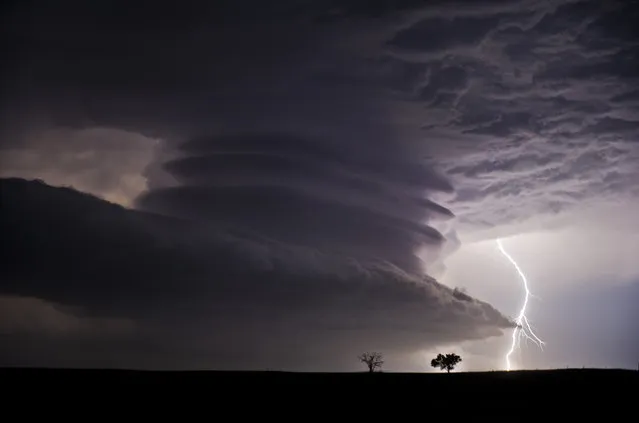
“Stacked Supercell with Lightning”. This huge mesocyclone supercell was near the Nebraska / Kansas border on the night of June 22nd, 2012. What a stunning structure! (Photo and caption by Jennifer Brindley/National Geographic Traveler Photo Contest)

“Stacked Supercell with Lightning”. This huge mesocyclone supercell was near the Nebraska / Kansas border on the night of June 22nd, 2012. What a stunning structure! (Photo and caption by Jennifer Brindley/National Geographic Traveler Photo Contest)

ATTENTION! All pictures are presented in high resolution. To see Hi-Res images – just TWICE click on any picture. In other words, click small picture – opens the BIG picture. Click BIG picture – opens VERY BIG picture.
Details
25 Jun 2013 13:12:00
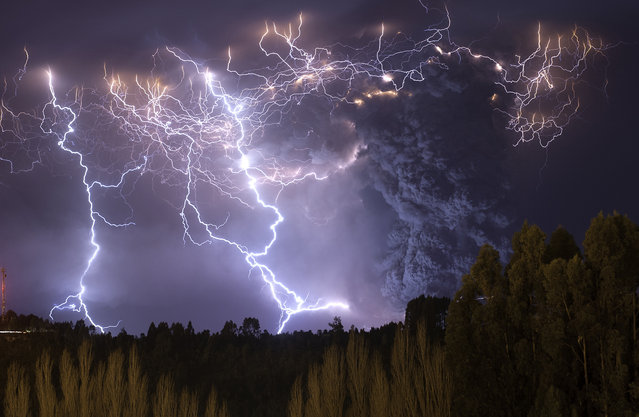
The eruption of Cordon Caulle began on June 4, 2011, located in the Region of Los Rios in Chile. For about 12 months, people and animals became accustomed to living with the daily fall of ash, which also caused problems in the air traffic in South America. The explosions and lightning during first days of the eruption could be seen from hundreds of miles around. This photograph was taken on the second night of eruption from the town of Lago Ranco. (Photo and caption by Francisco Negroni/National Geographic Traveler Photo Contest)

The eruption of Cordon Caulle began on June 4, 2011, located in the Region of Los Rios in Chile. For about 12 months, people and animals became accustomed to living with the daily fall of ash, which also caused problems in the air traffic in South America. The explosions and lightning during first days of the eruption could be seen from hundreds of miles around. This photograph was taken on the second night of eruption from the town of Lago Ranco. (Photo and caption by Francisco Negroni/National Geographic Traveler Photo Contest)

ATTENTION! All pictures are presented in high resolution. To see Hi-Res images – just TWICE click on any picture. In other words, click small picture – opens the BIG picture. Click BIG picture – opens VERY BIG picture.
Details
23 Jun 2013 11:24:00
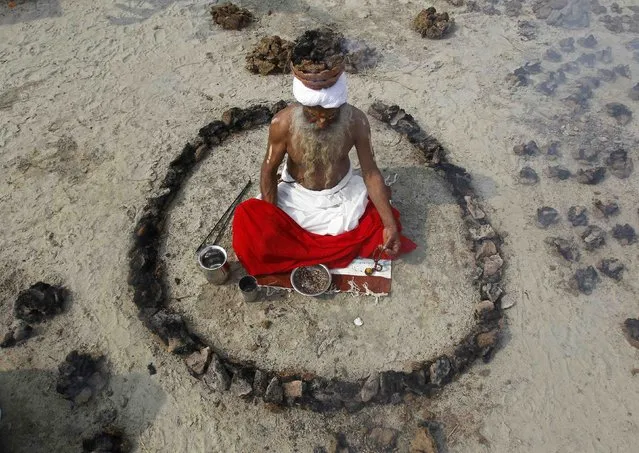
A Sadhu or a Hindu holy man offers prayers while sitting inside a circle of burning “Upale” (or dried cow dung cakes) on the occasion to mark the Basant or spring festival, on the banks of river Ganga in the northern Indian city of Allahabad January 24, 2015. Basant is celebrated mainly in the northern Indian states marking the start of the spring season. (Photo by Jitendra Prakash/Reuters)

A Sadhu or a Hindu holy man offers prayers while sitting inside a circle of burning “Upale” (or dried cow dung cakes) on the occasion to mark the Basant or spring festival, on the banks of river Ganga in the northern Indian city of Allahabad January 24, 2015. Basant is celebrated mainly in the northern Indian states marking the start of the spring season. (Photo by Jitendra Prakash/Reuters)
Details
25 Jan 2015 09:07:00
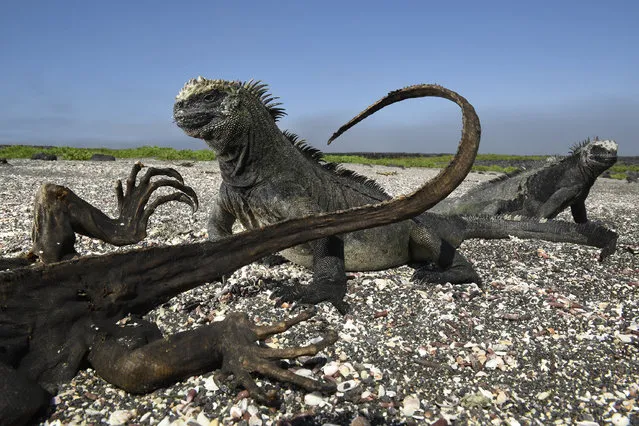
Galapagos – Rocking the Cradle: Four major ocean currents converge along the Galapagos archipelago, creating the conditions for an extraordinary diversity of animal life, April 25, 2016. The islands are home to at least 7,000 flora and fauna species, of which 97 percent of the reptiles, 80 percent of the land birds, 50 percent of the insects and 30 percent of the plants are endemic. The local ecosystem is highly sensitive to the changes in temperature, rainfall and ocean currents that characterize the climatic events known as El Niño and La Niña. These changes cause marked fluctuations in weather and food availability. Many scientists expect the frequency of El Niño and La Niña to increase as a result of climate change, making the Galapagos a possible early-warning location for its effects. (Photo by Thomas P. Peschak for National Geographic/World Press Photo)

Galapagos – Rocking the Cradle: Four major ocean currents converge along the Galapagos archipelago, creating the conditions for an extraordinary diversity of animal life, April 25, 2016. The islands are home to at least 7,000 flora and fauna species, of which 97 percent of the reptiles, 80 percent of the land birds, 50 percent of the insects and 30 percent of the plants are endemic. (Photo by Thomas P. Peschak for National Geographic/World Press Photo)
Details
16 Apr 2018 00:01:00
This is the remarkable moment a group of skydivers performed a world record breaking feat in honour of their friend who died while skydiving. Known as a “Bigway”, the daring jump involves 57 people holding hands in a predetermined design as they hurtle towards the ground, head first. (Photo by Ben Nelson/Caters News)

This is the remarkable moment a group of skydivers performed a world record breaking feat in honour of their friend who died while skydiving. Known as a “Bigway”, the daring jump involves 57 people holding hands in a predetermined design as they hurtle towards the ground, head first. After making the first shape, the group then break away before coming back together to form a second shape all in a single skydive. Captured using a GoPro camera by Alaskan skydiver, Ben Nelson, 36, the topsy-turvy footage shows the adrenalin junkies soaring through the air at around 160mph before banding together twice in mid-air, making the stunt a world first. (Photo by Ben Nelson/Caters News)
Details
28 Mar 2015 11:56:00
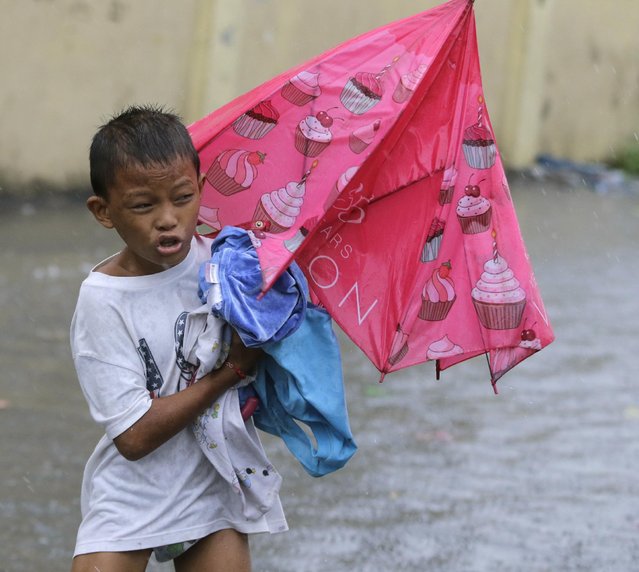
A boy evacuates to safer grounds at the onslaught of Typhoon Rammasun (locally known as Glenda) which battered the city Wednesday, July 16, 2014, in Manila, Philippines. (Photo by Bullit Marquez/AP Photo)

A boy evacuates to safer grounds at the onslaught of Typhoon Rammasun (locally known as Glenda) which battered the city Wednesday, July 16, 2014, in Manila, Philippines. (Photo by Bullit Marquez/AP Photo)
Details
17 Jul 2014 12:05:00
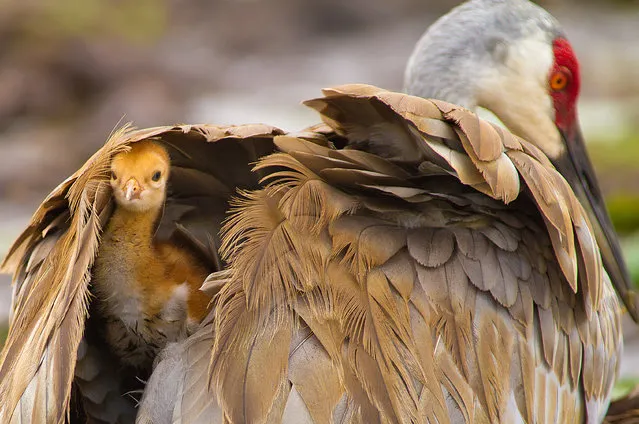
“Hiding In The Shadows”. This Baby Sandhill taking refuge under Moms wings while sitting on her second egg. I witnessed this baby being born earlier that day,and the next morning saw the other one hatch,what a sight to see. Photo location: Deland, Florida. (Photo and caption by Scott Helfrich/National Geographic Photo Contest)

“Hiding In The Shadows”. This Baby Sandhill taking refuge under Moms wings while sitting on her second egg. I witnessed this baby being born earlier that day,and the next morning saw the other one hatch,what a sight to see. Photo location: Deland, Florida. (Photo and caption by Scott Helfrich/National Geographic Photo Contest)
Details
08 Dec 2013 11:51:00